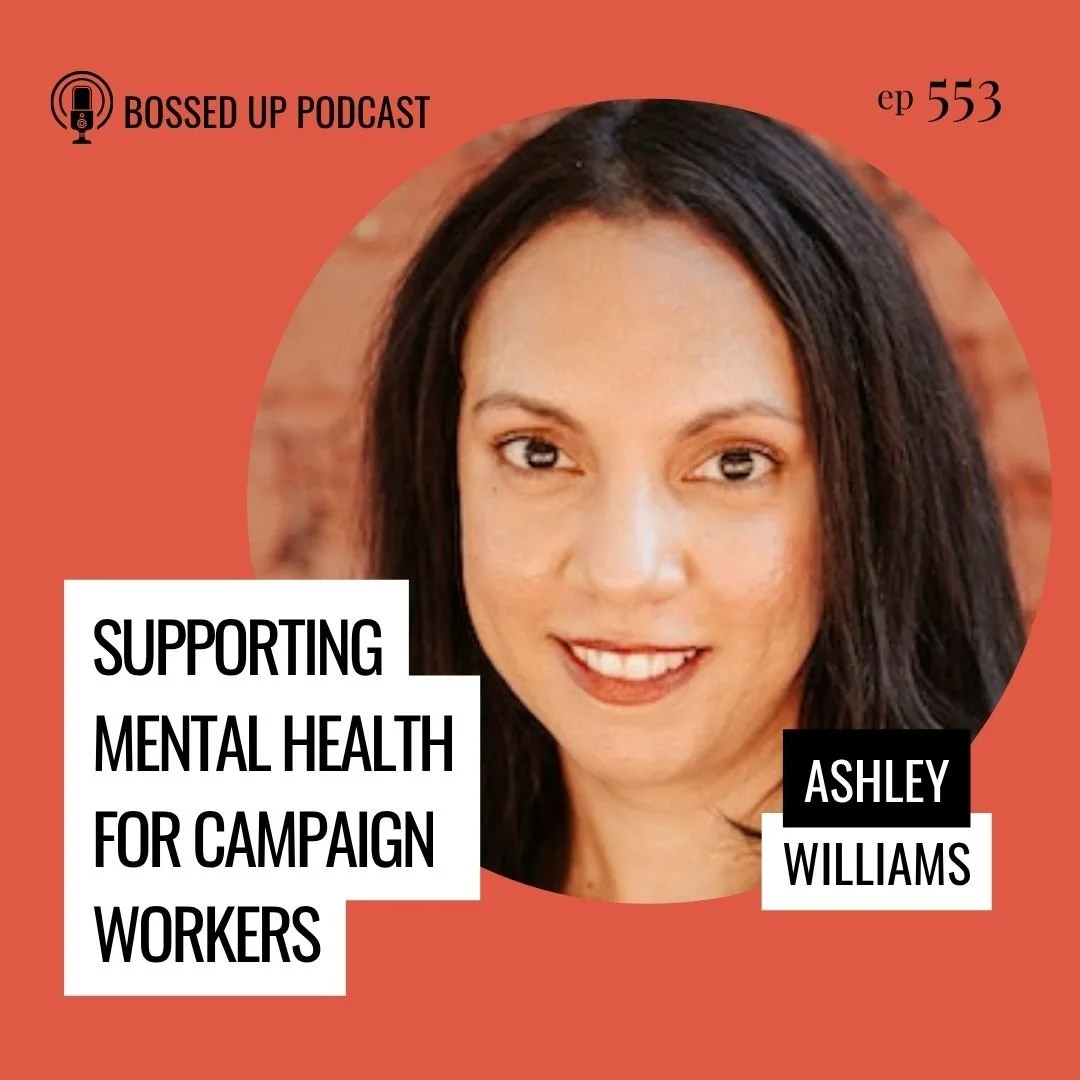
Supporting Mental Health for Campaign Workers
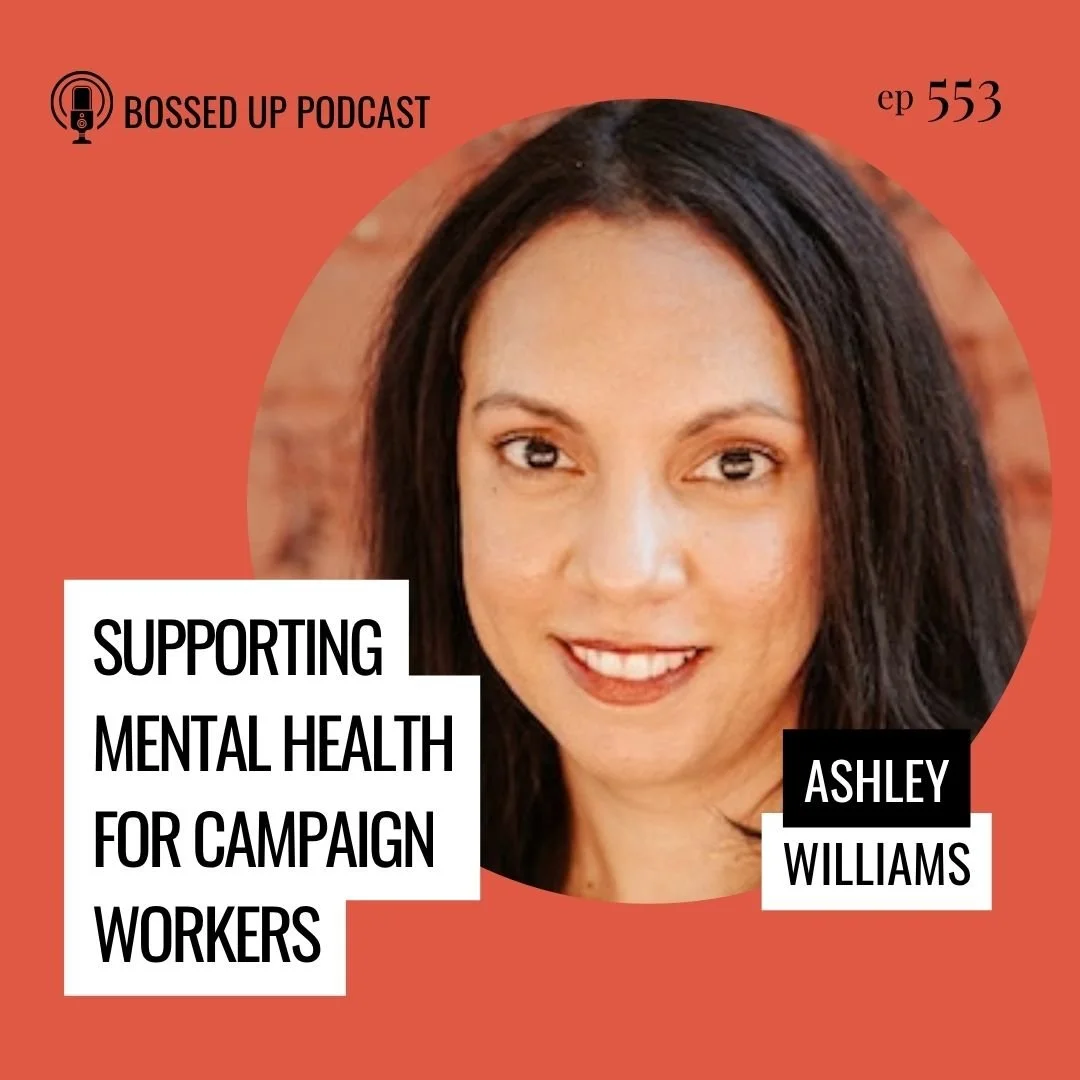
Episode 553 | Host: Emilie Aries | Guest: Ashley Williams
Are advocacy organizations overlooking the mental health of their greatest asset?
There’s a certain type of person who signs up to work for a political campaign. They’re generally aligned in purpose to those who work in other advocacy and caregiving capacities: they’re hard workers, incredibly dedicated to the cause, liable to run themselves ragged before they stop. Unfortunately, the institutions that attract these kinds of devotees all too often take advantage of this them, whether deliberately or not, and vastly underinvest in their long-term wellbeing.
Ashley Williams, who I first met years ago through HIRED’s resume-building offering, worked on campaigns for many years. She saw this trend in action: the impassioned staffers who gladly worked for peanuts in exchange for the privilege of making a difference, even if just for a short while. When the campaign ended, they were left without income or healthcare benefits, until landing their next opportunity Today, Ashley runs Mind the Movement, a nonprofit that raises awareness about the importance of mental health benefits for workers in campaign, government, and grassroots organizations. Her take on what’s missing and what’s needed for these essential organizers is refreshingly rooted in worker rights and practical infrastructure.
The link between caring and caregiving
There is, Ashley theorizes, a link between people who choose service professions and deep-feeling traits. It’s not hard to imagine how a heightened sense of empathy, combined with being immersed in the plights facing the world today, could pair neatly with an increased risk of burnout, anxiety, depression, and other mental health concerns.
After watching a young staffer on her most recent campaign experience a mental health crisis with no professional support (just an immediate manager, overworked as well, who was left to deal with it on her own), Ashley asked herself, “Why isn’t this handled better, in environments where it’s so common?” In addition to the hourly pressures of the campaign trail, these dedicated workers face impending unemployment, no matter how successful their work. There needs to be a softer landing for these empathetic people. From this realization, and Ashley’s resulting research, Mind the Movement was born.
The non-profit provides mental health resources and support for campaign staff, who are often young, just out of school, and with no financial safety net beneath them. Mind the Movement also supports grassroots organizers doing long-term capacity building, and the thousands of federal government workers who lost their jobs in the 2024 regime change.
The business argument for more care in campaigns
Ashley’s mission is more than just bleeding hearts for staffers in need. There’s a business case to be made for mental health support in campaigns, too. Why should funders and foundations care about the staffers in their short-lived initiatives? Ashley argues that the “get em in and get em out” churn and burn mentality that’s traditional in this line of work is overlooking a major factor in the continued success of all organizers. Letting temporary workers go without a thought to their wellbeing at the end of the project means severing the connection with the people who actually built the relationships, on the ground, with the voter base; the staffers who made possible to the dissemination of the candidate’s message, for low wages and long hours.
What does a workplace that supports mental health look like?
Though Ashley works with a narrow subset of industries, it’s easy to make connections between what she’s fighting for and the need for more mental health support in all organizations.
Mind the Movement’s recent campaign for Mental Health Awareness Month is an excellent example of what leaders and managers everywhere should be pursuing. The initiative was all about unmuting yourself regarding mental wellbeing and normalizing the act of speaking up about it in the workplace. If you’re scared to tell your immediate supervisor or your boss that you’re struggling, if asking for a day off feels like a surefire way to earn a black mark on your file, nothing will ever change.
Situations like these are exactly why Bossed Up’s LEVEL UP program includes modules teaching managers how to create psychological safety and lead with emotional intelligence. Because the change needs to be systemic, and it needs to come from the top down. We see far too many organizations taking their workforce for granted, from directors all the way to interns, reinforcing environments where trust is hard to come by. Ashley sees a need, as well, for offerings like Employee Assistance Programs and hotlines that allow workers to bypass their superiors if that’s what they need to feel safe enough to share.
If you’re a leader or manager who wants to help your organization do better, Ashley says the best thing you can do is seek out resources to educate yourself. There’s the Unmute Yourself Toolkit, for instance, as well as mental health first aid and suicide prevention training, which help people in positions of authority spot the signs of crisis early enough to intervene.
How to deal with constant overwhelm
These days, overwhelm is coming at us from all directions. It’s no longer just a result of our high-performing career pursuits; it’s in our media, day after day, and too often, it feels like we have to choose between remaining well-informed and remaining sane. Is there an alternative to just ignoring the outside world and gardening all day?
Ashley votes yes, though she also acknowledges the importance of finding activities, like gardening, baking, or figure skating, that renew you, so you can continue fighting the good fight. Whether you’re a salaried employee or a short-term staffer, Ashley recommends the following best practices to keep yourself healthy in the midst of seemingly unending nationwide crises.
First, she encourages us to recognize that it’s a privilege to be able to stop paying attention, even for a day at a time. Many people in America right now risk imprisonment, deportation, or worse if they don’t stay on top of the ever-changing policy landscape.
Then, there are boundaries. We know the slew of fear-stoking headlines being thrown at us is designed to cause intentional overwhelm, in the hope that we will throw up our hands and just comply. It is an act of intentionality to not let them win. At the same time, we need to be okay enough to carry on doing whatever our part is. Focus on what you have control over, Ashley says. She references Glennon Doyle, who recommends choosing the main thing that breaks your heart and focusing on that. Volunteer, donate money, do what you can, for that sector, and don’t feel guilty about the causes you can’t join.
Ashley’s focus, to build a society that supports its vulnerable workers, is widespread and so worthy. It’s well worth taking care of ourselves to ensure we can continue to support initiatives like hers and the changes they’ll create in the future if given the opportunity to grow.
I want to hear about the mental health supports and benefits at your organization. What is your workplace doing right (or wrong)? What could they do better? As always, share your perspective and discover the missions other women are upholding on our Facebook Courage Community and our group on LinkedIn.
Related links
Episode 518, How Millennial and Gen Z Leaders are Changing What it Means to be in Charge
LEVEL UP: a leadership accelerator for current and aspiring women managers
TAKE ACTION to foster change in career mental health:

-
[CONFIDENT RHYTHMIC DRIVING THEME MUSIC WITH DRUMS STARTS]
EMILIE: Hey and welcome to the Bossed Up podcast, episode 553. I'm your host Emilie Aries, the Founder and CEO of Bossed Up. And today I'm excited to dig into mental health in the workplace, particularly for those who are working in careers they deeply care about.
[MUSIC FADES AND ENDS]
Careers for the common good, careers in politics and advocacy and community organizing, or just part of the broader caregiving economy which historically has under invested in the mental well being of its workforce.
Joining me to break all this down is Ashley Williams. For the past eight years, Ashley's built and led national democracy and political programs and she's the creator of the largest political organizing training of all time, where she trained 60,000 people in four weeks during the height of the pandemic. She now runs an organization called, Mind The Movement which was started after the historic 2024 election and the mass firings of federal workers in early 2025. Mind The Movement subsidizes therapy for fired federal workers, out of work campaign staff, and underemployed or uninsured community organizers.
What started as a report on the mental health of campaign staff that Ashley pioneered has grown to include other movements, civil service, and democracy workers who she serves through Mind The Movement. And to celebrate Mental Health Awareness Month, they recently debuted a new toolkit called Unmute Yourself: Start the Mental Health Conversation at Work which equips leaders, managers and all workers to talk about mental well being and and signaled to the fact that it's an important part of overall well being and sustainable success in the workplace. She's experienced mental health, challenges herself since childhood, and is committed to supporting others without a safety net to get the support they need. Ashley welcome to the Bossed Up podcast.
ASHLEY: Thanks for having me. I'm excited.
EMILIE: I'm excited to reconnect with you and hear all about what you've been up to. But you were just reminding me right before we hit record over here, how long has it been since we last were in each other's orbit? And how did you get into the Bossed Up community?
ASHLEY: Oh, gosh, I don't know. [QUICK LAUGHTER] I think someone sent me maybe like a resume guide or something and then I listened to your podcast and then followed your stuff. I really went through like the whole like user journey on your website. Yeah. And then eventually I had like a call with you where you helped me with my resume or like a few calls.
EMILIE: Oh yeah, that's right. That's right.
ASHLEY: Which was wildly helpful. And I always, I always tell people like my, I literally like doubled my income after you helped me with my resume. So thank you.
EMILIE: I'm so glad to hear that.
ASHLEY: That was going into 2020, and then after that, that was obviously a crazy time, but that was an election year, and I got a job that basically, like, changed my whole career. And then we may have talked after that at some point, but you definitely had not had either of your kids yet. So at least five years.
EMILIE: Wow, that's wild. Well, congratulations. And that makes a lot of sense. And now I remember because that was right around when we were developing our HIRED job search program. So if anyone's listening who wants my resume advice, you can now get it on demand in that course. But welcome back.
Now you've transformed your whole career again and launched this incredible nonprofit called Mind The Movement. What's the story behind it, and what are you all about?
ASHLEY: Yeah, so I'm like a professional career pivoter. I feel like I change crews every five years. [LAUGHTER]
EMILIE: That's like, a very bossed up thing. By the way, I'm sure women listening are like, same girl. Yeah.
ASHLEY: Yeah. It's like I like to, like, learn a lot and do things intensely. And then I'm like, okay, I did that. What's next? Yes.
EMILIE: Yeah.
ASHLEY: So the thing you helped me with my resume for was a job working on a campaign in 2020. So I'd been working in politics for a couple years at that point, after being a volunteer, going back to, like, 2008, first Obama campaign. So that's been what I've been doing up until 2024. And then I worked on the presidential campaign in 2024. Went to. I was working at the headquarters in Wilmington, Delaware after the candidate switch. And basically, like, the short backstory. We'll get, I'm sure, more into the long backstory, but the short backstory is someone on our. On my floor had a mental health crisis.
The day after election day was a young staffer who was not allowed to be left alone because they were a danger to themselves. And I remember thinking, like, why is this not really being handled super well? Like, where's HR? Why is there, like, individual manager just being left to figure out what to do here? And that just seemed crazy to me. Like, a campaign with, like, a billion dollars doesn't have, like, a plan and infrastructure.
And for this and for those who haven't worked on campaigns, you know, basically all week and a half after Election Day, you're out of a job. If you're lucky, your insurance lasts for until the end of the year, so about six weeks. And then you're just like, out with nothing. And we know that we sign up for that. But I felt like there needed to be a little bit softer of a landing for people, especially if they're struggling with their mental health. And so, I basically fast forward a little bit, started this organization called Mind The Movement that provides mental health support to campaign staff. So that's the little bit of background in the short story of what.
EMILIE: Right. Well, it's a very compelling story because having worked on a variety of campaigns and in Election World for many years at the start of my career, a certain type of professional is attracted to that work. Oftentimes, campaigns are run by the young and scrappy, right? These are people who don't have a ton of privilege and resources. They're just getting their career started. They don't have a huge savings account. You know, if they're lucky, they've got parental support of some kind, but that is not a guarantee. And they're fighting every day. They're working crazy hours for, you know, what to them feels like an opportunity to change the world. So the stakes feel incredibly high.
And I know folks listening from the nonprofit sector or, uh, from the public sector and public service roles of any kind can relate to this. This idea that your identity and your job are not distinct when you're working in that kind of a field. And so, you know, half the campaigns are losing campaigns, if not more, actually a lot more, [LAUGHTER] if you think about primaries and whatnot. So losing can be extremely disorienting to everyone. And if you already are predisposed to have mental health challenges, like, it is an imperative that we have some infrastructure. The HR professional in me now is thinking, like, just from a liability and compliance standpoint, it's like the Wild West.
So what is it that you think needs to transform, whether we're talking about in your domain, specifically in campaigns or in workplaces, to better support mental health for all?
ASHLEY: Yeah. Well, and just taking a step back to what you just said, I really think someone somewhere needs to study this. It'll probably end up being me at some point when I have time is like, the through line between people who choose to do helping work, whether that's being a social worker, a therapist, an organizer, working in the government. People who give their lives to helping others are doing that because they're paying attention, because they see what's wrong in the world. And if you're paying attention, how can you not have anxiety? How can you not have, like, insomnia? How can you not have, like, depression, right? So I, I really. It's like, it's like very chicken and egg. It's like, which came first? Were you like a sensitive feeling and that's why you chose this career? Or does the career kind of cause it.
EMILIE: Totally. Well, let's talk about that actually for a second. Because my mom's a nurse, she still to this day works 12 hour shifts. So I've thought about this a lot when I was writing my book. And Anne Marie Slaughter has some great research around the caring economy. A lot of amazing, like nursing scholars and caring economy scholars at New America, her think tank in DC, have done some really fascinating research into that. And what I find is that folks with high levels of empathy like you're describing, they feel the pain of the world. They feel the pain of, of their patients, of their customers, of their constituents, whatever.
The dynamic is, there's this like, selflessness that often shows up there where it's really hard to hold a boundary to take care of yourself. Half the nurses I know are caretakers in their romantic relationships have that dynamic going on at home. And it's just like, oh, man, there has to be a balance between giving so much of yourself and taking care of yourself so that you can be sustainable. Because campaign life for many is not sustainable. And it's, it is sort of interesting because there are organizations that will exploit that.
ASHLEY: Yes, there are. And I think there's also, how do I say this, with campaigns in particular, and we work with a couple other constituencies besides campaigns, but with campaigns in particular, like, it's built to be torn down, right? It's like six months, 18 months. Every single thing you're doing, you know, it's short term. And so like, what is the incentive to invest in people that, like, you're like, off boarding. And like, right now we're recording in June, like in November, five months from now, they're going to be off boarding the same people.
And so that's part of what I'm, the bigger vision for this is like, how do we make the case for why it matters to invest in people, even if they're not working on your campaign or they're not, you're not managing them, like, how do we invest in them and why does it matter long term? And that's actually been a really hard case to make with organizational leadership, and funders, and foundations, because they're used to this just sort of like, get them and get them out, like, mentality. But it's like we lose…
EMILIE: Burn and burn
ASHLEY: …100% and we lose such good people. We lose the continuity of skills and relationships if we want to do, you know, proper organizing in the community. We lose people who have the relationships to the voters we want to turn out. And there's such a big management problem on campaigns. Like, people get promoted just because they were good at their job and have no management skills, are not given any sort of management training. And then it's just like,...
EMILIE: Well you have that in common with the rest of the world Corporate America does that too.
ASHLEY: …okay. But it's like, it's. And like you said, it's often people who are really young and they're just like thrown in these incredibly high stakes roles with no support and then experience burnout. They act in ways they're not happy with, but they're just repeating what they've seen. And so we really like long term want to make the case for why investing in those people keeps good people in the work longer.
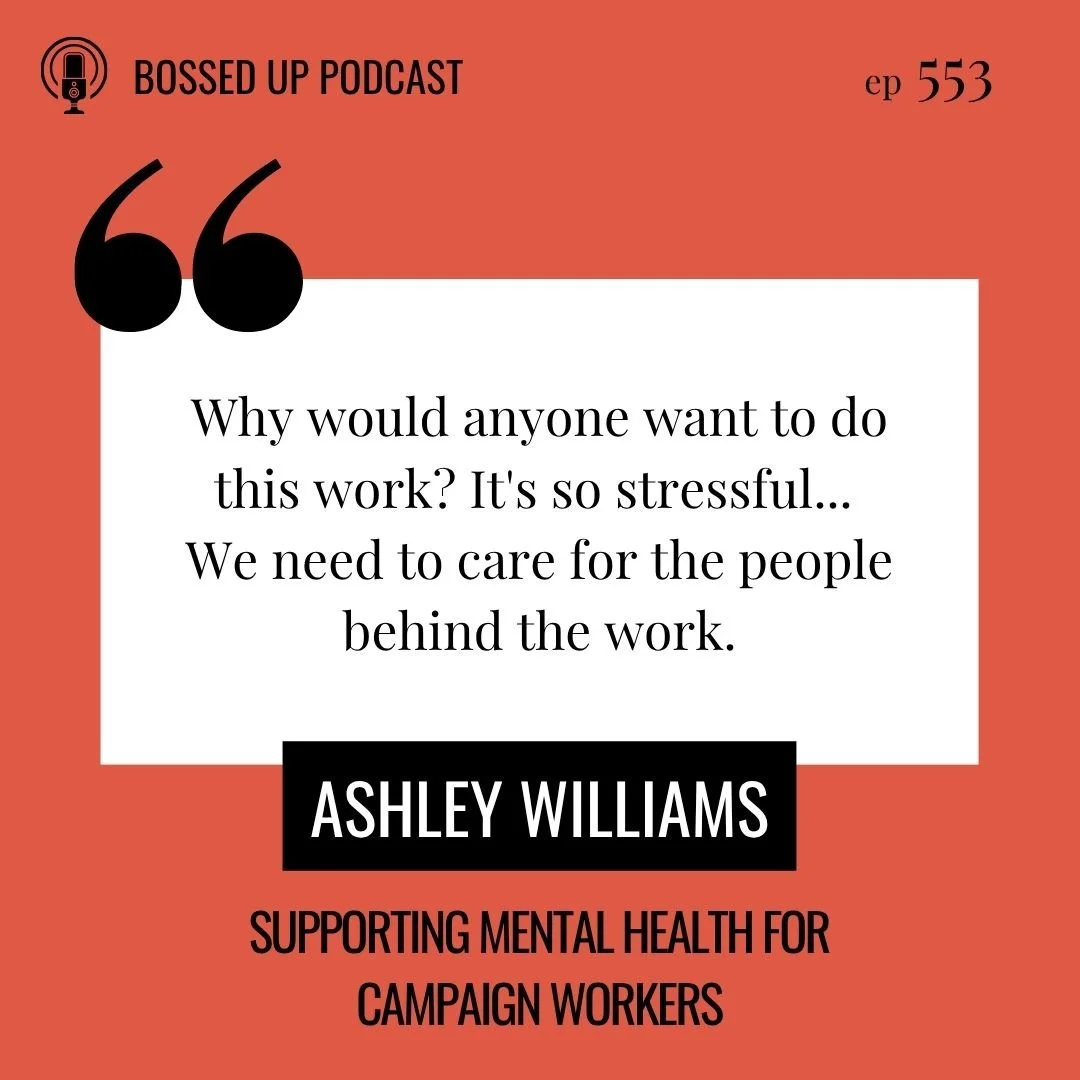
And so that people don't just transition out and say, like, oh, I'm gonna go, you know, be a consultant or I'm gonna go work in tech, or I'm gonna go do something else where they could make a lot more money and have a lot more stability and have, you know, like, employee programs that invest in them. Like, why should, why would anyone want to do this work? It's so stressful. And even when you win, it's still this like short term, get in, get out. You're not paid well, but you'd be willing to work for a small amount of money. And I think we need to care for the people behind the work and that's sort of the thinking behind everything that we do.
EMILIE: Yeah, that makes a lot of sense. Just from a movement building perspective. It's like, yeah, the campaign short term, but hopefully you're part of a bigger movement that makes sense to, to invest in. It's, it's hard.
ASHLEY: Yeah. And that's one of the other groups that we do provide mental health support is grassroots organizers who are doing like long term capacity building. So that started this year with supporting organizers on the ground in Minnesota who were, you know, dealing with ICE and everything that was happening there. So we support those folks and then we also provide mental health support for former federal workers. So folks who were working for the federal government thought they had, you know, continuity and they were going to get a pension one day and have their whole lives mapped out and just like overnight lost their careers. And there have been, you know, some really tragic reports of like, suicidal Ideation and people dying as a result of those job losses. So that's the third group that we support.
EMILIE: Fascinating. Well, you've done an amazing job. How have you gone about fundraising and building a nonprofit? Because that's what you've done here. And I'm looking at your website and your incredible advisory board. How has it been going from being a campaigner yourself to being the founder of a nonprofit, which involves a lot of selling the work before you can even get to doing the work?
ASHLEY: Yeah, it's been interesting. So it's, we're coming up on a year from when I first like legally was able to start fundraising, like through a fiscal sponsor, which is like complicated legal structure. And I've been like, reflecting on all that I've done and all that I've learned. So I didn't know how to start a nonprofit, right? Like I've worked, worked on large scale political programs that like somebody else fundraised and they said, here's the goal, Ashley, take it and do it. And I can do that. So yeah, starting from scratch and like learning all the like, legal stuff, I feel like I've gone through like a self-guided master's program.
And yeah, so it was like a lot of like learning a lot of reaching out to people I know who started their own organizations and saying like, I know you're super busy, but like, can you just tell me like, answer this question that like Google is not solving for me. A lot of reading, a lot of just figuring things out and then writing up plans and documents and showing them to people and saying like, is this what I need? Is this what a funder wants to see? And then like getting a lawyer and having them look at everything. So that part actually was fun, right? Like the before part was really fun. And then it was like, oh no wait, now I can fundraise. And now I'm responsible for like,...
EMILIE: Now I have to fundraise.
ASHLEY: …yeah, fundraise. I will say that has been like the biggest challenge, right? Like the programmatic side, the building side, the branding side, the storytelling, the network. All of the like building stuff is really, really fun and easy for me. Fundraising is definitely still my, my biggest difficulty so far. All of our fundraising, it's been like a mix. It's been actually an even split between one grant that we got corporate sponsors and then individual small dollar donations from my personal network. So like, we've done okay, but like, we need a lot more. So my focus now is learning more about like, raising money from foundations and high net worth individuals and kind of opening up new revenue streams. So that's what I'm trying to learn now. Yeah.
EMILIE: Amazing. Well, that makes a lot of sense. And so what is your vision for how campaigns can do this better? And for those listening who aren't working for a campaign, maybe we can take notes for how our organizations can support our colleagues or maybe even our future selves when we are all on the brink of a nervous breakdown or a mental health crisis. Like, what does it look like to be a workplace that is actually supporting folks going through mental health challenges?
ASHLEY: Yeah, so I'll answer the first question first. So my longer term vision is, you know, in organizing, we say you organize yourself out of a job. I really want to organize ourselves out of a job with Mind The Movement in the next handful of years. I really want to make a really strong case for why campaigns and organizations need to build mental health support into their benefits packages, like, benefits packages and air quotes for campaigns, because there barely are any. And make the case for why they need to put their money into this because it really isn't a sustainable model for an outside organization to pay for it.
And so my, my goal over the next couple of years is to collect really good data on like, look at the like, correlation between providing this type of support and maybe more elections were won, or more people, you know, stayed in the work for a longer amount of time or they all got promoted or collecting all that data really is the goal now to then be able to make the case for why it needs to be a line item for campaigns and nonprofits.
And so in terms of like, what any organization can do we actually, just for Mental Health Awareness month, had a whole campaign called Unmute Yourself that was all about unmuting, speaking up, talking about mental health. And I think that's really the first part of this is normalizing that it's okay to talk about mental health in the workplace. And obviously there's like a way to do that in a professional setting and that's what we cover in the toolkit. But if you're, if you're too scared to say to your boss, like, hey, I'm struggling, like, can I have an afternoon off? Or like, I feel uncomfortable in this, you know, we're the collie because of what, you know, whatever it is, if you're, if you're too scared to say that nothing's change, right? Like someone has to be the squeaky wheel to like, say the thing first and bring it.
And so, you know, maybe that's being able to, you know, go to your manager about something or go to HR. And so from more of a top down perspective, it's like, okay, how do we create an environment where people feel safe to do that? So it's really about like creating emotionally safe workplaces and like some really like simple, straightforward things of like how we speak to each other and how we meet and having regular one on ones with your manager, not just when there's a problem and just some really basic things you can do so that you can feel safe. When you do have a more difficult topic to bring up that it's okay. You're, you've sort of practiced that you've warmed up that muscle a little bit.
EMILIE: And I think that piece is so important. That's why we have psychological safety and emotional intelligence built into our management courses at Bossed Up, our LEVEL UP program, which we just reopened actually for enrollment for the first time in a while. Because power dynamics play a huge role in who feels safe unmuting, right? I remember even when I was in charge of my own company, you know, as the boss of Bossed Up, when I was struggling with postpartum depression right after we probably last spoke, when I was dealing with Max as a newborn, who was a true nightmare, [LIGHT CHUCKLE] but all kinds of feeding issues. He had health challenges. We didn't sleep for seven months. He was just like, that was a traumatizing time for all of us.
And when I was going back to work with postpartum depression, I remember there were a few days where and I was in my home office. We had a nanny share, so the nanny was here with my child and our neighbor's child. And I was in my home office, like basically just laid out on the floor like unable to do anything for like a day at a time. And I remember Irene, my programs manager, who is a total rock star, thank god, is still with me now a mom herself working our programs at Bossed Up. She would check in with me and be like, so are you gonna like, do any of the things that we talked about you doing today?
And I would be like, I can’t, like, I am like unable to function and being able to initiate that kind of a conversation from that state. It's just such an impossibly high bar to clear. Even when I was in charge. It's like to make your workplace safe for those who are in the depths of a challenging moment, like knowing that it's fleeting, knowing that everybody goes through something at some point from a mental health standpoint.
It's like, I think the piece that you mentioned there about the leaders and managers going beyond responding, but actually preempting and building trust and building high trust environments and high trust teams where you can like level with people on a human to human basis is a really important thing because there are some workplaces where they will say, yeah, we support your wellness, blah, blah, blah. And then the minute you've got to leave or stop performing because you're struggling, it's like, oh, well, now we need to have a PIP. Like, I know folks I work with now who said, yeah, when I had a mental breakdown, my boss pulled me in with HR and I was put on a PIP.
ASHLEY: Yeah. And you know, I, in the telling of the backstory of all of this, I talked about someone else's story. But I also, as a person who's had, you know, mental health issues my entire life, that has often affected my work and on that campaign in particular was like having like severe anxiety and like, it was, it was not safe to speak up, to anyone because like, you couldn't trust anyone. You couldn't, you know, you don't know who's talking to who. You thought you could trust them, you know, and that like, level of like paranoia, ah, for me really affected me of like, who can I trust? And who can, I can't, who can I not trust?
And so I don't entirely know how you solve that problem other than again, from the top down, which, you know, I'm not going to name names but like, look up, you know, who the leadership of certain campaigns are and be like, oh, I know, I understand why every, there was like a level of fear all the way down. You know, it starts at the top. And my first full time job out of school was at Madison Square Garden, which was owned by, is owned by Jim Dolan, who's like all in the news right now because of the Knicks. And people know that he like, has facial recognition technology to fire people who he doesn't like how he looks at them.
And I'm like, yes. And that created a culture of fear from him who we never met, would never interact, interact with all the way down to like, you're an intern and you're scared because someone asks you to cover their boss's phone for five minutes and you're not sure you're going to get, you know? And it literally starts at the very, very top of that, like, with your fear. And I, as a person who is, you know, sensitive and like notices everything and hears what everybody is sort of whispering. And people come to me with their problems. It's like, that is so toxic and almost like, I'm like, getting anxious just thinking about it. It's so difficult to perform at your highest level when you're feeling that way.
And I think that, unfortunately, is the case we need to make to companies and organizations who are like, I don't really care if you're struggling as a person, but they care about your output. They care about how you show up, are you client facing work? How are you with the clients? How are you in the work, right? Like they care about what you…
EMILIE: The business case.
ASHLEY: …The business case, exactly. Yeah.
EMILIE: I've been having to make the damn business case for gender equity for a lifetime, too. I feel you there, and it's really kind of annoying. But there is a strong business case I would venture to bet around because, I just think about my own experience. Like, when my mental health is intact, I can be creative, I can be a problem solver, I can be a pleasant person to be around. Like, there's so many more, you know, positives to having a mentally healthy workplace that that data has to be out there. So I'm excited to hear that you're heading in that direction.
What do you want folks listening to kind of know if they are struggling with their mental health or that if they maybe are leading a team and they suspect someone's struggling with their mental health, but they haven't heard from that person.
ASHLEY: Yeah. So I would say if you're leading a team, there's lots of resources out there and Unmute Yourself as one of them. But there' you know, trainings and things you can do. Like mental health first aid is one of the things that we put on a training for nonprofits and campaigns earlier this year. There's suicide prevention trainings. I would recommend all of those, like, for anyone, not just in hr, but like, anyone in a management position. Because it talks about, like, identifying signs that someone is struggling early.
And it could just be like someone who's always super active and engaged on zoom all of a sudden is not never on camera or they come into the office and they're like a little. They're disheveled all the time, right? It's like those early signs and early indicators of a crisis. So, I think that's really important. And it's, you know, mental health first aid, like regular first aid. It's like you're not becoming a therapist, you're not becoming a doctor, but like in a crisis, you know, the first steps to take.
EMILIE: Oh, that's so interesting.
ASHLEY: Really, yeah, I, it's really helpful.
EMILIE: I do think a lot of people say I'm not qualified, so I'm not going to address it. Or they address someone. Let's say someone comes in looking disheveled and you're like, I'm afraid of making this person feel bad. So therefore I'm not going to say anything. As opposed to being like, is everything okay? Or I've heard from managers who say, you know, I've asked if everything's all right at home and they said yeah, it's fine. And I don't believe them. And that kind of like, speaks to the fear based environment you mentioned earlier.
And I think there's important like identity dynamics to this too because I've worked with many folks of color who say, look, it is not safe for me to just show up and talk about my mental health. Like a Chad or a Brad can just roll in and say, yeah, I'm feeling, you know, anxious today and just get, have a different treatment response as opposed to a eyebrow raised.
So you know, if you're worried about being seen as like less committed already because you're a parent or you're a person of color and you're a minority or minoritized identity in the room, does that dynamic come up?
ASHLEY: 100%. And that is also something, you know, I heard in the research that I did around campaign staff of all that other side of, of the power dynamics and safety and all of that. And so again, I think that's where like the infrastructure comes into place because like, you, you know, you may not like, as someone's individual manager, you may not feel comfortable asking the question. They may not be comfortable responding honestly. And that's where like if you have the infrastructure built into the organization, even if you're a teeny tiny team of like, if this, then that, and I don't need to know, I don't need to see it. There's like this other avenue to have that built in and make sure people know what it is.
So for the, the other part of your question of what do you do if you're the one that's struggling? Step one is to like go back and look at the materials you got when you first started. Like, is there a hotline, is there a therapy subsidy that your company provides? Things like that, like that it's already baked in so you don't have to have like a personal, like go to my boss and tell them moment you can just take advantage of things that are a little removed from your organization through like, an employee assistance program or, or something like that.
EMILIE: I never heard of an EAP until I went to Corporate America.
ASHLEY: No, people on my advisory council who've only worked on campaigns, they were like, what's that?
EMILIE: It like doesn't exist in campaign world. So that doesn't surprise me, yeah.
ASHLEY: That's actually one of the things we're talking about in our advisory council meeting in two days is like, how do we help campaigns create those of like a pooled fund of money that like, so that people feel safe, like not having to go to their direct manager or the campaign manager, the HR person who probably doesn't even exist. But how do they access this other separate thing through Mind The Movement through like a separate entity where it feels little.
EMILIE: Yeah. I really love what a systems thinker you are because clearly you're trying to solve this problem that so many of us feel like it's a personal problem or a personnel problem, right?
EMILIE: It's like, like one person at a time who's struggling with their mental health, as though they're an anomaly when in fact this is a systemic like high frequency situation that we will all face when leading teams are being part of teams. So you're looking for a systemic solution and infrastructure. You've used that language. So besides like an eap, just give us a little sense of like what kind of systemic solutions you're thinking about. Like what does that infrastructure, like might it look like?
ASHLEY: Yeah, so it could be an organization providing on coaching therapists on call. And I, one of our advisory council members, she actually does that. Like she'll go into an organization like, once a month and be like therapist so and so is here. Like if you need her, you book your time, which I love. It could be you know, having like built in, you know, wellness days or mental health days or whatever you want to call it.
EMILIE: Amanda Litman, are you familiar with her?
ASHLEY: Yeah, yeah, yeah, yeah.
EMILIE: Because the way that she writes about this in her next gen leadership book, what was it called, when we lead. Yeah, kind of talks about that and they take, you know, you can systematize your organizational schedule around recognizing mental health is important.
ASHLEY: Or even, and like so much we say mental health. And I feel like people think that that's like a really dramatic like depression or anxiety, like yes, that. But also it's burnout, it's overworking, it's over functioning. So like it's new in campaigns that they even get one day off a week, right? So going in, if you're like a candidate or a campaign manager or you know, someone in a senior role at any type of job, like building in some boundaries of like, we don't have meetings after a certain time of day. We only work, you know, a certain number of days a week. And like, there's always going to be times where it's like it's a crisis, it's the culmination of a big project or it's election day and that changes. But you can establish those norms. And I think, you know, Run for Something is a great example of an organization that has like a four day work week and they've had that for a while now. Oh, my biggest goal, okay, my like biggest dream for mind the movement is that we have emotional support dogs at campaign offices.
EMILIE: Yes, please.
ASHLEY: You know, because they had them at the Olympics and I like love the Olympics. So like I was like, wait, we knew those too. So yeah, that's, that's my ultimate dream. If someone out there would like to fund that in any way, please reach out.
EMILIE: Yeah, I love that vision.
ASHLEY: That's the goal.
EMILIE: So, you know, you're kind of reminding me of some best practices at all of us could take from this because we are entering yet another campaign season and so we're all being bombarded, some of us more than others, with campaign literature and advertisements and news. And you were alluding to this earlier, but I was reminded of the fact that like, as human beings, especially feeling human beings like those with empathy, we were never really designed biologically, physiologically, to be exposed to so much information, to so much suffering in the world, to so much, so much like anxiety inducing, scary headlines that are kind of far removed sometimes, but just create this environment of constant triggering and retriggering in like this low grade drumbeat of a way.
And so for those of us who are struggling with whether to stay engaged in the news cycle and in our communities and in politics, or whether to, I don't know, just hypothetically like start a huge garden, maybe get into bread baking, [LAUGHTER] maybe like tune f*** the out of this crazy world that we've lived in. Even though she was really engaged her entire life up until this moment, like I will tell you, I am embarrassed to admit it, but like I've never been so tuned out from the news cycle and I see what the fuss is about. I see how good it can be to just focus on your immediate, like immediate vicinity and super hyper local organizing.
Tell me why or not why we should stay engaged. But if we do stay engaged, which I hope we all do, and we got to get our ballots in and everybody should vote and all of that stuff, but, how can we preserve our sanity as individuals navigating an over stimulating world, not just the workplace?
ASHLEY: Yeah, I feel so strongly about this topic and I'm like trying to reign in all my thoughts because there's a lot to say.
EMILIE: Bring them all, bring them all to bear. So take your time.
ASHLEY: So I would say thing one, we should acknowledge that like it's a privilege to be able to not know. It's a privilege to not pay attention. If you are an immigrant mother with two little kids and you have to make a plan of what happens if I get taken and who's going to pick my kids up from school, you don't have the privilege of not knowing. So I think it's important to name that.
That being said, we all hold, many of us hold different types of privilege and that's the reality that we're existing in. And so I really feel strongly that we need to have boundaries. We need to make it through, right? And that's part of what we're seeing in the world right now is like, intentional overwhelm being caused to us. So that is a tactic to get us to shut down so that we comply. And you know that, you know that has been tested throughout.
EMILIE: That's like from the fascism playbook, right?
ASHLEY: Yeah.
EMILIE: What do they call that? I've heard some name for that. Is it like just shock and awe?
ASHLEY: Something like that, yeah, there's a, we'll remember it. But yeah, that's the thing, right? To get us all to just be compliant and like numbed out on our phones. And like I remember when like, what was it? Pokemon Go was a thing and people were just like blindly like walking into traffic. I was like, I think we're being prepared for something really bad here. And I feel like you know, a handful of years later we're all almost at that point where like we walk into traffic on our phones and stuff. So one that's a tactic and like for me that's motivating to stay engaged. Because I'm like, you're not going to win. But I also think we have to like survive. We have to be healthy, we have to be functional, we have to be okay enough to do our part in this, whatever, whatever everyone's individual part is.
And so I always say like, I can watch the news or I can do my job, but I can't do both. And I, you know, my friends who are least engaged in helping and making a difference get every breaking news report. They're like, on the New York Times, like, oh, my god, did you see this? Did you see this? Did you see this poll? Did you see this horrible thing? And I'm like, no, I didn't. Because I'm focused on my part, what I can do, what I have control over.
And so I think that is really important is, like, pick your, like, news sources. Pick how much you take in. Maybe it's like one day a week where you're gonna go to a trusted news source and catch up. Some newsletters you subscribe to. Seeing the news and all the bad things on social media is terrible. Like, I follow very few, like, political. I follow no news things other than just, like, my friends. And sometimes, like, okay, I might have to unfollow for a while. So I really curate what I see so that I can stay well enough and functional enough to do my work.
EMILIE: Which is advocating for something.
ASHELY: Right.
EMILIE: You know, it's so. It's like, there's an interesting dichotomy there, which is like, if you are someone who is compromised in terms of, look, my career yields a paycheck. It doesn't fulfill my sense of purpose, then it might make more sense to be really plugged in, in certain arenas in your life, but choose your battles mindfully is what I'm hearing.
ASHLEY: Exactly. Pick your lane. I remember, you know, in the early days in, you know, of quote, unquote, “the resistance” in 2017, people were getting really overwhelmed of, like, all the things. And I heard, I think it was Glennon Doyle talk about, like, choose the number one thing that breaks your heart and focus on that. And so if that's, you know, immigration or access to healthcare for women or, you know, whatever it is, like, pick your thing and focus there. And we can all do things locally, nationally if you are well resourced, donating money. Like, so many campaigns or not campaigns, but organizations have shut down in the last year because of a lack of funding. So, like, if you have some, like, amazing job or, like, you're, you know, making widgets like, awesome, donate some money to these scrappy organizations in the communities.
And the last thing I want to say about, you know, what you mentioned of, like, let's just, like, have gardens and bread baking. Yes to all those things. I actually. I'm so late on the sourdough train. I want to get on it. I also, like, I figure skate exorbitant amounts of time each week. Like that is my time where I'm like, unplugged, totally selfish, doing something that brings me joy. And I think we need those because otherwise what are we fighting for if we don't have joy and if we don't have purpose outside of the struggle? So I think it's a both and.
EMILIE: That's so great. I interviewed someone recently. We were talking about burnout and recovery. And figure skating is a really great example of the kind of activity that really does renew you because physiologically it's really hard to be on like multitasking while you're figure skating, right? You are in the moment. You are locked in. It is like a Zen endeavor in some ways because it's body and mind engaged at the same time.
ASHLEY: Yeah. So highly recommend having a movement practice having, I love a hobby, like I think I'm joining a bowling league. I can't bowl, but like, sure, why not? Because, yeah, then I, you know, spend my work time on, things trying to make a difference. So we all have our, our lanes and we also need to sustain ourselves emotionally too.
EMILIE: I love that so much. Ashley that's a great note to end on. Where can my listeners keep up with you and mind the movement and get their hands on the toolkit, which I'll drop a link to in today's show notes.
ASHLEY: It's all on mindthemovement.org and then on social, we're on LinkedIn and Instagram and Substack.
EMILIE: Awesome. Thank you so much for being here and keep up the amazing work.
ASHLEY: Thanks, Emilie.
EMILIE: For links to everything we talked about today, head to bossedup.org/episode 553. That's bossedup.org slash episode 553. There you'll also find a fully written out transcript of the podcast, if that's your thing, and a blog post summarizing Ashley's key points. And now I want to hear from you. Let's keep the conversation going after the episode. In the Bossed Up Courage Community on Facebook or in the Bossed Up Group on LinkedIn, tell me, what does it look like in your workplace when it comes to mental health and well being? How does your organization signal that they care about your mental health or perhaps that they don't.
[CONFIDENT RHYTHMIC DRIVING THEME MUSIC WITH DRUMS STARTS]
I'd love to hear your stories, good, bad and everything in between, about how the world of work do better when it comes to taking care of worker well being. That's all for today, but until next time, let's keep bossin’ in pursuit of our purpose, and together let's lift as we climb.
[MUSIC ENDS]