Quiet Negative Self-Talk and Outwit Rumination
Episode 549 | Host: Emilie Aries | Guest: Donna Jackson Nakazawa
The fix for your stress spiral might be simpler than you think.
I’m guessing you’ve experienced this spiral before: that anxiety-inducing cycle we fall into after a meeting with our boss or an argument with a partner, or before an important job interview. We replay the real or imagined conversation in our minds over and over again, and every repetition spikes our stress and piles on the self-judgment for failing to say the right thing.
There’s a name for this: rumination. And it’s the very topic Donna Jackson Nakazawa tackles in her new book, Mind Drama: The Science of Rumination and How to Outwit Your Inner Defeatist. This is the science journalist’s fifth book, coming on the heels of numerous highly recognized titles, including 2022’s Girls on the Brink, which I strongly recommend if you’re interested in social media’s impact on young people. Donna’s research and writing are featured in a wide range of publications, including Wired, the New York Times, and NPR. She sat down with me to talk about this phenomenon that, despite affecting us now more than ever, ⅓ of Americans can’t even name.
What is rumination?
Rumination might not be the word you use to describe your personal battle with negative self-talk and stress-inducing catastrophizing, but that’s exactly what we’re experiencing when we tumble into this mental trap. The simplest definition Donna can give is, “intensely judging yourself and others,” but there’s a lot of nuance to the term.
It often comes in the form of those sticky thoughts, she explains, those spirals you’d like to get out of but that keep pulling you back. Rumination isn’t identified so much by the quality of the thought but the intensity of the emotional, and even physical, reaction it evokes. A ten-second exchange with a neighbor can spark the same severity of rumination as an all-out shouting match with your spouse.
The formative years
We know that our experiences from gestation to adolescence play a huge role in how we deal with things as adults, and rumination is no different. As Donna points out, our spirals almost always boil down to the same thing: worrying about whether we matter to the people who matter to us or who have power in our lives.
The default mode network in our brain gives rise to the experiences that form our ruminative thoughts and sensations. It wires up before we’re even born and is constructed based on the messages we get from our earliest moments, the attention we receive that clarifies whether we matter. Trauma of any severity that occurs during this early period gets hardwired into our reactions. We assume we’re the problem, and this effectively creates an inner child that’s predisposed to this cyclical reaction to all our social interactions, whether we’re 21 or 85.
The gender divide
I see rumination coming up a lot with clients who are processing a performance review or preparing for a negotiation. I wanted to know whether these women, often high-achieving perfectionists, are more prone to this kind of beating ourselves up and the impostor syndrome it shakes to the surface.
Donna confirms that the research shows women ruminate more than men. It’s partly our neural hardware: our brains are evolutionarily wired to be activated in social situations. We’re designed to think through those situations to a greater extent, in order to protect ourselves and our offspring.
But Donna’s interviews indicate it’s more than that. So many women have a tendency to ruminate over conversations we have, often with men. The trait was shared so widely across her subjects that she had to address it directly in Mind Drama. She believes the similarity is closely linked to our sense of voicelessness. This echos the research of Carol Gilligan, who discovered decades ago that the less girls voice themselves as they come of age in our patriarchal society, the more likely they are to develop conditions like anxiety and depression.
But there’s good news: Donna has seen the very real and lasting benefits of using various approaches, including a framework she developed herself, to decode, understand, and honor our rumination patterns. By reviewing and naming them, she’s found, women actually banish the residual thought spiraling that crops up after an interaction.
Start spiraling up: the MIST framework
The term “spiraling” is such a fitting and visceral one. In Mind Drama, Donna often uses this phrase and describes methods to help us spiral up rather than down.
When we get stuck in rumination, she explains, we spiral further and further into repetitive neural networks. Every repeat reinforces the track we’re laying, making it easier to return to again, each time we see or think about that person or event. The result is the inability of that part of the brain to carry out its other functions; essentially, a lockdown. That means we’re spinning out about the past or future rather than listening and responding thoughtfully to the current moment or conversation.
To help people spiral up instead of down, Donna guides them to set down the beliefs and narratives they’re clinging to that aren’t their responsibility, disrupting the thought pattern and shattering the lockdown using language to which our brains are primed to respond. Donna’s effective MIST framework stands for:
Mental imagery that creates the ruminative story
Intense emotions
Somatic sensations
Tying it together into an awareness with real, verbal precision.
Overcoming impostorism
Donna walked me through the first step of her process using an experience I recently had, where I expressed to my husband that I am a fraud, all my pursuits are bound to be failures, and my skills (subpar compared to my family’s) aren’t worthy of running a pop-up bakery. Even while I was stuck in this loop, the rational part of my brain was dissenting, and that’s the thread Donna pulled on.
Using verbal precision to name the mental story I was creating, Donna helped me come up with a sentence packed with emotional grit and staying power: “Here’s my old story,” she echoed back to me, “of how I’m amateur hour, which makes me feel embarrassed, and I feel that in the pit of my stomach and my chest.”
Simply putting a label on it, one that’s very familiar, very “me,” instantly made my rational brain come back online to rightfully question my negative narrative. Naming it, Donna says, let me step outside the story and recognize it for what it is, like standing up to a bully or confirming there is no monster under the bed. I felt the positive effect instantly, and there’s research to back this up: fMRI scans show that when we get specific and personal in our naming, we’re using tools that speak to the very part of the brain where those messages were first formed.
Setting a good example for ourselves and others
Naming your rumination story doesn’t mean thoughts of that situation will never come up again, but now you have a shorthand that quickly jogs your brain back to full function. One thing Donna has found in her research on this topic is that once we see the patterns, we can keep the approaches that resonate in our toolbox, helping us quickly reassert our voice and shifting us further toward self-compassion. Voicing the truth allows us to exit situations with no residual ruminating.
It feels very similar to the gentle parenting I’m practicing with my 4-year-old right now, redirecting tantrums to speak to whatever need isn’t being met. A toddler has no other avenue to voice this, but adults do. Donna acknowledges that we’re basically practicing radical reparenting on ourselves, stopping ourselves from buying into the narrative that what we feel or need doesn’t matter. This goes beyond the spirals we fall into in our minds; it’s something we want to be aware of in conversations with those close to us, too.
Rumination is contagious, Donna says. There are two types of “talking it out” with a friend. The first, “tend and befriend,” addresses the mood and what happened, but shifts to helping the other person reframe and move toward a productive outcome. The second, “co-rumination,” results in the conversation partner hopping on the spiraling bandwagon, hyper-focusing on the specific problem, and keeping the story going, which actually enhances the stress and those repetition pathways.
When we practice the skill of naming our ruminations and raising our voices, we start to change the relationships previously dominated by silence and spirals. If a problematic connection with another person doesn’t change, or gets worse, in the face of this newfound expression, it’s time to let those relationships go. You are a grown up, Donna stresses. You’ve had enough experiences to know inside when something isn’t okay, and you don’t need to explain yourself. You can just leave.
Today’s rumination epidemic
During her research, Donna found that subjects acknowledged doing more stress spiraling in recent years. Unsurprisingly, this seems to be linked to the unending onslaught of awful things going on in the world, which we can learn about in moment-to-moment detail on our phones. Combine that with social media’s well-known mental health impacts, the loneliness epidemic, and even things like escalating road rage, and the sympathetic nervous system (our fight/flight response) is ramped up regularly. When our brains are constantly scanning every experience for whether it’s safe or unsafe and largely returning with evidence of the latter, extra rumination is a natural progression.
This should empower us more than ever to control what we can and strive to become the architects of our experiences. Whether that’s backing off from relationships heavy on the co-ruminating or deleting your social media feeds, it’s comforting to know you do have agency here.
And Mind Drama shares physical tools for helping us cope, too. Doing something physical with our hands can make a huge difference (I mention this in Episode 548, Why Adding to my Plate Eased My Burnout). Even something as simple as using your peripheral vision to look at your elbow while making a specific sound or lying on the floor and staring at the ceiling can calm your nervous system and stop rumination in its tracks.
How does rumination show up in your life and career, and which of Donna’s tactics do you plan to apply to help you break the spiral and assert agency over your thoughts? Check out the Courage Community on Facebook or our group on LinkedIn to find out what approaches other women are taking and keep reclaiming your power!
Related links
Bossed Up: A Grown Woman’s Guide to Getting Your Sh*t Together by Emilie Aries
SPEAK UP: A Live Assertive Communication Course for Women in the Workplace
Learn to speak up and assert yourself -
in the workplace and beyond:

-
[CONFIDENT RHYTHMIC DRIVING THEME MUSIC WITH DRUMS STARTS]
EMILIE: Hey, and welcome to the Bossed Up podcast, episode 549. I'm your host, Emilie Aries, the Founder and CEO of Bossed Up. And today we are tackling the topic of Rumination.
[MUSIC FADES AND ENDS]
If you have ever left a meeting with your boss and just replayed that conversation over and over and over again in your head, then you know what rumination feels. Feels like. And it's not great. Maybe it's a relationship dynamic with your siblings or your parents, or maybe it's an anxiety spiral you're going down in anticipation of a big presentation at work. Or maybe it's just kicking yourself for saying nothing when you had something important to say.
This is what we're going to unpack and get into today with my incredible guest, Donna Jackson Nakazawa. She's the author of five books that explore the intersection of neuroscience, stress, and emotion, including Girls On The Brink, which was named one of the best health books of the year by the Washington Post, the Angel And The Assassin, named one of the best books of the year by Wired magazine, and Childhood Disrupted, a finalist for the Books for a Better Life award. Her works appeared in Wired, the Boston Globe, the Washington Post, Health Affairs, Statistics, Psychology Today, and Psychotherapy Networker. She's appeared on Today, NPR, and is a regular speaker at universities and organizations. And today, she's joining me on the Bossed Up podcast to talk about her brand new book out today called Mind Drama: The Science Of Rumination And How To Outwit Your Inner Defeatist. Welcome, Donna, to the Bossed Up podcast.
DONNA: So happy to be with you. I love your mission and happy to join it.
EMILIE: Yeah. And congrats on book launch day.
DONNA: Thank you. I'm really excited to have the book out there in the world finally. So, yay, let's start, right?
EMILIE: Absolutely. And I was so pulled in by the focus of your book being the word rumination, like front and center. You say that nearly a third of Americans have never even heard the name rumination for that. That feeling. So I'm wondering for those listeners who are like, what is rumination all about exactly? And how is it different than just overthinking? Can you help us sort of ground us in. In what rumination is and is not?
DONNA: Yes. It's so interesting that we all do it. Science shows we're doing it more than we ever have before, and yet a third of us can't even name what this act is, which is why I call it mind trauma. So to break down rumination for you in our common vernacular, it's really those sticky, sticky thought spirals you wish you weren't caught in that you would like to get out of. But for some reason they're so seductive and they just keep pulling you back in even when you don't want to be in them. They are defined not so much by the quality of the thought itself, but by how intense it is and how it makes you feel and, and your inability to exit.
So what does that look like? We've all been there. You're driving somewhere and you get there and you don't even remember being like, in the car or on the road because you're replaying a conversation with your teenager and you're thinking, well, what am I going to say tonight, you know, at the dinner table? Or you are replaying some s***** itty bitty little comment, somebody made it work, right? And it's going through your body and bringing up a lot of intense emotions. But it's also quantified by replaying the past and preparing and future casting into the future. So those are all different ways that we can look at rumination. The shortest form that I can give you is intensely judging yourself and others. That sort of does it for people.
EMILIE: Yeah. So I this comes up so often in our community here at Bossed Up when I talk with women about preparing for a negotiation, let's say, or processing a performance review that did not go the way they anticipated or advocating for advancement in the workplace. And these are, you know, my listeners who are tuning in are high achieving, sometimes perfectionistic and anxious women who will ruminate and replay those conversations over and over again, thinking, if only I'd chosen different phrasing, if only I'd, you know, mastered exactly what I should have, could have, would have said or had the perfect retort in my back pocket when I needed it. And it does turn into this like, beating up of your past self that I think fuels a lot of that imposter syndrome of feeling like a fraud or feeling inadequate. And I wonder, do you see that emerge differently in women in particular? Is that something that you've studied or the research has anything to say about?
DONNA: I do. And it was, so it's so interesting you bring that up that I, uh, ruminate. So the research shows that women ruminate more than men. That is just a fact. And some of that is just our neural hardware, right? There's certain areas of our brain that get really activated more easily and that has to do with how we developed across evolutionary time. We're more wired for thinking through social situations in order to protect ourselves and our gene pool, our offspring, right? So that's kind of the nuts and bolts of being alive.
But at the same time, it's funny you say that because in the course of my interviews, I was interviewing women and men, of course, about their own experiences with rumination. And they were kind enough to like, join me on this journey, to try to exit their own with a lot of cool science based tools. And it arose so often that women were ruminating about conversations that they'd had, often with men in their lives, that I just had to walk up to it in the book and just say, look, you know, so and so story. Ada may sound like Paola and Paola may sound like, you know, Virginia. But at the same time, that tells us something, that this is such a common experience for women.
And here's what I investigated, it is associated with our sense of voicelessness. And here, kind of promise or carrot I want to throw out to your listeners is that what I watched in myself and the people who joined me on this journey was that by learning to decode, understand, befriend and honor our ruminating thought patterns by looking at them honestly and clearly and seeing, oh, these are signal fires from my past that are telling me these are the tender, wounded places. These are the places where I need to work on myself. And by doing that work, committing to that work, which is more fun and easier than you might think, they found voice. And the beauty of the finding their voice by making friends with their rumination was there was no residual thought spiraling after these events.
EMILIE: I would love to unpack that further. Let's start with adverse childhood experiences, as you call them, or ACEs for short, right? What do those past experiences have to do with our present tendencies to ruminate?
DONNA: Great. Well, everything. Because it turns out that we all ruminate about the same things. We ruminate about situations, interactions that are social and emotional in which we worry whether or not we matter to the people who matter to us or who have power in our lives, right? And so that is all emanating from a part of the brain, for the wonks out there like me, the science journals, we're going to give you some, some language, you know that it's kind of nerdy, but called the default mode network.
It's just a fancy name for a network of three areas in your brain that give rise to the experiences that form our ruminative thoughts, those sticky images, emotions and bodily sensations, that part of the brain wires up pre-life, you know, pre, pre-birth, and from conception onward in response to the messages we receive from our earliest caregivers in their gestures, tone of voice, presence, care for us, tender touch as to whether or not we matter for who we are, for the unique being we are.
And if that area is wired up in an environment of trauma, it may be trauma with a capital T or small T. As simple as the absence of mattering, the absence of presence. Maybe your parents did the very best they could. They never locked you in a closet or beat you, but they simply weren't able to be present when you were afraid or when you had big needs, or they criticized you endlessly, or you needed to perform in a certain way to be loved. All of those are trauma. And that area of the brain becomes more ruminative early in life because it is a child's way of trying to respond to, rethink, and figure out why the people who are supposed to keep you safe, let you know you'll be tended to, aren't doing that. You're not getting that feeling.
And so you begin to rethink at how could I perform differently? How could I behave differently? What could I change about this situation from my child's point of view? Because I must be the problem. That area gets wired up early in life and it's very common. We know that different types of childhood trauma or adversity affect two thirds of us. It's very rare to be walking around without some history of trauma at this point. It could be grown up trauma, but that's what adverse childhood experiences have to do with it. They predispose this area of the brain to launch you quickly and ferociously into this intense cycle of thought spiraling.
EMILIE: Yeah, you've used that language before, spiraling. And it's so visceral. Tell me more about that spiral and why you're using that language to describe rumination. And then you've got a neurohack that it sounds like can help us exit, you know, find an exit ramp called Ballistic Interruptions, which I'd love to learn more about. How do we experience that spiral and then how do we get ourselves out of that spiral?
DONNA: So what that spiral looks like is you have lunch with a friend and the, uh, conversation goes sideways, right, whatever. And you're replaying it the whole way home. And you know that you want to focus on all the creative and interesting things that, you liked it for you, like plan your next podcast or talk, you know, for me, like have that great talk with my son or my daughter about like, whatever hike we're going to do this weekend. Like I want to be there and not here thought spiraling. But we call it thought spiraling also, or mind drama.
The spiraling is because we're spiraling down further and further into these repetitive neural networks that we're continuing to lay down tracking for. So that each time and every time we think about that person, that event, that conversation, it all comes back to us more quickly, more vividly, more intensely. And it gets that part of the brain that I mentioned in lockdown and it is locked down. There are 267 areas of your brain that you need to light up and let talk to each other for good communication, healthy problem solving, constructive thinking, ideation, creativity, ingenuity, flow, they're not online when you're ruminating, when you are thought spiraling, those areas of your brain are on lockdown. I also want people to know that when we use these different techniques, we can turn spiraling from a negative into a positive. We can spiral up.
EMILIE: Okay. Oh, that's interesting. Yeah. Because there is something habitual here, right? Like that, that feeling of having like, a well worn neural pathway where it's like, oop, I'm slipping back into that negative self-talk. It's familiar to me. Maybe I've inherited from my childhood, you know, narratives or what people literally said to me as a child. And I had an experience recently where I was getting really anxious and self-critical and Brad, my husband, was like, about what? I was like, everything, just generally, maybe it's all a failure. [LAUGHTER] He was like, that sounds like your dad. And I was like, yes, that like sounds that does. Like this isn't actually my narrative. I was just sort of like slipping into the spiral that sucks you down. Like maybe it's all crap. Maybe I'm a fraud. You know what I mean? Like…
DONNA: And you're not alone.
EMILIE: …yeah, just being like sucked into that feels like a very passive experience in your own brain. It's like not a conscious choice. So I'm curious to hear about spiraling out or spiraling up to disrupt that.
DONNA: So let me just say that's so common and so understandable because as kids, when we receive those messages, we automatically believe that the problem must be inside us, right? We give messages, we're getting messages way before we're old enough to say, oh no thank you, I really don't want or need or deserve that. That's not appropriate. So we carry these beliefs that really aren't ours to carry anymore. And what I love about doing this work is that people get to set down these stories, these beliefs, these narratives that aren't theirs to carry anymore. It's really kind of beautiful to watch.
EMILIE: Yeah. Lightening our mental load a little bit. Just like, I can see, like laying down the baggage that is not mine to be carrying anymore. It is a very empowering experience. Talk to me about some of those neuro hacks, like, how do you disrupt and when you're, when you're slipping into that thought pattern, what can we do in those moments?
DONNA: Well, the most effective framework that I know of is called the MIST Framework. And it's something I developed based on this very recent cool neuroscience about how this area of our brain that gives rise to our ruminative experiences, how it works and how we can work with it to get it to open back up again. And so, the MIST Framework is. I worked with that because first of all, a writer is going to love an acronym.
EMILIE: Yeah.
DONNA: And second of all, second of all, when we're lost in our mind drama, we're in a mist we cannot see clearly. We can't see ourselves clearly, as you just so beautifully demonstrated. So MIST stands for M, for that mental imagery which throws up those reels you've seen a thousand times that kind of create a story, right? And I is for those intense emotions that come up, and S is for those somatic sensations that arise. And T is for tying it all together into an awareness of the story with real verbal precision, that is very important. And we're talking to that area of the brain, and it turns out the language that we come up with to talk to our brain is the language our brain is most likely to listen to, as we all know. Because when we're putting ourselves down or beating up on ourselves, our brain listens so completely. So do you want to try it with me?
EMILIE: Let's do it. Yeah, sure.
DONNA: Okay. All right. Excellent. So you talked about that situation in which you were talking to your husband and I am a fraud, imposter syndrome, whatever. So if you were to just kind of use verbal precision to name the mental state story that all those images create. So for example, for some people, it might be, here's my story of how no one sees me, or here's my story of how they don't see me. Or here's my story of how I'm, I'm diminished. Or here's my story of how. So it's very distinct, very quick. Here's my old story of.
EMILIE: Sure. My old story of how I'm a hack. [LAUGHTER]
DONNA: Great. I'm an imposter.
EMILIE: Yeah, absolutely. Or like, who do I think I am. Specifically, this relates to my new porch pop-up bakery, which is actually going incredibly well. And I've been baking my entire life and come from a family of bakers, but the rest of my family members are better bakers than I am. So, like, the judgment there of, like, oh, my gosh, my focaccia wasn't perfect, you know?
DONNA: Is it? Here's my old story of how I'm not good enough.
EMILIE: Oh, yeah.
DONNA: Okay.
EMILIE: What if someone doesn't like it? They're not gonna love it, you know, like, it's not perfect. It's not great.
DONNA: So here's my old story of how what I create isn't good enough.
EMILIE: It's not good enough. Yeah.
DONNA: Does that feel like, we want things that have emotional grit.
EMILIE: Well, it's sort of like, you know, what it feels. Feels like is, I'm an amateur. That's what it feels.
DONNA: Okay.
EMILIE: That's the real story. It's like, I can be an amateur baker and selling baked goods is different. And there's something like, this is just not good enough to be at that level. That's really the, the thing that makes me feel that deep seated shame is like, amateur hour, you know?
DONNA: Here's my old story of how I'm amateur hour.
EMILIE: Absolutely. Yeah.
DONNA: Which makes me feel. And go to those intense emotions of shame.
EMILIE: Yeah. There's this, like, pit in my stomach that,...
DONNA: Well, we'll get to that intense emotion. So here's my old story of how I'm amateur hour, which makes me feel ashamed.
EMILIE: …yes. And embarrassed. Yeah.
DONNA: Okay. And now it's in the pit of your stomach. So can you, like, say all of that, something to the effect. I don't want to put words. Here's my old story of how it's amateur I'm amateur hour, which makes me feel ashamed and embarrassed and, and grabs me in the pit of my stomach. Can you tie it all together? That's the tea. Go.
EMILIE: So here's my old story. I am an amateur baker. Faking it, you know, and that makes me feel incredibly, like worried that someone's gonna be dissatisfied and embarrassed that it's just not good enough. And I feel that in the pit of my stomach and in my chest, and it's, like, deeply uncomfortable.
DONNA: And by having that awareness, does it seem like it's moved outside your body just by two feet that you can see it and name it?
EMILIE: Yeah. What I feel is, like, my rational brain coming online.
DONNA: Yes.
EMILIE: And saying, is that true, Emilie?
DONNA: Yes.
EMILIE: That's what is already starting to happen. Like, once you name that, you can go, oh, I know where that comes from. And it's b*******.
DONNA: Yes. And you get to step out of the story. You get to set the story down. And that is the very first step to emotional freedom. I mean, obviously I have hundreds more steps in the book, because I really got into this. I mean, I rolled up my sleeves. But that is where we begin, because it's what allows us. And that's why I developed the MIST Framework, because it works so effectively with the brain. And how we now know the brain works when we're ruminating and have to work with that area of the brain.
And what happens is that area of the brain then lets go. It's kind of like, if you were talking to kind of a bully because, you know, ruminations bully us. And you spoke back to the bully. You were like, I see you. Like, I see you. I see all your tender, hurt, wounded places. And the bully was like, oh, this is not much fun. I'm going to, not even that. But, like, you see me. You caught me. Or the boogeyman of your childhood. It's like, okay. It's kind of why you used to go look under the bed, right? Like, it's like, oh, okay, I see that there's nothing here. It's not that it isn't still gonna arise. It's that your brain lets go. So that, as you said, other parts, your brain come online. And there you have a moment, there you have the beginning.
EMILIE: Ah.
DONNA: Of an ability to drop the story and to not carry that which is not yours to carry.
EMILIE: Yeah, I love that so much because that specificity is very empowering. It doesn't seem like it would be empowering to stare your biggest fears, like, straight in the eye and be like, okay, what do you look like exactly? What am I dealing with here? But it is so much more manageable than the generalized anxiety that, like, is just simmering in the background, [LAUGHTER] you know, that's like, what's going on here? I just, like, generally feel really anxious. It’s much harder to work with than, oh, here's what I'm worried about. Let me name it. Let me unpack it a little. Let me, like, stare at it so that I can work through it. And then you can feel that part of your brain coming online and saying, let's check the facts. Like, does that align with reality? No.
DONNA: Let's check the facts. And FMRI scans show that when we name these things with real specificity in a way that has personal emotional grit for us. That's why I don't want to feed you the words, right? That has personal emotional grit and staying power for you. That when we do that and we work with that and over time you can even shorten it so it gets very, very rapid for you to be able to [SNAPPING FINGERS NOISE] call that up when you need it. When we do that in FMRI scans, what happens is the brain lets go, that anxiety lets go. So we have to use these tools that work for our brain because our brain is where these messages were first formed.
EMILIE: I love that. And it sounds like in the book you really use your brain as a case study too, right? Like, what inspired you to get personal as you approach this? Because you've been, you know, doing this work for, for some time. Like what was the personal connection here to this topic?
DONNA: Well, first of all, as you know, I'm a science journalist. I've written quite a few books. Childhood Disrupted, Girls On The Brink, The Angel And The Assassin, so on and so forth. And this topic of the brain getting stuck on overdrive in thought patterns. I've interviewed, I don't know, 20,000 people in my life. You know? And whether someone had childhood trauma or not, there's a lot of adult trauma out there, right? There's a lot of growing up trauma that we don't think of as, you know, it can happen, iIt doesn't have to happen when you're 0 to 18. There's sexual trauma. There is so much suffering out there that we don't call childhood trauma. There's loss, there's grief.
And across the thousands of interviews I've done over 30 years, this topic has arisen over and over. And I guess that I know that it also is an issue for me. And so I wrote the book after I had a work issue. And I work with a lot of very high powered men who are very well known in the world. I interview them and interface with them all the time at conferences and giving talks. And I also have your sense of imposter syndrome. Like you said, a lot of your community were here because we're really trying to find our voice despite the anxiety.
And I began to see this was an issue for me. And I got a phone call one day, I was at my doctor's office from not even a colleague, but someone who had asked to read an early manuscript of one of books, which again, I'm a science reporter. And he called, he said he was writing a paper and he borrowed a bunch of my book, but I wouldn't mind because of his name, he would be able to put it out there earlier and with more authority than just me. And that I, he knew I wanted this and that that was my ultimate mission as a journalist, was to do good and certainly not to have any kind of, you know, and I was so confused because it aligns so clearly with some messages of my childhood of voicelessness and male power dominating rational thinking, or personal needs, or safety, that I like, I, I kind of lost like my brain.
Like I came home, my husband thankfully was working at home that day and I skipped the doctor's appointment and he was like, okay, I've not, I don't like, what is happening. Like you are shaking all over and the dogs were barking and they were upset. And he said, call your editor. And I have a wonderful editor at Random House. She's amazing. And she got the attorneys on it and the whole thing was taken care of in half a minute. Like I didn't have to do anything ultimately, but I couldn't stop spiraling about it. It was three minutes of my life. And two weeks later it was still on replay. And I thought, okay, I know a lot about rumination. I've never really dug in. I've never really studied. Let's go back to the earliest research on it. Let's start from there. Let's learn this. And then into my own project. I was talking to my editor and she was like, this is good stuff. So there you go.
EMILIE: That's so interesting. Oh my gosh. And I can see the connection between voicelessness or loss of voice phenomenon. Deb Jahansky's research I'm sure you've come across is a big like, looms quite large in our SPEAK UP program at Bossed Up, which is all about how to find your voice and how to speak up frankly, off the cuff or in presentations. But what an acute example of powerlessness like voicelessness and as a part of that cognitive freeze response that of course leads to rumination and regret and like replay. Wow, that is so, unfortunately, so relatable for so many of us.
DONNA: Yeah, no, and we've all been there. And I think one of the beautiful things that I found in doing this research with following others and myself is that once we begin to see these patterns and we have these actionable neuro based hacks, I mean, I hate that because that word hacks is like, but you know, we have these real tools and we've chosen ones which resonate for us personally and they're in our toolbox, right? We're like, okay, these are the three things that I know work for me. And we do them. We find our voice.
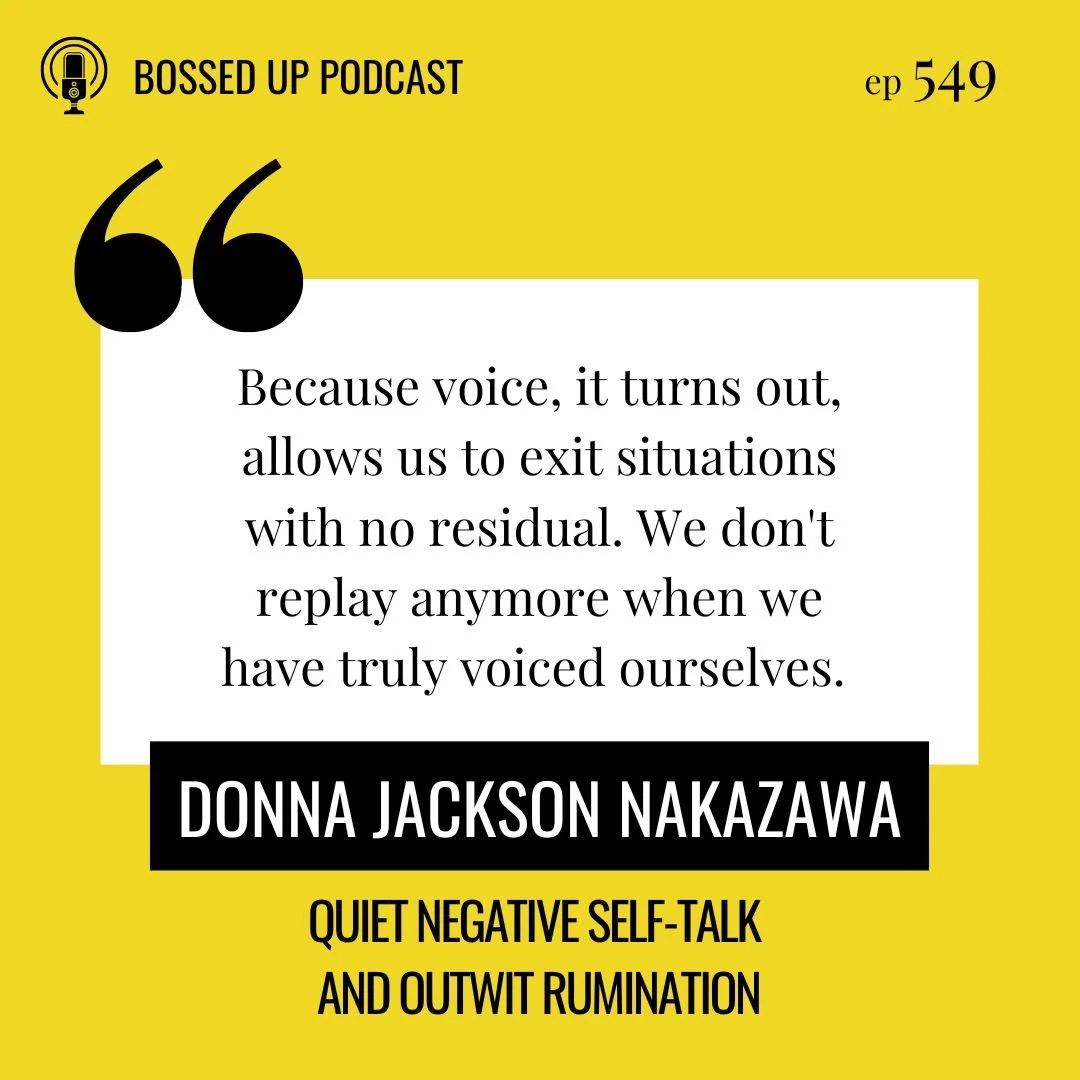
That's what I witnessed in myself and in others, this radical shift towards self compassion. Because we see and hold our story that we see the tender thing beneath the noise that is steering our ship, all that noise that's steering the ship, and we see the tender truth behind it, and suddenly we're commanding the ship, right? We are the skipper, not to get into poetry, we are the master of our fate or whatever, but we have voice. And when we have that voice, we change, we stop spiraling. Because voice, it turns out, allows us to exit situations with no residual. We don't replay anymore when we have truly voiced ourselves.
And that goes back to Carol Gilligan, right? Her work with girls in the 1950s. Like, the less girls voiced themselves as they came of age in a, in a patriarchal, misogynistic, sexist society, the more they lost their voice, the less they voiced themselves, the more likely they were to develop depression, anxiety and other issues. So we are walking around as adult women struggling to say things in a way that we're not too assertive, but we're, and we're not just strident and we're not aggressive and we play to the male ego, but we do it in such a way that we come off with authority.
EMILIE: Exhausting.
DONNA: It's endless, exhausting.
EMILIE: Totally. I mean, that has been the topic of this podcast since its origin, you know, for almost a decade now. That is the tension that we unpack here. And it's just so interesting to see how timeless it is. But how much of this gets internalized, right? We like, we bring those messages inside the house, so to speak. And as you were talking, you've mentioned parenting comparisons earlier. I have got a one year old and a four year old, and so I'm in the thick of like, toddler gentle parenting, as they call it, via the millennial take on redirecting tantrums, et cetera.
And I was just thinking about how much of what you're describing feels a lot like how I redirect a dysregulated 4 year old, right? It's like speaking with compassion to the need that's not being met and the voicelessness that it's inherent in like, like not having emotional intelligence dialed in at age 4, right? And bringing that level of compassion to yourself is kind of, it's like a radical re-parenting that takes like, kind of like, seeing your own inner child as being dysregulated. And saying, okay, well, what's the how can I look at this with compassion and not why are you having a meltdown right now? Lock it up like we're in public, you know, stop crying. Which never works, right?
DONNA: Right. Or buying into the old story of how your voice doesn't matter what you think or feel or need just doesn't matter. And going into that space as opposed to doing the work we just did. And of course there's a lot more, you know, it, it's, it's, there are a lot more steps to it. But to have that ability to make that essential leap that you're trying to help your four year old make, which is there's nothing wrong with you, right? This, the central problem is not within you. That is not where this resides. And to be able to do that for yourself is a radical re-parenting. And that is very much what doing this work on our own mind drama is about. At the end, we have re-parented ourselves in a way that makes us able to voice ourselves in the same way that we might as a parent with our four year old, right?
EMILIE: And that we want to model for those little eyes watching us or bigger eyes, you know, like.
DONNA: Absolutely.
EMILIE: There's something contagious about that. That in a good way.
DONNA: Yeah. Rumination is in fact contagious. There is something called co-rumination. And so it's interesting. In female friendships, there are two types of sort of talking it out with your friends. One is what's called tend and befriend. That is like tend to your friend's wounds, tend to what happened, but also help them move toward a productive outcome, a reframe, a new way of thinking, a constructive plan. And co-rumination is where, you know, a group of people are together and they just keep going about this one mom, or this one kid, or this thing that happened to one of them. And that actually makes your rumination worse. And it's not good for you for your physical stress machinery. It keeps the story going longer.
So we also want to think about that and how we are with ourselves when we're ruminating. Am I replaying something I've replayed a hundred times before? Am I getting anywhere? Is there any emotional processing going on here? Am I coming up with any strategies when I want to get out of this? Can I? Or does it keep sucking me back? And so I have a checklist in the book for ways to kind of notice both in friendship and in yourself. Like, is this going south or is this spiraling up into something productive, because we have to ask ourselves those questions.
EMILIE: Oh, my gosh, I love that. In my book, I talked about what I call mirror theory. It's like you at some point have to decide which mirrors to stand in front of too. Like, if you've got friends who are reflecting back to you your deepest anxieties, they're jumping into that, that spiral of rumination with you. We gotta stop standing in front of those mirrors, like, waiting for a better reflection to come at us, you know?
And so it kind of reminds me of the message around, like, look, some folks are going to tend and befriend or more capable of coaching you through an emotional response. And it's like, incumbent upon us to make sure we're not. We're not expecting more from friends who can't necessarily get there with us or can't help us along. Because I know that sometimes after I hang out with friends, especially since motherhood, I think motherhood opened me up to so many different friend groups. And then, like, a year in to hanging out with a bunch of moms in my neighborhood, I was like, oh, I feel worse every time I come back from hanging out with these women. Like, I need to stop going to these things. Like, this is not good for me. And so that reflection is like, that's kind of on us at some point to say, is this like a relationship that's good for me to bring my anxieties to or not.
DONNA: Right. And so one woman I worked with in the book, she was ruminating about a friendship that she had in which she seemed to her like the other mother was particularly hard on her own daughter, like, this woman's daughter, and very competitive and kind of snarky and. And maybe didn't have her daughter's back the way that she felt like her daughter's best friend's mother should. And so it was got really kind of weird and competitive around, like, college applications and so on and so forth.
And so she had to do the MIST Framework to figure out how this was so sticky for her because she'd grown up with a twin sister who was also extremely competitive and who was also trying to get her to, like, not speak up about certain things. And her daughter's friend's parent also had done something that was kind of needed to be spoken up about. And she got a lot of insight by working on her ruminations, her thoughts spiraling, her MIST Framework using ballistic interruption, a lot of somatic tools, different types of quick visual therapies that I offer in the book or strategies.
And she was, she got there, but she realized in the process that we really shouldn't be with people who are reenacting our most difficult stories. Like, if you are with someone who reenacts those stories, and it's an opportunity for you to grow in a way that when you return to that relationship, you see, like, oh, okay, you know, this is different now I'm voicing myself, and the relationship has changed. And I saw this with a lot of married women. They voiced themselves, and the relationship started to change.
But if there is a relationship in which you begin to make clear friends with your MIST story, that confuses you with your thought patterns, your rumination patterns. You decode them, you befriend them, you do the work, you find your voice, and those relationships either worsen or stay the same. That is not a friend group. It's just not a friend group. And I think we're all old enough. And I remind women of this all the time. You are old enough, whether you are 22, listening to this or 92, you have had enough experience in your life to know inside when something makes you feel worse instead of better. You know when it's not okay.
EMILIE: Yes, and you don't need to explain yourself either.
DONNA: You do not need to explain yourself.
EMILIE: You don't need to, like, rationalize. This is why I'm divesting from this relationship, right? Like, if you feel worse hanging out with this person, that's reason enough. You know, that was so revolutionary for me earlier on in my life. And better relationships will find you. That's the other thing. Like, when we make space for better relationships, they find their way.
DONNA: Yes. And you also know when you leave a friendship or conversation or work meeting or a family event and you feel great.
EMILIE: Yes.
DONNA: You know, when you've connected.
EMILIE: I could talk to you all day. Donna, this is fascinating. I'm, like, obsessed with your. Your field of research and how you've approached it. I do want to ask one last question around timeliness. You mentioned at the very top that we're all ruminating more than ever. And I'm wondering why the h*** that is. Because it is very. That resonates. Is very true. And also why what's happening? I mean, is it just, like, gesturing at the general state of the world, like, what is going on that's. That's leading us all to this unhealthy and unwelcome thought pattern?
DONNA: Well, it's one of the first things I noticed in my interviews that everyone was talking about. I think I'm doing this more than I ever have before. So when I investigated that, what I learned is, you know, this unending fire hose of news. And so social media and fear from whatever it is, you know, a pandemic barely in the rear view mirror, right? You know, school shootings, political discord, social media, you know, ramping up our algorithmic emotions in the most intense and unpleasant way. Even road rage is higher than it's ever in any time in which it has been recorded. So what is road rage except rumination? It's people caught in their stories.
So all of that perfect storm, a loneliness epidemic, an epidemic of disconnection, everything happening online versus the kinds of real person face to face interactions that actually help ameliorate rumination and bring us back to a groundedness. It turns out all those things in our backdrop in the world around us environmentally. Remember, we're in a constant environmental dance. Our brains are dancing with the environment around us 24/7. And that question your brain is always asking is, am I safe or unsafe? And if more of the messages around you, whether they're online or on your group chat or in the world or on the news are about unsafety, um, this is going to ramp up your stress machinery in a way that loads you up, predisposes you, fills the barrel, whatever analogy you want for more rumination.
EMILIE: That makes so much sense and also leaves me feeling like, more empowered than ever to be the architect of that environment, to be the designer of my lived experience whether it's pruning relationships that need pruning or how I'm spending my time. Like, I have never taken more seriously my effort to get off the doom scrolling habit that I had. And it's like it's really working. I'm making a lot of progress there by just filling my time with other things like baking, and gardening, and zero scaping the whole front yard. And I'm like, I would much rather be busy working with my hands than being on my phone. It's just mentally like, being in charge of that experience. What's happening here in terms of input is just like, so important based on what you're saying around environment.
DONNA: Yes. And you're onto something. Using our hands is a very quick, quick neuroscience based tool to exit rumination, baking cupcakes, gardening, all of that. But there's so many other quick tips for getting out of the ruminative state that in the ways we talk to ourselves, which I give like hundreds of different ways we could talk to ourselves. Different somatic experiences, like simply putting your hands behind your head and looking with your eyes. So let's do this real quick. Now, I want you to keep your head forward. Don't move your head. Just keep. Now you're going to take your eyes and you're going to look all the way at your right elbow without moving your head. That's right. Now keep breathing. Keep looking. Now, on your next inhale, on the exhale, make a V sound. V. Keep your eyes on your elbow.
EMILIE: Keep your V. Ooh, this is getting interesting.
DONNA: Bring your eyes to the front. No, you moved your head.
EMILIE: Oh, I did, yes.
DONNA: So now we're going to do it the other way to your left elbow.
EMILIE: Okay.
DONNA: Inhale. [V noise] If you do that for just two to three minutes, you cannot ruminate at the same time and you will start to yawn.
EMILIE: I believe that it's like, a patting your head and roughing your belly situation. Yes.
DONNA: It actually calms your brain for a reason that has to do with evolutionary biology. Because when we were unsafe across evolutionary time, eyes were forward and a very narrow range, right? Kind of like funnel vision. You could only look all the way to the side when you were safe. So if you keep doing that, your vagal system will completely release the intensity of emotion around rumination. So there are things like that we can couple up with the MIST framework. You can get down and lie on the floor and stare at the ceiling, and your brain will break its perspective.
EMILIE: Wow, that's fascinating. I am so excited to dig into this book. And I know the women listening are feeling the same. So where can our listeners get their hands on a copy? And where can we keep up with you and all the phenomenal work you're doing? Because obviously I could talk with you all day here.
DONNA: Well, I had so much fun with you. So the book is out. It's available wherever books are sold. You can get it from Walmart to your favorite local bookstore, which I hope you'll frequent, to Amazon, anywhere you would like to buy your books. And it's on audible. And you can keep up with me at DonnaJacksonNakazawa.com. you can keep up with me also on Substack at Donna Jackson Nakazawa and at Healing Together. You can keep up with me on Instagram. Although I will say I am a low social media human. After writing a book about social media and its effect on girls and their development, I realized it probably wasn't that great for me either. So I am there on Instagram at Donna Jackson Nakazawa. You won't see me as an influencer, however, because I'll be out there doing more creative things with my time.
EMILIE: Amazing Donna. I will drop links to all those great resources and Girls on the Brink, which is definitely worth a read for those listening who want to know more about the the social media crisis and its impact on girls, right? And I'm so excited to get my hands on a copy of your new book. Congratulations.
DONNA: Thank you. Thank you for having me. I really enjoyed this conversation and thanks for the work you're doing to help women everywhere find their voice. I really appreciate that.
EMILIE: Likewise, thank you for links to everything Donna and I just talked about. Head to bossedup.org/episode549 that's bossedup.org/episode549. There you'll find a fully written out transcript and a blog post summarizing Donna's key points. And now I want to hear from you. As always, let's keep the conversation going after the episode. In the Bossed Up Courage Community on Facebook and in the Bossed Up Group on LinkedIn, how has rumination shown up in your life or in your career?
[CONFIDENT RHYTHMIC DRIVING THEME MUSIC WITH DRUMS STARTS]
And how can you apply some of the tools and tactics that Donna shared to get out of that spiral and reclaim your power over your mind? I can't wait to hear from you on this. And in the meantime, let's keep bossin’ in pursuit of our purpose and together let's lift as we climb.
[MUSIC FADES AND ENDS]