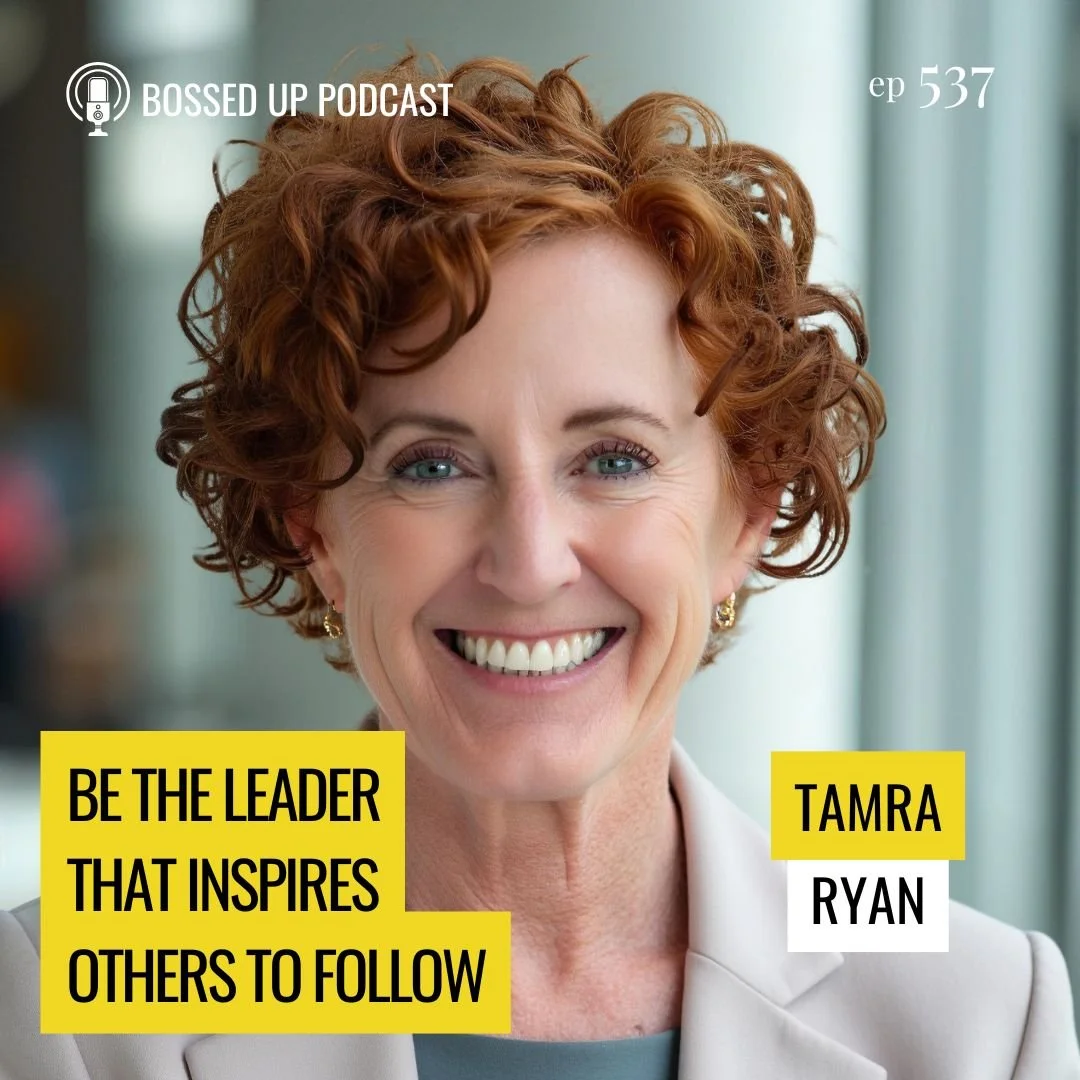
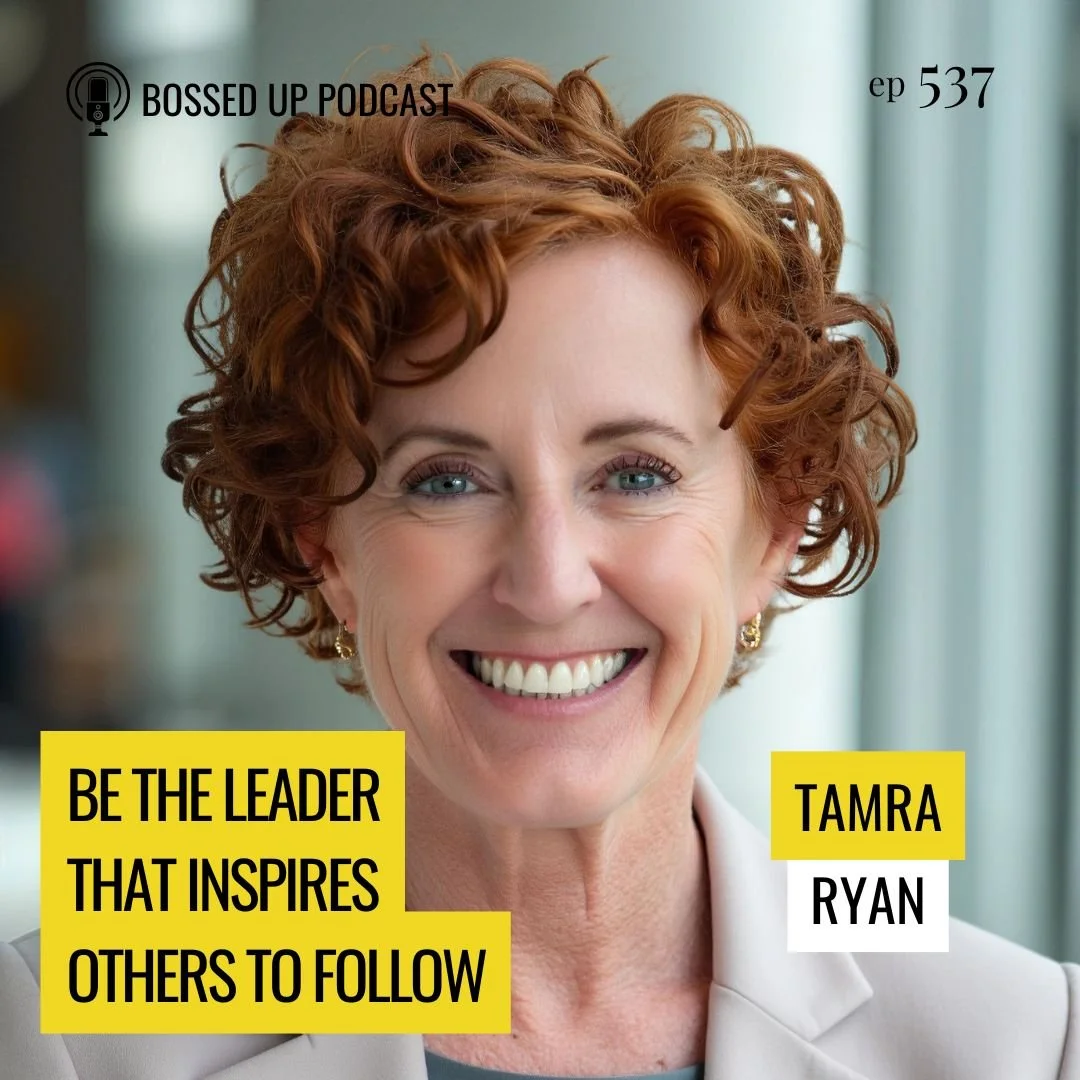
Be the Leader that Inspires Others to Follow
Episode 537 | Host: Emilie Aries | Guest: Tamra Ryan
The kind of principled leadership we need now.
There’s no shortage of people in power mis-using and abusing their power. Every day, our political climate offers us a fresh example of individuals who lead with blunt force and intimidation, and every day, I’m reminded of how essential it is that the people we choose to follow, and the leaders we strive to be, embody empathy, honesty, and integrity.
Tamra Ryan has a long history of leading with clarity of purpose and compassion. As a nationally recognized speaker, author, and leadership expert, she spent more than 20 years as CEO of the Denver-based social enterprise Women’s Bean Project. Now, she serves as the Economic Mobility Fellow for Colorado’s Common Sense Institute. Throughout her leadership journey and embedded in all her writing, speaking, and coaching, Tamra champions a concept she calls “followship”—building leaders who embrace responsibility, navigate challenges with compassion, and create meaningful impact, not just better bottom-line results.
Doing well and doing good: Women’s Bean Project
Women’s Bean Project is a remarkable example of public and private industry collaboration. The manufacturer of nationally distributed food products is staffed by women who experience chronic unemployment. At the end of their six-to-nine-month work period, they transition into jobs within the community. During Tamra’s two-decade tenure, the Project saw a 10X rise in sales and a 95% employment rate in former staff members one year out. Women’s Bean Project showcases how a company can both do well and do good.
Clear and compassionate: four elements of followship
Often, Tamra sees leaders focus too much on one half of her requirement for leading and too little on the other. She wants leaders to get really clear on what they believe in and also give grace and have compassion for the opposing side.
In Followship: 16 Lessons to Become a Leader Worth Following, Tamra outlines four areas in which aspiring leaders must excel:
A clear vision of where you’re going and the ability to inspire people to come with you;
Integrity, or follow-through on promises that engenders trust;
Courage to do the right thing, even when it’s unpopular
Emotional intelligence, including the ability to invite dissent without anger or retaliation.
We all know self-centered leaders who rose to power with a winner-take-all mentality, thinking only of personal advancement and not collective vision. But the other side of the coin is tricky, too: even the most well-meaning leaders often face fears about the blowback of clearly sharing their beliefs.
The risk of speaking out
Disagreements aren’t bad, Tamra clarifies. The problem arises when we can no longer tolerate dissent and difference in belief.
There’s always a risk to speaking out, and that risk varies depending on the factors that affect our social standing. We still have to do it, Tamra asserts, even when we run the risk of an opponent weaponizing their disagreement through official complaint or public recrimination. The challenge in leading, she says, is knowing that not everyone will agree with you but still being willing to say your piece and stand by it.
Being a woman, especially a woman of color, certainly adds a layer of risk. Tamra acknowledges that there’s a dance we have to do, particularly right now, between standing up for what we believe in and not putting ourselves in a position of “untenable risk.”
Whether you hold a formal position of authority or not, Tamra has action items for those of us working to become better leaders in our own lives, leaders who inspire followship.
Get clear on what you believe, says Tamra. While recognizing that every cause can’t be the hill you’re willing to die on, you have to know what you stand for and what you’re willing to fight for. Once you have identified your core values and top causes, fight for them, but don’t hold so tightly to your beliefs that you end up spiraling when anyone shares a different opinion.
Tamra left me on this uplifting note: Don’t let overwhelm stop you from making any moves at all. Remember that even the smallest acts can make an impact. Big change comes from the small, concerted efforts of many.
I want to hear about how you’re navigating leadership in this current climate. What steps, however small, are you taking to keep moving forward? How are you speaking up and making an impact? Join the conversation in our Facebook Courage Community and our group on LinkedIn.
Related links from today’s episode:
Episode 536, “Strategic Detachment: A Trend for Surviving and Thriving”
Episode 525, “Resisting Despair: Coping Tools For A Declining Democracy”
Unleash your leadership and SPEAK UP at work:

-
[CONFIDENT RHYTHMIC DRIVING THEME MUSIC STARTS]
EMILIE: Hey, and welcome to the Bossed Up podcast, episode 537. I'm your host, Emilie Aries, the Founder and CEO of Bossed Up and today I want to share a conversation about what inspires people to follow you,
[MUSIC FADES AND ENDS]
what inspires people to see you as a leader. And how, particularly in this acutely challenging political climate, should leaders think about navigating the boundaries of taking a stand versus having empathy for those who disagree with us.
Tamra Ryan is joining me for this very fun conversation and is a nationally recognized speaker, author, and leadership expert who's redefining what it means to lead with purpose and compassion. After serving as CEO of the Women's Bean Project from 2003 to 2025, it's a social enterprise transforming lives through transitional employment, which you'll hear more about in a moment. Tamra's dedicated herself to empowering others to become leaders worth following.
Her journey from corporate executive to thought leader reflects her passion for creating lasting change through visionary leadership. She also is currently serving as the CORS Economic Mobility Fellow for Common Sense Institute Colorado, a think tank. There she engages in critical policy discussions aimed at fostering economic opportunity and equity. Through her writing, speaking, and coaching, Tamra equips leaders with tools to embrace their responsibilities, navigate challenges, and create meaningful impact. Tamra, welcome to the Bossed Up podcast.
TAMRA: Well, I'm great to see you in this format.
EMILIE: I know, right? It was just not that long ago we were hanging out together in person. So spoiler alert to all my listeners who hear me rave about Colorado and all the great work being done here. Tamra is in the club based here in Denver, yes?
TAMRA: Yep. I'm a fifth generation Coloradan, so I've been around for a while.
EMILIE: Got some street cred in Colorado. I love it. Well, I'm excited to talk with you today about all things leadership, as you like to call it, Followship. Based on the excellent book here that I'm holding in my hand. So excited to dive into. But first, tell me a little bit about how you came to the work of leadership.
TAMRA: Well, in some respects, it started a very long time ago when I was in school and I was identified as a leader, so other people were seeing it. And so that just became a part of my identity. And so I was always attracted to leadership roles, I think. But also there were many times when I remember looking around and thinking, thinking, well, why isn't anybody standing up or speaking up? And you know, when I think when you do that, it's incumbent upon you to be the one in many respects.
So that was sort of a recurring theme for me. And I actually, my career went a lot of different directions. I have two science degrees. So, you know, I thought at one point I was going to be a researcher and maybe I could have been a leader in research. But I realized I was so not a researcher when I was working on my master's degree. And then I had the opportunity to go into the business world and it culminated really in my last job, which was being the CEO of Women's Bean Project. And I was the CEO of that organization for 22 years.
EMILIE: Amazing. Tell us about the Women's Bean Project because it's a really fascinating model and a social enterprise. I think so many folks across the country, and certainly for those listening from Colorado would be interested to know about.
TAMRA: Women's Bean Project is really, I think it captures people's imagination because I remember after becoming the CEO and telling people about it, I became so much more interesting. [LAUGHTER] And I don't really think it was me. I think it was the fact that we had something interesting to talk about.
It is a social enterprise, as you said. And they are a food manufacturer. So they make a line of food products that are distributed all across the U.S. in hundreds of stores and then of course, online. And that's not really what's special about the organization. What's special about it is that they hire women experiencing chronic unemployment. So a typical woman hired hasn't had a job longer than a year in her lifetime. She has a long history, often of addiction, possibly incarceration, maybe homelessness, domestic violence. I mean, all the things, when you think about it, that would get in the way of getting and keeping a job. So she gets hired at Women's Bean Project and she works there for six to nine months and at the end goes on to a job in the community.
And what really put us on the map, particularly during my tenure, was that we grew our sales really significantly, about 10x from when I started. And also that we really started to hone in on the things that actually really make a difference to somebody. Not just short term, but long term, and help her own her own future. And so, a year after graduating the program, over 95% of women are still employed. That's really fundamentally what you care about, right? It's one thing to provide services, it's another thing to actually provide services that allow someone to change their lives, right?
EMILIE: And maintain that sense of agency and dignity through work and through self-actualization. I mean, it does sound like such a transformational model. And I think what captures people's attention and certainly captures mine is this belief in the private sector's ability to both do well and do good, right? And I think we've come a long way, right? I've, I've podcast a lot here about my somewhat disillusionment as part of the girl boss wave, right?
When I started Bossed Up in 2013, Lean In came out the same month the Benefit Corporation became all the craze. Like the concept of where you start the book saying look like people's trust in leadership is at an all time low, particularly in the public sector. And so as someone with a poli sci degree, I was really attracted to this idea of the private sector's ability to solve social problems through business. And the Women's Bean Project has a really fascinating way of doing that, both through a private enterprise and you're grant funded and have a nonprofit arm, right?
TAMRA: Yes. Yeah, it's about 60 percent sales and 40 percent of fundraising. So on an average year.
EMILIE: Yeah. Very inspiring. And you and I met speaking on a panel recently. Or we've crossed paths before that, but most recently speaking on a panel about affordable access to childcare. And you're now in a position where you're taking sort of an economics approach to systemic policy change. And I just wonder, as someone who was a leader for a transformational social enterprise that straddles that public private sector now looking at these broader systemic policy issues, have you had a similar disillusionment? I don't know if there's a better word for it. To me in terms of is the private sector living up to its potential on the front of the social part of social enterprises? What do you think?
TAMRA: Yeah, well, that's a very sticky question, [LAUGHTER] but I will say that what I was originally attracted to, I'm the economic mobility fellow for a think tank here in Colorado. And for quite a while, before I left Women's Bean Project, it was my side hustle. So I've been doing it for over three years. And I think what originally attracted me to do that work, even as a side hustle, is because I think so much of the work that we do doesn't take into account that we're all everything is, is part of a system. And so we can have a tendency to legislate, you know, vertically and we say, okay, we're going to change this one thing and that affects these people, but we don't think about how all the other things are affecting the people.
And what I saw over and over again, and I talk in my first book, which is called The Third Law, I talk about all the things that push back on change for women, like Women's Bean Project hires. And the reason I want to talk about that is because I think in general, humans want to simplify things. We want to say, well, she went to prison because she made mistakes and she needs to be punished for that, or she just needs to pull herself up by her bootstraps and figure it out. And I really think that when we understand that we are all part of a system, and like the women served at Women's Bean Project, those trying to achieve economic mobility are also part of a system, most of the conditions are affecting them versus them affecting the system. That's what's appealing to me is really thinking systemically, and I just think we don't tend to do that.
EMILIE: Yeah, well, it's hard to even know where to start, right? And so what are you finding? I know you're finding a lot, but tell us a little bit about the work you're doing when it comes to economic mobility, because that I think is the name of the game these days. It's feels like something that's really hard to access for a lot of folks.
TAMRA: Well, it is. And you know, I'll just use minimum wage as an example in part because in Colorado, it is so much higher than many other states and in Denver in particular, it's over $19 an hour right now. Well, I really feel strongly that we waited a really long time to increase minimum wage, and then when we do, we ratcheted it up very quickly. So today our minimum wage is tied to the consumer price index and so it will continue to increase that much. And what didn't happen is, again, speaking to systems, we increased minimum wage so quickly that we didn't give businesses the opportunity to adjust in the meantime.
And so in the long run, one of the things I've written about is, what you do is you risk decreasing the number of jobs. So you hurt the thing you were trying to help because you've made an effort to change something so rapidly without allowing the system to adapt. And so, minimum wage jobs for, say, teenagers or people with barriers to employment, which is an area I'm very familiar with, will struggle to get employment because the employer will look at them and say, they're not worth 19 dollars an hour, they don't have the experience for that. Or I can't afford to hire 10 people anymore. I'm going to have to hire seven to get the same amount of work done. Because my, you know, I just can't afford that in my business.
EMILIE: Right. And is the premise there that with a slower timeline, the business community would have any more appetite for that, or are you going to find that no matter how fast or slow the transition is?
TAMRA: Well, I would argue that a slower timeline that would, that happened over years, instead of no change and then all of a sudden, big change would allow the businesses in the community to adapt.
EMILIE: Yeah. And, and that sounds so indicative of the whiplash of our politics, right? It's like whenever a new administration comes in, out with the old, in with the new. And I just feel like we've on not just a local level, definitely on a federal level. We just are ping ponging between extremes these days.
TAMRA: Yeah, well, I think that's the nature of a pendulum, right? A pendulum goes one way to the extreme, but when you let it go, it doesn't go back to the middle.
EMILIE: [LAUGHTER] Yeah.
TAMRA: It, by definition, it swings all the way back to the other side.
EMILIE: Yeah. I could talk more about that in Citizens United and how that impacted the extremes of our politics and all of that jazz, but this is a very different podcast. [LAUGHTER] So let me get us back to leadership, because although that's a very fruitful dialogue, I don't want to grill you on the economics of minimum wage.
TAMRA: Well, that's good because I have two science degrees remember?
EMILIE: That's right. [LAUGHTER] Well, I should grill you about career change because I'm sure my listeners should, would be interested in that because you have had such a varied career and it's inspiring, right? I think part of what I found very inspiring about your book on Followship is this idea that, you know, in an era of declining trust, which I think has only become worse since the book came out, right? Our faith in institutions is frayed. Our faith in leadership in the private and public sectors and nonprofit sectors are frayed and declining.
Like, what is appealing about leadership, first of all, like, why should, in an age of, you know, Lean In and McKinsey are saying women's appetite for leadership is also declining. It's like, what are the rules of this new game of leadership? What do people actually want from our leaders? And knowing that, you know, who should aspire to leadership or why might you aspire to leadership in such a challenging and fraught time?
TAMRA: I think so much is written about leadership, and I fully acknowledge trust is one of the biggest challenges we have today, in fact, I talk about that in the book at the beginning of just like, we don't trust, you know? And it was at least when I was writing the book and doing the research and the business community was the most trusted, but it wasn't trusted in general. It's just like I trust my boss or I trust my company. One could argue that the reason you stay in the job is because you do.
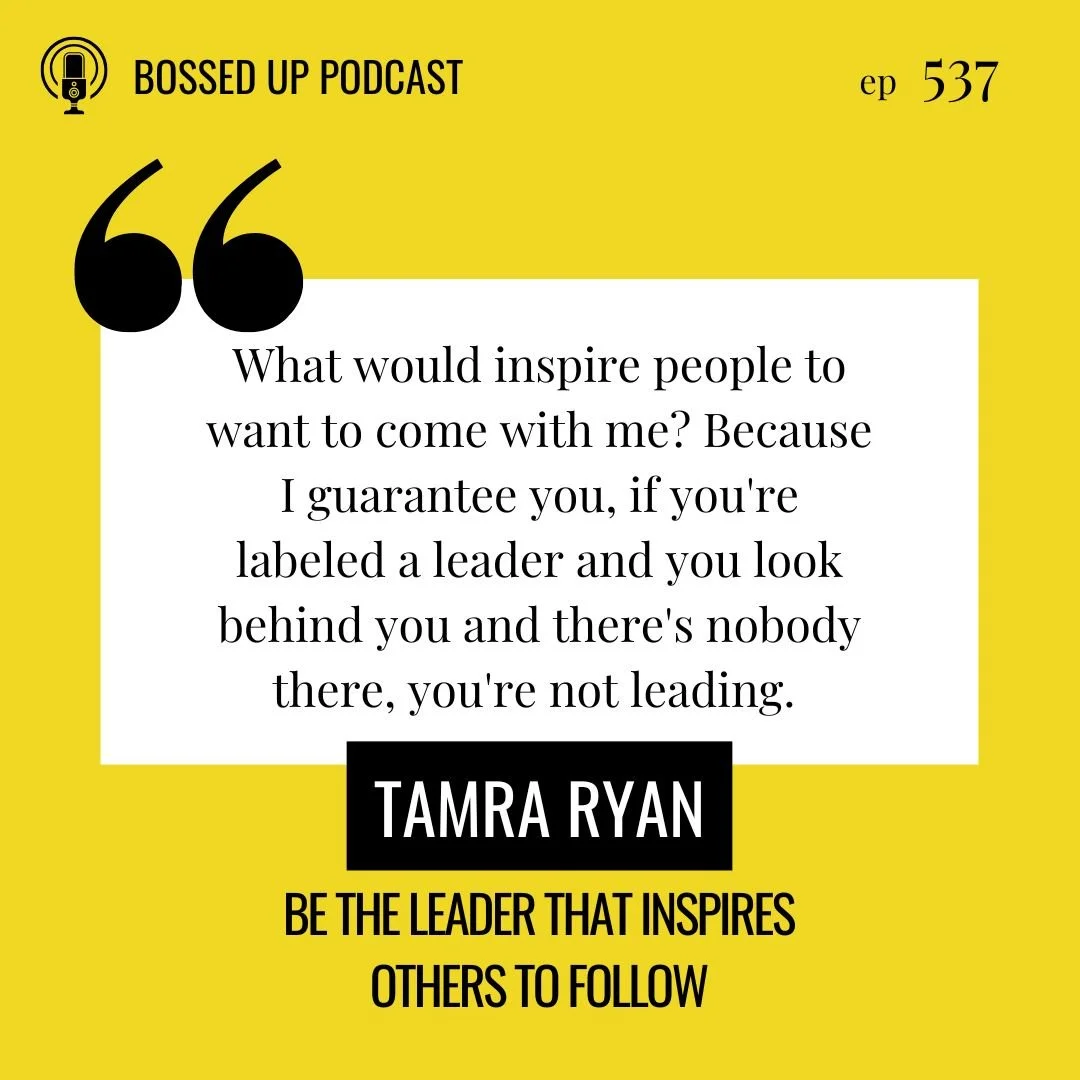
But really, I think the bigger point is that we tend to look at it from the standpoint of leadership as opposed to looking at it from the perspective of what inspires somebody to want to be there with you? And that's what I call Followship. Like why does somebody want to follow someone? And that I think gets really lost because we tend to think more selfishly about how we lead. It's a trap, I think, we think, why would I want to lead? What would I do if I were a leader, et cetera, as opposed to, what would inspire people to want to come with me? Because I guarantee you, if you're labeled a leader and you look behind you and there's nobody there, you're not leading.
So I really think that there are four areas that followers are looking to a leader for. It's a vision, like, get me excited about where we're going, like, what's the purpose of my work? Why do I do this work? And I think that can be done no matter what kind of sector, what sector you're in. And also it has to be beyond, my vision is that I make a lot of money.
[LAUGHTER]
EMILIE: We're Gonna increase sales by 3% this year. Woohoo. Let's go.
TAMRA: Yes, it really is. Why, why does our business make a difference to the people who are our customers or our community, etc? We create jobs, things like that. So a vision and enlisting people to come with you on that vision to get them excited about it. It's integrity. And we, I really think we have a dearth of that in the world today. And it's also having the courage to do things that are the right things. And I think it's scary right now to be a leader often. And then the final part is emotional intelligence. And those are, that's how I thought to break it out. Because I think that's what people are really looking for from their leaders. And so if you can capture those elements, I think that would be I think you could get great satisfaction in leadership.
EMILIE: Totally, as opposed to this sort of megalomaniac leader paradigm that we see too much of, right? Which is this self centered leader who's not exercising emotional intelligence, and empathy, and thinking about purpose, and collective vision, but very much a self centered, winner take all approach which we've, we've talked a bit about on the podcast before. So I think that's a very inspiring vision of leadership that actually attracts a lot of women.
TAMRA: I do think so too. Yeah.
EMILIE: Right. Servant leaders. A lot of women I know, whether they're leaders in their community or businesses or what have you, are like, yeah, I was called to act. You know, I answered the call of leadership. You know, this is what happened in my life. That's why this is a purpose that I'm pursuing and felt compelled to, to use your words, stand up and say something. When I saw that no one else was. And I think that's very inspiring and feels risky today.
I couldn't help but think when I was reading, you know, this idea that like speaking up and having integrity behind your, your decisions and daring to act even when it's hard. There's been a chilling effect in corporate America, at least when it comes to, I don't want to say anything for fear of isolating someone, for fear of turning someone off. In fact, I just did a vision training recently and all my senior leaders were practicing a really silly vision exercise which was, sell me on the best vacation ever, right? And they, they each said the following. You know, I had them write a postcard from this future best vacation ever. They said, the weather's great, the food's delicious, we're having so much fun. I wish you were here.
And I said, what the h*** just happened in this room? What? Why didn't anyone commit? Why didn't anyone choose something visceral that I could hang my hat on, that I could imagine joining you for? And they all said, oh, we wanted our audience who's listening to be able to see whatever matters to them in my vision. And so they were all purposefully vague because they told me they were afraid of turning someone off. And in this climate, which is so sensitive, which is so tricky to make a stand about anything nowadays. Like, what would you say to a leader who's afraid to be clear because they think that putting any kind of a stake in the ground is going to turn some folks off.
TAMRA: I really think that now is the time to be clear and to, I guess, two parts. One is to be very clear on what you believe in and also give grace, when people don't believe the same thing you do. And I think that one of the reasons that we are afraid, many people are afraid to speak up, is because we lack. Not that people lack the opinions, but that they're afraid of lack of grace. And I don't think that's going to change unless we decide to model it.
EMILIE: Yes.
TAMRA: And so an opportunity for a leader to model grace, in my view, is the only thing that's going to change their team and change their company.
EMILIE: I love that. It's like being clear about where you stand while leaving the door open explicitly for people to disagree, to invite dissent, to, like, acknowledge a difference of opinions, and then to give them grace if dissent does emerge. I think we've really, as a society, like, lost the ability to disagree without being disagreeable.
TAMRA: 100%. Yeah. And really that's what makes me sad is that, you know, I talk with my kids a lot about it's, disagreements in a relationship aren't bad. It's what you do with that disagreement and how you behave in that disagreement or how you can live with that with not agreeing. And so, it makes me sad for us as a, as a society that we've lost that ability, because how boring would it be if we all agreed?
EMILIE: [LAUGHTER] Totally. It's, you know what really opened my eyes to that, because I'm so assertive, just like, in my nature, and I've had my own business for so long that it's easy for me to just speak up without too much fear of censorship, that I didn't recognize how, like, dominant my voice can be in some environments. Ironically, she said into her podcast microphone, right? [LAUGHTER] Like, I had the opportunity to be a part of the Governor's Fellowship program through CiviCO. Are you familiar with that?
TAMRA: Yep.
EMILIE: And I loved the explicit focus on political diversity as, like, part of DEI, frankly, right? But political diversity, communicating with people across the aisle, finding common ground, appreciating and really listening to understand divergent perspectives. Because the debate person in me, the mock trial kid in me, you know, loves persuasion and loves argumentation, and that's just really different than the kind of emotional intelligence it takes to be a great leader, right?
TAMRA: Yeah. I think people do want to know that you really believe in something.
EMILIE: Right.
TAMRA: For sure they do. They don't want to necessarily be beaten over the head with it.
EMILIE: True, so true. So it's interesting you say that, because a friend of mine works for a global company, and recently she told me that in a workplace setting, she was talking about sort of like comparing a lesson from history to a lesson of leadership, talking about American values, how they, you know, liberty and justice for all has sort of remained true over the years, even though our vision for America has evolved, right?
And there are different moments in time throughout history when our values are really called into question. And she said, you know, now feels like a moment where people are really called to defend American values and live up to those values. And because she said that, she walked into a meeting with her boss a few weeks later, and her HR representative was there, and someone had submitted an anonymous report through the ethics hotline saying that she was engaging in political speech in an inappropriate way at work.
And so when I say, like, chilling effect, I'm hearing what you're saying, and I believe wholeheartedly in this idea that, like, leaders should take a stand, leaders should lead with their values. But what happens when someone who disagrees with your values doesn't just disagree to your face or lose the ability to respect and, like, give grace to people, but it becomes weaponized. And I'm, I'm seeing that happen in a, in an environment that feels like, you know, companies are just. Nike was just sued by the EEOC for engaging in diversity initiatives. Like, it does not feel like a safe space to talk about things like that.
TAMRA: Yeah. And I would say, Emilie we still have to do it.
EMILIE: Yeah.
TAMRA: That’s, I think that's where courage comes in.
EMILIE: That's encouraging. I'll pass that along.
TAMRA: Well, I. So I guess take it to the other extreme. And what's the alternative, right? What's the alternative is to give up what you actually believe in. And I guess that's not a compromise I'm willing to accept. I think that part of the challenge in leading is always navigating and reading the room and understanding that not everyone's going to agree with you.
And at the same time, be willing to say, I didn't say anything that I don't really believe in. That doesn't mean it needs to be inflammatory. And I'm not meaning to imply that what your friend said was inflammatory. But I think we can calmly and with emotional intelligence, really stand up for what we believe.
EMILIE: Yeah. I think it also just reminds me of risk, right? Like, there's inherent risk in leadership. There's inherent risk in speaking out. And for some of us, those risks are greater than others. You know what I mean? And so kind of knowing your own risk tolerance in an environment that feels unsafe. We just had a podcast interview here about, you know, navigating hostile workplaces as a woman of color, you know, understanding that, look, identity impacts how people perceive you. And so how dare a woman speak out, you know, can ruffle some feathers more so than others.
TAMRA: For sure. And I think, the added layer that a woman has and a woman of color has is navigating self-advocacy in an environment that might not feel safe because silence is also complicit.
EMILIE: Yeah. And also damaging. It's like damaging to yourself, to your soul, to your spirit. And the world misses out, you know. But there are real risks to speaking out right now.
TAMRA: Yeah, for sure there are. And I don't mean to. I think it might sound like I'm minimizing them and I don't mean to do that. I think that's the, a little bit of the dance we're in right now is standing up for what you believe in and at the same time not putting yourself in a position of untenable risk. How about if we call it that?
I am part of a group of women leaders that has, over the last year has come together to really try to figure out what we can do as a group of women, what we can do to stand up for what we believe. We can all agree it's a nonpartisan group. And what we all believe, which is we believe in the Constitution and we believe in the rule of law. And really when you talk about American values, trying to peel it back to the fundamentals of what our country was built on, and we're navigating that in real time of just where does it make sense for us and what could we do that could have an impact? And so, I think even if you're not seeing it, I think everyone's, you know, sometimes there is a little bit of relief in knowing that you're not the only one.
EMILIE: Oh my gosh, so true. I mean, almost every conversation I have with friends, which I just came back from a friend's house over coffee and had this similar conversation, it's always like, how are you holding up? [LAUGHTER] Like, How are you doing? Besides all the other stuff that's going on, and there's this, uh, implicit understanding that everyone's struggling to make sense of the world right now. And that to be in America right now, especially as a patriot who cares deeply about America, can feel incredibly triggering to watch what's going down. And so I think you're right that there is integrity and emotional intelligence and vision called upon by leaders and that every one of us has a responsibility to play and not like normalizing, and ignoring, and just succumbing to the self-silencing effects that they're going for. You know what I mean?
TAMRA: Yeah, yeah. It's both, it's the self-silencing effects and also the chaos and really not, I think, allowing the, the chaos and, and somewhat the disbelief because I feel, I feel that a lot also. Like, seriously? [LAUGHTER]
EMILIE: Right. You're like, this can't possibly be real. And that's the point. Yeah, yeah, scary times. I'm glad to hear that you're gathering people together, women leaders together. I feel like just that alone is an act of leadership that we all can take a page from. So if you've, if you've got something to share with the women who are listening, whether they're in a formal position of authority at work or not, what would you challenge us to do? To be leaders in our own lives and to inspire Followship?
TAMRA: I think it really starts with being really clear on what you believe and acknowledging we don't all have to believe the same things, but be very clear on what you believe. And also everything can't be the thing that you're willing to go to the mountaintop with. Really is, you know, if everything's important, nothing is. So what do you really believe? And then be willing to stand by that. While also giving grace to the people who, who don't agree with you. Because I think that it's possible we do the first part better than the second part. And that's where we start to spiral, where we believe so strongly that we don't give space for disagreement.
EMILIE: Right, absolutely. And it's, it's also just like doing something in the face of overwhelm as opposed to feeling like it has to be all or nothing.
TAMRA: Yeah. And I think, you know, it can be done. I think we tend to overlook that small acts can have an impact, but if everyone does something small, that's how the world has changed. And I think we, you know, we're at a place I think in general in our political environment, we don't believe that our small act can matter, that our vote can matter, or that our, you know, that the one little thing that you did matters. And I actually think that that's actually the only thing that does matter ultimately.
EMILIE: Yeah, that's so true. It's easy to feel overwhelmed, and beaten down, and like your voice doesn't matter, but you're reinvigorating that even in me. LAUGHTER] It's easy to get beat down these days. So I appreciate your perspective on all of this. Tamra, thank you so much for sharing your experiences and your encouragement with our listeners. Where can my listeners keep up with you?
TAMRA: Well, Tamraryan.com and my first name is spelled T-A-M-R-A, last name is Ryan. That's my website. You can find me on LinkedIn at Tamra Ryan. So I'm pretty easy to find and, well, really, those two places are probably the best.
EMILIE: And I'll link to those and your two books, which are awesome. And you do a lot of speaking, right, on these topics?
TAMRA: Yeah, I do speaking on these topics. I have a talk that I've been giving a lot lately about legacy, and I think that's, you know, that's very related to what we've been talking about in terms of how today can I be doing some things to build what I'm going to leave behind?
EMILIE: I love that. Well, thank you so much, Tamra. I'm impressed by the legacy you're building and appreciate you being here.
TAMRA: It's great to see you.
EMILIE: For more links to everything Tamra and I just talked about, head to bossedup.org/episode537. That's bossedup.org/episode537. And now I want to hear from you. What do you make of today's discussion? It's a tricky time to be a leader in the workplace, no doubt about it. Or in your community, for that matter. You know, the temptation to tune out and just stick your head in the sand is real for so many of us, myself included. I don't know about you, but I kind of waffle between, you know, what I just podcasted about last week. Strategic detachment and feeling kind of okay, focusing on where I can make an impact versus complete overwhelm. It is easy to succumb to despair.
I just actually received this interesting email from a Bossed Up podcast listener. She wrote the following quote, “I came across your podcast when searching for ways to help figure out how to take action with how I'm feeling in our current state of government. Your podcast from late 2025 still speaks to what's happening today. Did you get much feedback from that podcast and do you plan to do a follow up?”, She's referring to my episode number, 525, Resisting Despair: Coping Tools For A Declining Democracy. She goes on to write, “my friends and I are sending letters, calling representatives, sharing spreadsheets of contact info, sending postcards, sharing posts. It doesn't feel like enough and we don't know what to focus on next. Everything seems to be wrong, but I will not despair and I will not lose hope.”. So shout out to you, Carrie for sharing your thoughts. Thank you for writing in.
I wrote back and basically said, I think every episode I've doing now is a follow up to that podcast. And today's conversation with Tamra really feels aligned with that, right? It's like, how do you lead from where you are, whether you're leading in your community or leading in your workplace, in the face of overwhelm, in the face of despair, how do you resist the temptation to flatten yourself for self-protection? Because that's part of the strategy here, right? Like, how do you make sure that you are still willing and able to take a stand? It's not easy to do. Tamra doesn't sugarcoat it. She's not trying to make it sound easy, but in some ways it's simple. It's like getting back up again. That was an Aaliyah quote. We all gotta be channeling our inner Aaliyah and brush ourselves off and try again, despite what the world is handing us.
So to that end, I encourage you to please write in. Know that it's just me on the other end of the mic here. You can always shoot me an email at Emilie@bossedup.org my inbox is always open, as I like to say. And if you're enjoying the show, leave a comment and review. In Apple Podcasts or Spotify or wherever you get this podcast.
You are not alone. So if you're listening to this and you're nodding along and you're picking up what Tamra and I have been putting down today, please know that there's a whole community of women. Whether we all agree politically or not doesn't matter to me, right? Like I think diversity of thought, as Tamra was saying, is such a value add to our community. But there is a whole community of women who are listening every week alongside you.
[CONFIDENT RHYTHMIC DRIVING THEME MUSIC FADES IN]
So take a moment today to join the conversation after the episode. As always in the Bossed Up Courage Community on Facebook or in the Bossed Up Group on LinkedIn, I will see you there. Until next time, let's keep bossin’ in pursuit of our purpose and together let's lift as we climb.
[MUSIC FADES AND ENDS]