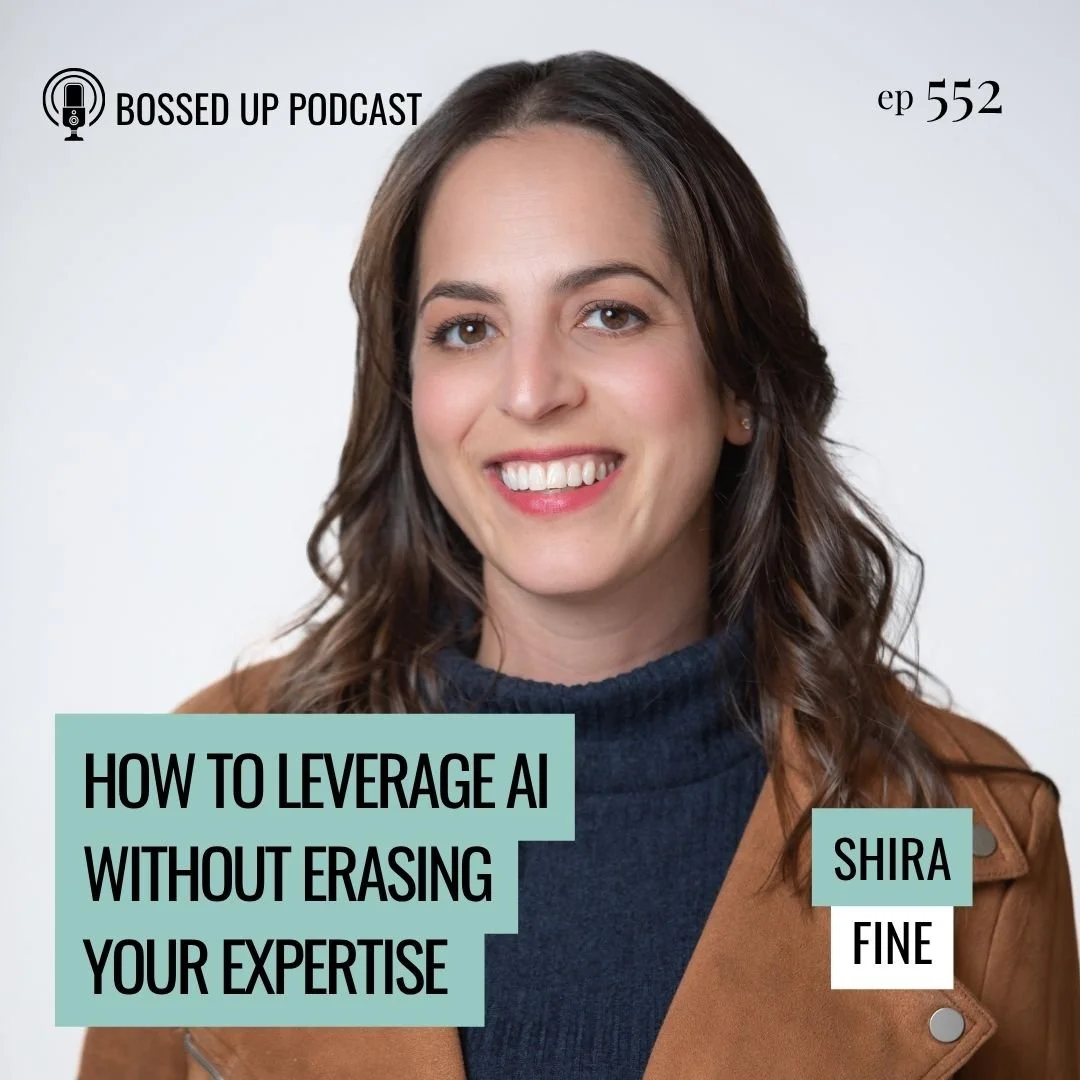
How to Leverage AI Without Erasing Your Expertise
Episode 552 | Host: Emilie Aries | Guest: Shira Fine
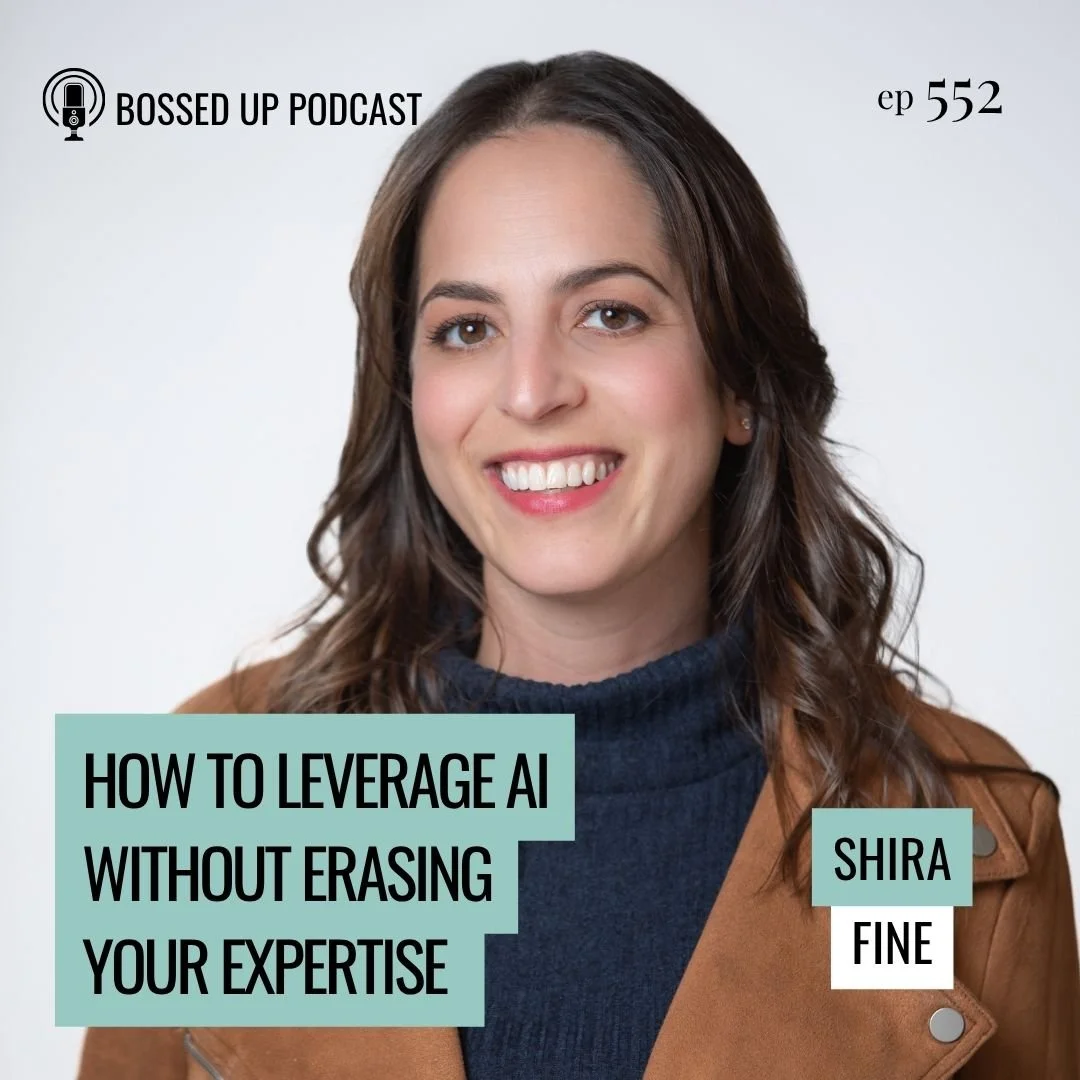
The best way to keep AI from taking your job might be to make it work for you.
Is AI a source of unlimited potential or the destruction of work as we know it? As women, do we need to be embracing AI wholeheartedly to keep up (and keep our jobs) or should we avoid it at all costs? As is usually the case, the answers to these important, timely questions seem to fall somewhere in the middle. Communications pro Shira Fine joins me to share her take on how we can experiment with AI without erasing our experience and expertise, especially as women facing a world in constant technological upheaval.
Beyond the prompt: integrating AI workflows
After launching her own communications agency five years ago, Shira has prioritized experimenting with AI to figure out how it can serve her best. For those who are setting up their first-ever account with Claude or ChatGPT or any of the other chatbots out there, she recommends following a Good, Better, Best approach.
The first step is to just start prompting. Ask the bot a question, get an answer. Don’t be afraid to use Claude like a Google search while you build some level of comfort. From there, you can transition to “better” with projects. By inputting details about your experience and role, you can create a database from which the bot will pull to assist you in something ongoing, whether that’s news aggregation, email triage, or meal planning.
Finally, “best” looks like building. It’s up to you whether you play around with coding to erect a custom CMS that works perfectly for your needs or you turn to a program like Cowork to develop the most ideal personal assistant. Either way, offloading to AI the rote, menial tasks that demand the biggest mental load is where you really cross the threshold into making AI an essential tool.
The question of privacy and intimidation
The thing is, those “better” and “best” steps require providing an AI tool with a lot of personal or proprietary business information, and many of us are understandably hesitant to share this kind of data with Big Tech. They’re right to be, Shira acknowledges, but there’s a difference between caution and staunch avoidance.
First off, Shira stresses the importance of paying for a subscription if you’re planning to use AI for anything more than asking the odd question. If paying for a pro account, some AI features allow you to ramp up the privacy settings and include options that won’t train the AI based on your inputs, preventing your interactions from training the machine. The way things are going, Shira predicts that it won’t be long before the average user has no more cause to be concerned about privacy with AI tools than they are about privacy in Google Workplace. Ultimately, though, if you’re uncomfortable putting personal data into Claude, there are plenty of other ways to make use of AI.
When it comes to intimidation and feeling like we’re “falling behind”, Shira takes the hard line: it’s a learning curve, like any other new technology, and the only way to get around the curve is to get in the race. Furthermore, newcomers to the AI space need to stop assuming everyone else knows more than them. We’re all learning. One of the great things about chatbots is that you can ask them directly how best to use them; you can command them to ask you questions that will help them help you. Diving in and playing reveals just how accessible these tools really are.
None of this means Shira is discounting the phenomenon I outlined in Episode 540, The Double Disadvantage: AI, Women, and the Future of Work. The issues of AI eating away at the jobs most often held by women isn’t just fearmongering. But Shira has spent her career in PR, and she also illuminates an important but unspoken fact: telling the world (and your investors) that a mass layoff is due to replacing human jobs with AI plays a whole lot better in the media than admitting you’re being hit hard by the economic downturn and have to slash departments to keep the doors open. In other words: don’t believe everything you hear about AI’s ability to steal your job.
It’s not cheating
A lot of women are hesitant to dive into AI assistance because offloading any amount of the work assigned to them feels like cheating; I got into this in Episode 546, The Hidden Force Keeping Women from Using AI. Women have always had to work harder than men to prove their worth. It’s understandable that not being able to show our work, even the nitty-gritty stuff at the base of the project, feels like slacking off or selling out.
Shira likens using AI tools to using a calculator or a formula in Excel. Sure, AI can pick up the repeated tasks that take your time and energy but not much brainpower. That doesn’t diminish the work you put into a project. Rather, it lets you focus your time and energy on the parts that make you irreplaceable: your years of experience, strategic thinking chops, ability to read a room, and the people skills that enable you to build stronger teams and revenues.
Some of this worry comes from professionals just copy/pasting whatever AI pumps out, but Shira reminds us that’s not how successful people do it. Just like you’d never ship an email penned by a junior copywriter straight off to your firm’s most important client, you go into a chatbot relationship with eyes open. The output may never be more than 80% there; finalizing it still takes your human mind, voice, and expertise.
Shira acknowledges all the downfalls contingent with this AI revolution, from environmental impacts and job displacement to autonomous weapons and the looming threat of human redundancy. But a lot of smart people in significant organizations are working hard to build regulations that keep people paying attention and keep these risks in check.
She’s unapologetically optimistic about the benefits of this technology. The most incredible thing, she says, is how anyone can now use AI to design a boutique solution just for her, something that is optimized to her needs. And that frees up more time for working women to flex our knowledge and showcase our high-level expertise, so we can keep lifting as we climb.
Where is your head at these days when it comes to AI? What concerns you about the ethics around its widespread adoption, and how are you making use of the benefits? As always, I’d love to keep the conversation going on the Courage Community on Facebook or in our group on LinkedIn.
Related links
LEVEL UP your leadership and
AI skills by leaning into your expertise:

-
[CONFIDENT RHYTHMIC DRIVING THEME MUSIC WITH DRUMS STARTS]
EMILIE: Hey and welcome to the Bossed Up podcast, episode 552. I'm your host, Emilie Aries, the Founder and CEO of Bossed Up. Today I want to pull back the curtain on women and AI from a specific angle of like, okay,
[INTRO MUSIC ENDS]
if you feel late to the game, if you feel like, you're sort of sick of AI being shoved down women's throats or this sort of fear mongering narrative, oh my god, women are being left behind by the world of AI. Today we want to break down, like, how AI can personally benefit you and how this mindset around AI that it kind of feels like cheating can prevent so many hard working, brilliant women from reaping the rewards of like, understanding how we can actually make this technology work for us when it matters, when we mindfully choose to pursue that, and if we don't want to, if we want to be thoughtful in our use of AI, that's a really important part of this conversation as well.
We really want to break down today how to protect your career longevity, how to be agile and how to be adaptive in this ever changing world. In fact, if you're a woman who's skeptical about AI, who is not trusting of big technology companies, that is very legit, very valid of an opinion. And my guest today is going to help address that from a place of being an advocate for tech reform herself.
So joining me today to help break all this down is Shira Fine. Shira creates bold, award winning communication campaigns for organizations and high profile individuals advancing world changing ideas from helping startups find their voice, to launching advocacy organizations in tech reform, child safety and disability rights, to guiding nonprofits through crises and elevating their influence.
She uses communication to solve complex problems and drive impact. As a partner at Bryson Gillette, Shira heads the strategic communications and public affairs practice and helped grow the firm from 10 to over 40 people. Today the organization is recognized as one of the fastest growing, award winning, intentionally diverse firms at their scale, majority women and people of color, trusted by clients to deliver creativity, cultural fluency, and results. In 2026, Shira was named a PR Week Woman of Distinction and a PR News Top Woman in PR and Communications. Shira, welcome to the Bossed Up podcast.
SHIRA: Thanks so much for having me. I'm really excited.
EMILIE: So tell me more about you and your background and how you've come to really focus on the subject of AI and its use in communication and beyond.
SHIRA: Yeah, absolutely. So I was born in D.C., went away to school, I studied communications and I came back to work at agencies in D.C. i thought people doing comms were just really smart in our nation's capital. And then like so many stories, I fell in love with a boy from California and wound up out west. And I had my two sons. And about five years ago, I left the firm that had moved me to California and started a new agency with my long term boss. We're intentionally diverse. We're 60% people of color, 60% women. And I get to take everything I liked and leave everything I didn't. And I have a lot of freedom to experiment and that includes AI.
EMILIE: That's great. So one of the things that really caught my eye when I was thinking about having you on was this idea of taking AI integration beyond just prompting. Can you share more with me about what that's looked like in your organization?
SHIRA: Yeah, absolutely. So building with AI has been one of the most fun things I've done. But I did not start here. And when I'm talking to people about AI for the first time, I usually talk about good, better, best as kind of a framework to approach. And you should always aim for one step higher than you've been. So if you have barely opened AI, good would be downloading the Claude app and starting to prompt, right? So how can I phrase this email? Better? It's a great place to start.
And if you've done that, then better would be starting a project. Tell that project instructions about you, what you do for a living, what your priorities are, and then put your prompts inside the project so it learns from itself. And if you have that, you can make projects for, you can make projects for each different area. But then best, is building. And so whether that is in Cowork or in Code, you just want to open it up and start telling it. A problem you have in Cowork that can look like a personal assistant. So every morning Cowork scans my emails, Monday.com, Slack News that I've asked it to look for and it drops in Slack a summary of my day and it almost always starts with wow, that day looks really tough. Which I need to like make it a little nicer. [LAUGHTER] I definitely need to make it nicer, but it's. I don't have a chief of staff and this is a chief of staff. It tells me its opinion of what to prioritize, what news stories to know. And that is Cowork. And that's like my best level.
Or on Code, like what is a problem you're having? For me, I kept having to edit proposal. I edit proposals all day long. New business is such a big part of what I do. And I was making the same edits over and over and over again. So I talked Code and I said, like, what can I do? And together we made a website, a proposal tool where you upload the RFP, you talk about the challenges, you talk about the client. It is built on language that we wrote, which is a really key part of it. And then it spits out a proposal that's like 80% there. And we're able to focus on the creative and the human thinking. Not the same language that we use time after time.
EMILIE: Yeah, interesting. And what do you say just off the bat for folks who are listening and say, okay, theoretically, I can see the value of this, but I can almost hear two refrains coming up. One or right away? One would be, I'm not sure I'm comfortable, like, giving away my privacy in that way. Like, you're talking about giving a lot of access to my company's intellectual property or my organization. Like, ooh, I, you know, I have a defensiveness that flares up. I'm not sure I trust the technology or the technologists behind it. And then the second is just the intimidation factor. Like, I don't know what the h***l you're talking about. How do I even, how do I even approach this when I'm like, just the blind leading the blind here. So how would you address those two concerns?
SHIRA: Yeah, so first of all, you should be skeptical. I do not trust big tech. Nobody should fully trust big tech. They are focused on financial gains. They are not focused on saving humanity. And we actually do a lot of work in AI reform and making sure there are guardrails, people pushing for guardrails in this space. So I guess I would say, yes, you're right, like, you should be skeptical. You should be thoughtful about this. If you have a pro account, you have more access to privacy tools. So that's the first thing. It's worth the $20 a month for many reasons, this being one of them. And then second, in settings, there is an option to not train the AI based on your inputs. And nobody should be doing AI without selecting that. And then my third point is probably a little more controversial, but I think in a year it will be like Google Docs. You would never worry about putting private things into Google Docs. You would never worry about how you're using Google Drive.
So the more you feel comfortable sharing, the more useful the tools will be. But also, if you do not feel comfortable yet, then ignore Cowork, just don't do it. Don't do it yet. Because there's so many other ways that it can be useful. And then in terms of intimidation. I've listened to your podcast a lot and I know that I, I really was into the double disadvantage episode where women, I'm going to get it wrong. Where women both are more impacted by AI and less and the AI jobs are less available to them. And I think that's right. And I think we have to know that going in. And you start somewhere you're comfortable. I know a lot of the guys are like, you should start with cooking. And there are negatives that there are positives. But, like, start with cooking. If you have not touched it, start with, I mean, I have a project where it knows that I am a family of four and I'm a working mom, so make those meals 30 minutes or less. And my five year old doesn't like things with green in it.
[LAUGHTER]
EMILIE: So how do I sneak the veggies in? Yeah.
SHIRA: Or just like, please no scallions. The number of times I pick scallions off a meal. But I'll upload a photo of what I bought at Whole Foods and my CSA order and it will plan my week and it will remember the recipes that I like. And so if you're afraid of entering in the workspace, enter it, like connecting it to your Gmail. And maybe you're afraid that everyone knows more. And they don't, by the way. Like, they do not know more than you and I think if you can get over that hump. And sometimes cooking is a great entry point, but then like, jump to the work stuff. Cause that's where it's gonna accelerate.
EMILIE: Yeah, I think that's a really good point. It's like there is a learning curve and the only way you get through that curve is to start messing around a little bit. And so, yeah, I find, I find that the mindset hesitancies that so many women have, especially around concerns over climate, you know, that require massive regulation to solve for, right? This is not an individual's responsibility. Like, these are corporate entities that need to take responsibility for the impacts they're having and governments need to be regulating them. So I love hearing that you're involved in that.
But we take it upon ourselves to say, well, I shouldn't use this to meal plan this week because I don't want to kill the planet over my meal planning. You know what I mean?
SHIRA: Mhmm.
EMILIE: It's just women absorbing that mental load, right? And absorbing that, like, consciousness or collective consciousness or conscientiousness on behalf of the world. And there's a, there's a downside to that, right? I love that in some ways we're so thoughtful. But, you know, what do you make of the women will be left behind argument? Is there some truth to it or you think it's mostly fear mongering?
SHIRA: I think that it is definitely a risk, but I think it's, women are not behind today because nobody is behind. You're only. I mean to sound corny, you're only behind if you don't stop. I have this story of how I started coding. I was in a Zoom where it was just a casual Zoom where a bunch of people joined to talk about how they were using Claude Code and only one woman shared. And she started and she had built an entire personalized CRM using Claude Code like it was. She rolled it out to her whole organization. It was totally bespoke and everything worked. It was incredible.
And then the men started presenting and I love men. I'm a boy, mom, [LAUGHTER] I love men. But the men were sharing things that were much more in draft. They weren't ready, they weren't all working. Some of them hadn't even used Claude Code and felt confident to say, I don't really know the difference between Claude and Claude Code, but here's something cool I made and I thought that just so showed the difference between men and women and the way we approach new technology.
And the coolest thing about AI is you can ask the AI how to use it. You open a chat and you say, here is the problem I am facing, what is the right tool to use? What is the right prompt? And most importantly, ask me questions, interview me about what I'm trying to accomplish. That has been the biggest game changer with Claude is that its default is usually to interview you. ChatGPT likes to assume it knows what you want. And you are, your brain is the differentiator. Your years of experience is what makes it better. You put garbage into AI and you get garbage out. So you're leaning on your expertise. But like anything, you can ask your friend who's smarter, in this case, your friend is the AI on how to best use it. And that is a way to really open up the tools.
EMILIE: Totally. And you're speaking to another common challenge I see when it comes to women adopting AI or just starting to experiment with AI, which is this feeling of, am I cheating, right? This hesitancy of like, well, it has to be hard for it to come out great, you know, or this feels like such a shortcut that I shouldn't do that feels like wrong morally in some way. What would you say to women who are saying, no, I can't, you know, I can't cut corners in that way?
SHIRA: Well the first thing I would ask is, is it cutting corners when you use a calculator, right? Like you would never hesitate to use a calculator, you would never hesitate to use a formula in Excel. What is the superpower of AI is you are offloading all of your rote tasks, you are offloading everything repeatedly. Everything that you can repeat. And what you hold on is what actually makes you special, right? It's your creativity, it is your years of experience, it is your strategic thinking, right? AI can't read a room, AI can't understand nuance very well. That is what you get to focus on. So it's not cheating, it's working smarter and it's saving your time for the parts of you that'll make the biggest difference.
EMILIE: Totally. I think your proposal kind of project is a good example and what I've been thinking a lot about is how women can even get started analyzing their workflows. That's something we've been doing at Bossed Up, where I've really challenged Irene, our programs manager and I to step back from the day to day. Instead of working in the business, let's work on the business for a moment and say, okay, looking at our workflows, where can we identify opportunities where AI might add value? Because we're not just trying to use AI to use AI, right? It's a tool that can be used as a means to an end, not just because it's fun to use or because it's cool to use. So how would you say you've done that analysis? Like, what would you advise folks do to step back and just start to scan either their personal life or their work life for opportunities where AI could add value?
SHIRA: I really started with the pieces that were taking the biggest mental load, right? I'm a mother, I am an agency leader. [LAUGHTER]
EMILIE: No shortage of mental load in your life.
SHIRA: I'm an adjunct at USC. Like I like to be busy. I'm also, you know, trying to do some thought leadership on the side and I want to know what's going on in the world. So I looked and I was like, what is draining me the most? And for me it was dinner, right? Every friggin day it's like, what is for dinner tonight? People have to eat and it's so uninspiring. I was like, get rid of that.
EMILIE: I say this all the time to my husband. I'm like, again, again. We feed them dinner again?
SHIRA: Yes, but it's what is, what is draining in the day, right? This is not going to revolutionize the way you operate, but it is going to free up your plate a little bit. So for me it was backgrounders. I now have Claude at 3:00pm every day. Claude scans my calendar and any meeting that I have that is external and with not repeating so it doesn't do it for my client calls, but non-repeating external meetings. It pulls a backgrounder, tells me about the person, tells me if they've been in the news, tell like, tells me basic details about them. I am so much more prepared for those meetings. I no longer spend any brain power worried that a meeting is going to surprise me. Like that's huge for me.
EMILIE: Now I want to know what, what did Claude say about me? No, I'm just kidding.
SHIRA: It did, it did. Well, don't worry. I knew I started prepping for at least a week ago.
EMILIE: But no, I love that. That's so interesting. Okay, that's a good example.
SHIRA: It's so helpful. And it was causing me a lot of stress because I, you know, new business is a huge part of my job. I meet with someone new most days, at least days when I'm doing my job well. And those meetings are not helpful if I don't know that that person just published a book, if I don't know that their organization is about to file an IPO or something like, right? Like it makes them such a better use of time and people love it when you know little things about them. It used to be called stalking and now it's just being well informed.
[LAUGHTER]
EMILIE: I love it. Yeah. And offloading the cyber sleuthing, you know, is a great example. Yeah, I love that. And you mentioned this before, but like looking for repeated tasks, rote tasks and making it personal. You mentioned earlier the salience around uploading your own reference docs or your own language for the novice listening who's like, I don't really know what she's talking about, but that sounded important. Can you expand upon that?
SHIRA: I mean this is really going to depend on what your job is, right? So for me, I am a communications consultant. I make communications plans, I write messaging, I write proposals. My amazing ops team has taken all of our existing language and put it into docs. So whatever you write the most often. Okay, let's make even more basic. We all write emails. We all write way too many emails. There are probably some emails that you write over and over and over again. But even just downloading your 20 last emails you wrote and uploading all of those emails to a project, it will better understand your voice. And that is now your email project. So if you want help responding to a default client or colleague or I don't know, whatever email you write, as long as it's, now that it has your emails as a source material, it's going to use your voice. And then if you're willing to up level just a little bit. We've all seen stories about AI slop and AI tells. I like to add in an instruction to avoid AI tells. So I'm like, rest in peace the EM dash.
EMILIE: No em M dashes, no EM dashes.
SHIRA: No, it's not X, it's Y. I also block. I can always tell now people are like, that's genuinely interesting. Like nothing is genuinely interesting. No human has ever, ever said that. So you can, that'll make it a little bit better and then know that the output is 80% there. Do not just copy and paste. Spend the time, put the human eyes on it, trust that you are smarter than the machine and make it, just make it a little bit better, make it sound like you.
EMILIE: I'm always a little surprised. I've been using Claude quite a bit to write captions for my Instagram, for my home bakery, my pop up porch bakery, which I too like to stay busy, for god knows what reason. But it's been very fun and I'm loving like growing a new brand online that's more visual than anything I've ever done in leadership development, right? This is like very visual, very fun medium and I've been offloading caption writing and occasionally cloud will still get some major very basic fact super wrong.
Like Saturday is June 5th, not June 6th and I'm like, double checking my work. I like, have caught myself thinking they're probably right, that Claude is probably right. And then I look back at the date, like calendar and I go no, you're totally wrong. Like that's so such an easy thing to get right but you so mess that up. So it does kind of check you and like remind us not to default to the AI as being the all knowing because it's just not. It just still, it's still not there.
SHIRA: It's still not there. And I treat it the way I would treat an assistant. I would never take an assistant's work and immediately email it to a client, right? Like the goal, the more, the more time you spend training it, the more it'll listen.
EMILIE: Sure. The less work it'll need on the back end.
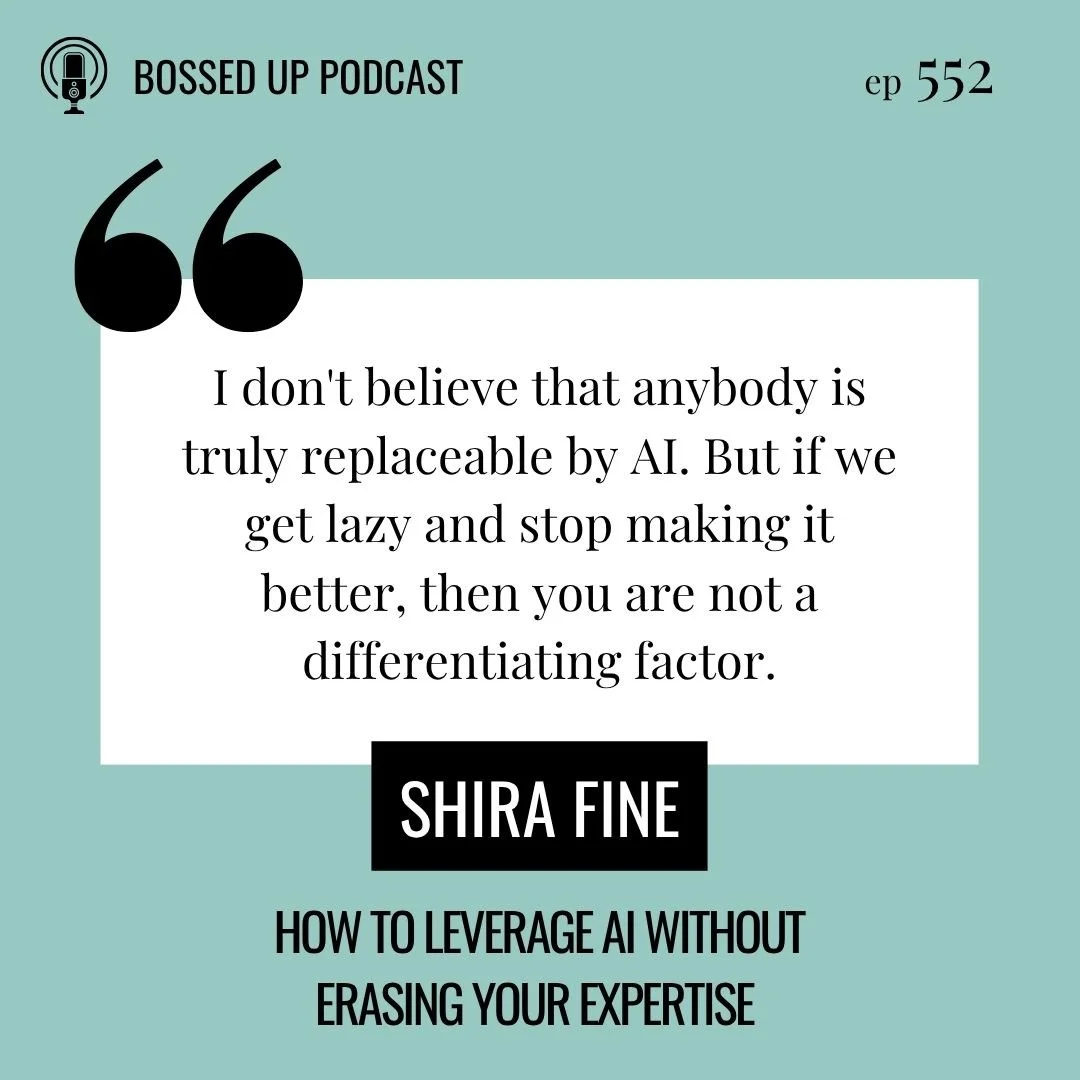
SHIRA: The less work it'll need. But also, you know, Claude comes out with a new version, it feels like every week. And it's better in some ways, it's worse in some ways. But we should all be paying attention. Like, otherwise we are replaceable. And I don't believe that anybody is truly replaceable by AI. But if we get lazy and stop making it better, then you are not a differentiating factor.
EMILIE: Yeah, let's talk about that, like, element of future proofing our careers here because, woof. There has been some shock waves sent through White Collar America in particular in recent months over job replacement or job security. How do we lean in to the differentiating factors we have as humans in order to make sure we are not just proving our value, but really showing that value in a way that gets recognized?
SHIRA: So first of all, know that this is all a PR game and this is all a narrative, right? When a company does mass layoffs, maybe because the economy isn't so great right now or so unpredictable, and then they blame AI. AI is a better narrative for your stockholders than our numbers are down, so we're firing people. So everything is a PR game. And I say that as someone who has worked in PR for 20 years,
EMILIE: I love that.
SHIRA: So don't believe everything on its, on its service. These big companies are not, are not being fully truthful with us. But that said, things are shifting faster now than I can ever remember. And you know what I say to my students who I think are in a really tough position, because if there's anyone who's going to feel the impacts, it is junior level. Because we do have note takers and we do have AI can recap and can remember every moment. And if you've ever used an AI notetaker, you know that they do a really good job. Not on the nuance, not on like, the reading the room, but in the capturing exactly what people said and summarizing it, it's great.
And so on the first day of class, I'm like, it is up to you if you learn anything in this class. This is a comms 101. You can do it all in AI, it is up to you. And they have to make that choice. They have to make the choice to remain a critical thinker. And like I said earlier, we're all on ground zero, right? AI in its current form is very, very new. And a 22 year old can learn it just as fast, if not faster than a 40 year old. They can be AI native and they can bring that to their company. They can say, look, I've looked at structures and here is ways that AI can speed you up. They can talk that CEO under the table because every CEO is like AI adoption, AI adoption. But they are so far from the actual work that they often don't actually know how to do it. And the 22 year old who is on AI every day, who is becoming an expert, who knows to not be scared of coding, who just gets in and does it like that, is how they can differentiate themselves for sure.
EMILIE: I love that so much. There's so much like, optimism in that as well as realism about the economic shockwaves that are hitting, that will happen. So let me close with two questions for you here. One is, let's start with regulatory. What is the biggest concern you see or you have that you want to see a regulatory solution?
SHIRA: Oh my god. Picking just one problem, I don’t know.
EMILIE: You can pick a few. This is the dark one. And then I'm going to end with ah, a. With an optimist. Okay. But this is like, I'm curious, like from your vantage point, being someone who's adopting, who's using, who's not just a critic from the sidelines, throwing tomatoes into the ring, you know, it's like, what do you really think is the most critical regulation that needs to happen?
SHIRA: I think there are harms today and I think there are harms of tomorrow. And harms today is the environmental impact. It is the bias of these systems, right? Like they are causing real harm today. It's the job displacement based on the optimism of CEOs. Like those are real harms today. And then future harms are autonomous weapons, are giving the AI bots all of our power, making humans pointless. Like is the, you know, the sci fi movie of the robots taking over. Like we are. I don't want to say, I am not a doomer, but we are closer to that than ever before.
EMILIE: I mean even the Pope's weighing in, right?
SHIRA: Right, even the Pope is weighing in. And our elected officials move slow, right? Our elective system does not reward long term planning, it rewards short term impact. So I would turn. There are many people much smarter than me, many organizations that are in this AI space and have long policy plans on how we can protect humanity, which is ultimately our goal. There are people who are experts in how bias can be removed.
So it is way too complicated of one system. Let's not only build data centers near communities of color, right? Let's work on how we train these bots so that they understand that we are not all middle aged white men. Like that needs you done. And let's definitely put something in place so that war is not, I mean war has already been transformed by AI and let’s, let us have people pay attention and minimize that harm.
EMILIE: Yeah. So good. I mean so many elements of what you just talked about are DEI. That's diversity, equity and inclusion work when done well. And it's just so sad to me that this is all happening. The rise of AI discussions and adoption is happening as the fall of DEI has happened. And it's just, I don't think there's ever been a more critical time for us to have DEI at the table in terms of decision making, so.
SHIRA: We can't be scared of having tough conversations and pushing our electeds and making them be better.
EMILIE: Yeah. And it's our job as citizenry. So I think those are all really key points. Let me flip the switch here and say what's the best use of AI you've seen? You've given us a few examples but like, bet most life changing. I mean you're, you're saying it's not going to be transformative, but there are some ways in which AI can be transformative. So how have you or someone, you know, like, really benefited from adopting some AI element of work?
SHIRA: I mean the most Incredible part of AI to me is that you can take your 10, 15, 20 years of experience and turn that into a bespoke product that only needs to work for you. Like your exact problem, the exact way you work like that is what it can do. And that's so incredible. Like at first I was like should I sell these products? And I said no, like this product is for me, this product, I don't want to make it for anyone else. I want it to look at my workflow, my priorities and create tools that work only for me.
And that's been really incredible. And also I made a video game for my son [LAUGHTER] which was really fun because he needed to learn Hebrew. And Hebrew flashcards are so terrible. And so I made a Super Mario game in like less than two hours where he had to jump and match the sound in the letter. And so you can also just have fun with it. It can make your work better, faster and like you can have a really good time while you're doing it.
EMILIE: I love that those are such great examples. Shira, thank you so much for sharing your experiences and sort of the nuance behind the work that you're doing on all of this. Where can my listeners keep up with you and the great work you're doing here?
SHIRA: I think the best way is on LinkedIn and I think that will probably be my LinkedIn will be in the show notes and then otherwise brysongillette.com that's where I work and I'm always available on email.
EMILIE: Amazing. Thank you so much for being here.
SHIRA: Thanks for having me.
EMILIE: For more links to everything we discussed on today's episode, head to bossedup.org/episode552. That's bossedup.org/episode552. There you'll find a blog post summarizing our key points from today and a fully written out transcript, if that's your thing. As always, I want to keep the conversation going with you. I want to hear what you have to say about the ethics around AI use, the personal benefits of AI use, and the totally legit skepticism you might have around
[CONFIDENT RHYTHMIC DRIVING THEME MUSIC WITH DRUMS STARTS]
how it's transforming the world of work and the world that we live in. As always, let's keep the conversation going after the episode in the Bossed Up Courage Community on Facebook or in the Bossed Up Group on LinkedIn. And until next time, let's keep bossin’ in pursuit of our purpose, and together let's lift as we climb.
[OUTRO MUSIC ENDS]