The Double Disadvantage: AI, Women, and the Future of Work
Episode 540 | Author: Emilie Aries
As the AI economy transforms the future of work, women are being left behind.
AI is rocking the workforce, and there’s a long line of op-eds and in-depth research exploring the many impacts coming our way. But despite all the press, one topic I don’t see discussed enough is the inequity embedded in this workforce revolution. The people who are deciding how AI will impact our futures aren’t including all the voices at the table.
Women, in particular, are facing what I call a double disadvantage when it comes to the AI economy. That two-fold obstacle—and all the factors surrounding it—is what I want to break down today.
The first disadvantage: women’s jobs are being more exposed to AI automation
In 2025, the UN’s International Labour Organization analyzed nearly 30,000 real-world tasks in order to identify which jobs are most exposed to generative AI takeovers. The findings are stark: in high-income countries, the careers women have are almost three times as likely to fall into the “high-risk of AI automation” category as those predominantly held by men.
Specifically, 9.6% of women’s jobs are likely to be replaced by AI, compared to just 3.5% of men’s jobs. The reason is pretty simple. Today’s generative AI is really good at the kinds of jobs women are more likely to hold: knowledge economy jobs that focus on cognitive, language-based work, such as HR administration, clerical tasks, bookkeeping, and so on.
Men are predicted to be less affected by the coming shifts because they’re more evenly distributed between these jobs and the kind of manual, blue-collar labor that’s hard to replicate with technology. That is, of course, not to dismiss the fact that even those jobs have been disappearing and changing for decades due to advancements in automation.
In early March, Anthropic, the creator of Claude AI, released a new report looking at the tasks people are actually using AI for. Based on that analysis, it posits that at-risk workers are more likely to be female, educated, and higher paid because it isn’t just the entry-level work that AI is replacing—it’s the professional roles we’ve spent decades building careers around. While there has yet to be any immediate spike in unemployment, the study did find that the hiring of younger workers in these occupations has already begun to decline.
The second disadvantage: the opportunities benefit men
Like most seismic economic shifts, there’s some good news that accompanies the bad when it comes to the AI economy. Unfortunately, the “good” here isn’t all that egalitarian. AI is certainly creating new jobs even as it replaces others. Machine learning engineering, data science, and the like are well-paid, fast-growing career paths…but they are disproportionately going to men. As of 2025, women make up only 22% of the global AI workforce. In senior positions, that percentage drops to just 14.
Another layer: the learning gap
There’s an admittedly tarnished silver lining here: there is an aspect of all this that we can control: educating ourselves on what AI is capable of and how it can help us stay relevant in our workplaces.
In 2024, Harvard Business School synthesized 18 studies encompassing 140,000 individuals around the world and found that women adopt AI tools at a 25% lower rate than men, even when access is equalized.
Three main trends drive this:
Women self-assess as less familiar with and confident in the use of AI.
They are more likely to see using AI tools as “cheating” or taking a shortcut. This is hardly surprising, and the study acknowledges that women historically face greater penalties for being seen as not having competence. They are therefore more driven to prove their worth and show their work.
Women consistently rate concerns about AI ethics higher than men. They’re worried about things like accountability, transparency, and bias; they’re asking harder questions about environmental impacts and reliability, and understandably so.
While these reasons are completely valid and we should be asking more questions rather than blindly adopting such powerful technology, I’m of the opinion that we need to keep learning how AI works and how it can work for us. Otherwise, men are going to keep capturing all the productivity benefits, and women will be left behind.
To be clear, I think we must absolutely continue to express concern: push for more regulation and transparency. But at the same time, start learning. Not only does voicing detraction from an educated standpoint have more weight, but you’ll be elevating your career prospects at the same time.
How to prepare for the AI economy
“Start learning how to use AI” is easier said than done. With that in mind, I just released a completely updated LinkedIn Learning course, Get Unstuck, packed with AI prompts and interactive tools to help you explore how a large language model (LLM) could be your very own career coach.
This is just one example of how we can start using AI to help us advocate for ourselves rather than letting it replace us.
What you can do
Start taking control of AI’s role in your life! First off, begin playing around with tools like ChatGPT, Claude, and Gemini, among others. A lot of articles recommend using them to meal plan and put together your grocery list. Go for it, if you want, but I’d encourage you to focus on work-centric ways it can boost your productivity and take things off your plate. More and more, the labor market and economy are looking for people strong in workflow systems, so find your strengths and outsource what you can, while staying within your workplace’s security policies, of course.
Start doing what you can to get yourself in the room where the decisions about AI in your workplace are being made. Odds are, these changes are already underway, and your voice deserves to be heard.
What organizations can do
Number one: Stop treating AI strategy and people strategy like two different things. If you’re looking to incorporate AI into existing human roles in your company, the absolute best people to help you figure out the most efficient way are the people in those roles right now. As the studies show, those people are usually highly educated women in senior positions. If you’re interested in business continuity—and what revenue-minded company isn’t?—you need their input in the transition.
Second, set really clear expectations about AI use at your company. Research shows that women are less likely to break the rules than men, so without explicit guidance, they’ll probably hang back while the men dive in. If AI at work is encouraged, make sure everyone knows it.
And third, audit your AI tools for biases. A 2024 Deloitte study of AI systems, like those used for HR, voice recognition, and financial services, found that 44% exhibited gender bias. If you’re using AI for performance reviews, hiring, or training, make sure it isn’t perpetuating algorithmic injustice.
What policymakers can do
As I said at the top, there is a dearth of diversity in the voices making the big decisions on AI. Because of this, glaring issues are slipping through the gaping cracks. New policies for AI need to demand transparency, especially when the tools are being used to make decisions that impact people’s livelihoods: employment, housing, healthcare, and so on.
Colorado is once again leading the charge on this, with an AI anti-discrimination law on the books (though implementation is currently delayed). Since then, at least a couple of other states have followed suit.
Right now, AI is shaping the future of work - and the new economy we all have to live with, so we need to figure out how to be a part of it. A few months ago, Tressie McMillan Cottom spoke at the Urban Consulate about our right to refuse a future where humans are treated inhumanely. She stresses that we don’t have to accept what’s laid out as inevitable. Instead, we need to actively shape what that future will look like.
That’s what Bossed Up has always been about, and I will continue to share ways you can shift, without giving in, as everything changes around you. Keep asking hard questions, keep learning, and keep tuning in!
What’s your take on how you factor into the AI revolution? Are you an early adoptor or a vocal critic (or both)? When you’ve done your chatbot reconnaissance, come on over to the Courage Community on Facebook or join us in our group on LinkedIn to share your findings and feelings with real women tackling the same urgent issue.
Related Links From Today’s Episode:
Anthropic, “Labor Market Impacts of AI: A New Measure and Early Evidence”
Harvard Business School, “Global Evidence on Gender Gaps and Generative AI”
World Economic Forum, “How AI is worsening workplace gender gaps and how we can course correct”
LinkedIn Learning Course, “Get Unstuck: Make a Plan to Move Your Career Forward”
Discover how AI tools can help you GET UNSTUCK at work:
-
[CONFIDENT RHYTHMIC DRIVING THEME MUSIC STARTS]
EMILIE: Hey, and welcome to the Bossed Up podcast, episode 540. I'm your host, Emilie Aries, the Founder and CEO of Bossed Up. And if you are like millions of us and stumbled upon Matt Schumer's super viral article on LinkedIn from a few weeks ago now called Something Big Is Happening,
[MUSIC FADES AND ENDS]
then you know something quite large is happening when it comes to the economy, jobs and AI. But I think something that is not discussed enough and is being underreported is that something even bigger is happening.
The people who are making decisions right now about how AI will impact the future of our workplaces, the future of our economy, the future of your job, are not including all voices at that table. So if you're a woman listening to this, you have every reason to listen carefully. Because right now it's not like the sky is falling, but the ground is shifting beneath our feet. And those of us who are paying attention are going to be better equipped to navigate the massive changes that are coming to the workforce next.
Today, I want to walk you through what I'm calling the double disadvantage that's facing women as it relates to the AI economy and the future of work, and hopefully what we can all do about it. So first, what is the double disadvantage? Women are facing two simultaneous problems when it comes to this AI transformation and how it's impacting the future of work. The first problem is that the jobs women are more likely to hold today, the jobs where women have made major gains, have stepped up into leadership roles at higher rates, they are disproportionately at risk in this AI revolution. They are disproportionately exposed. They are more likely to be subject to AI automation and replacement.
The International Labour Organization, which is the UN's labor agency, published a major study in 2025 analyzing nearly 30,000 real world tasks to figure out which occupations are most exposed to generative AI. What they found is striking. In high income countries like the US, women's jobs are nearly three times as likely as men's to fall into the highest risk category for AI automation. Specifically, about 9.6% of women's jobs are in the most exposed group, compared to just 3.5% of men's. And the gap's getting wider. It was 7.8 versus 2.9 just two years earlier. So we're seeing widening risk, more exposure of AI and generative AI in particular, replacing the kinds of jobs where women are more likely to occupy those positions as opposed to men.
So why is this happening? It's pretty straightforward actually. The advent of generative AI tools, things like ChatGPT, Claude, Gemini and the like, they're really good at cognitive language based administrative work. Think clerical roles, data entry, bookkeeping, scheduling, HR administration and the like. Women tend to be heavily concentrated in those kinds of white collar, or what we've talked about on the show here before, pink collar positions. Men meanwhile are more evenly distributed between those white collar and blue collar employment opportunities. And blue collar physical labor is something that AI still can't do, [LIGHT LAUGH] at least for now.
Now to be clear, AI is creating uncertainty for everyone. Men in manufacturing and trucking and trades, I mean they've been dealing with the threat of automation and the anxiety of automation threatening their livelihoods for decades now. And that's, that's very real too. But this current wave of generative AI agents specifically targets the kind of cognitive work or the mental work, the knowledge economy where women tend to be concentrated. And that's what makes this moment different.
A brand new report released just last week by Anthropic, which is the company behind Claude, put some real world data behind this claim. They looked at what tasks AI is currently being used for in the real world, not just theoretically what it could do. They found that the workers in the most AI exposed professions are more likely to be female, more educated, and higher paid. So Bossed Up listeners, listen up because that sounds like you. From what I know about surveying you, we're not talking about like, entry level jobs here. We are talking about the kinds of professional roles that many women have spent years building expertise in and building their careers around.
There is some good news in the Anthropic report, however. They didn't find a massive spike in unemployment for highly exposed workers, at least not yet. They did find however, something that should be getting our attention and is getting a lot of headlines right now. The hiring of younger workers into those exposed or higher exposed occupations. That's already started to slow. So the door might be closing gradually, not slamming shut.
Now at the top of this episode I talked about the double disadvantage. So that's just the first half of the double disadvantage. Let's talk about the second piece of the puzzle here. Problem number two facing women, as it pertains to the AI revolution, is that the kinds of new jobs that AI is creating, the opportunities that are coming with this workplace revolution are disproportionately going to men. While some jobs will get displaced, AI is also creating entirely new roles. Things like machine learning engineers, AI ethicist, prompt engineers, data scientists. These are well paid, fast growing career paths. And right now, women make up just 22% of the global AI workforce. At senior levels, it drops to under 14%.
And according to the World Economic Forum, men continue to dominate the kinds of industries where AI is creating new jobs and new career opportunities. Whereas women tend to be most concentrated in the roles and career paths that are most vulnerable and exposed to automation. So if you look at the full picture here, women are more likely to lose their current jobs to AI and less likely to land the new ones that are being created. And it's playing out across race, class and geography too. That is the double disadvantage facing women in this AI economy.
Now, as if the double disadvantage wasn't enough, there's a third layer to this that I think is really important for us to talk about. And it honestly might be one of the areas where we have the most control, the most agency to actually impact our outcomes and change things. Women aren't just more exposed to AI disruption and less represented in the AI careers of the future. We're also just less likely to be using AI tools in the first place by a significant margin.
Harvard Business School professor Rembrand Koning and his team published some recent research synthesizing 18 other studies that covered more than 140,000 individuals worldwide. They found that women are adopting Gen AI tools at about 25% lower a rate than men are. That gap shows up in nearly every region, sector and occupation studied. And here's what's really interesting. It's not just about access. It's not like a lack of access. Even when researchers equalized access to AI tools, women were still less likely to use them. I bet this doesn't surprise you. If you're listening, it didn't surprise me. But let's uncover what's actually going on here because it's not just like, oh, women don't have the technology or don't have access to the technology. It's definitely something deeper.
There's a few trends driving this. And if you're like the many women I've talked to about this, you probably can already predict a few because you probably have your own reservations as it pertains to using AI that are totally valid. First, women report being less familiar with AI tools and less confident in how to use them. They kind of self-assess their confidence in using them and their familiarity low. But what I found most interesting was this, women are much more likely to view the use of AI tools as cheating, as taking a shortcut, as not putting in the work, right? And they worry, they're more likely to worry about that. If they use AI to tackle their work and help them with their work, people will question their competence.
And as Koning put it himself in this research paper, women we know face greater penalties for being judged as not having expertise. It's like the competence perception is way harder for women to navigate. We all know this, right? We've talked about this here before, so the risk calculation is different. Women want to be seen as experts in their own right and want to prove their work and show their work. And it feels like using AI is a bit of a cheat.
However, the bigger picture concern that I've heard personally from many more women in my life, and I'd be curious to hear if this resonates with you, is this really interesting finding in Koning's analysis around ethics, women consistently rate concerns about AI, transparency, accountability, and just basic fairness a lot higher than men do. Women are asking harder questions about this technology, and frankly, that's a good thing. Like, environmental impacts. Is this a good thing that we should be adopting and using? Is this a reliable thing? What are the downsides? What are the penalties? What are the hidden biases embedded in this technology, right? That's really important. Those are very valid concerns, and it warrants pause before just diving in blindly to use tools to use them.
But at the same time, while I think women's concerns are valid and should be listened to by more AI companies, if women step back from using AI because of those valid concerns and totally take them out of the equation and don't use them as a result of their concerns around ethics or environmental impact or what have you, and men charge ahead not concerned, not bogged down with those reservations on the whole, the result is that men capture all the productivity benefits, become the de facto experts in prompt engineering and using this technology, while women get left behind.
And to be clear here, I don't think women need rescuing from the AI revolution. I think we are rightfully raising an eyebrow before just blindly jumping in. But at the same time, I do think now is a key moment for more of us to dip our toe in the proverbial waters and make sure we are not blindly ignoring what's coming our way, right? Because knowledge is power, and keeping yourself from having that knowledge because of concerns like, they're not mutually exclusive is what I'm trying to say. You can have concerns, you can voice those concerns. We all should be voicing those concerns about AI and technology and disruption and what's happening and the environmental impact and the real estate impact, right?
The data centers that are going in around the country because of AI and the negative impacts that's having on the communities that are being subjected to these data centers, et cetera. We should and can have those concerns while continuing to educate ourselves about what is actually happening in the space and what's actually possible with these tools.
Related research from the Federal bank of New York found that women's self assessed knowledge of AI is the single biggest factor driving the usage gap, bigger than income, education or age. Which means that closing this gap starts with learning. And learning is something every single person listening to this podcast can start doing today. It's actually part of the reason why I just re-released and recreated my LinkedIn Learning course completely reimagined with AI at its core. It's called Get Unstuck: Make A Plan To Move Your Career Forward. And it's all about career progress and career change and making career transformation a reality. And it incorporates AI prompts woven throughout that you can try right away as a way to start experimenting with how an LLM, a large language model, or a chatbot can help be a career coach for you that's more accessible as you navigate these kinds of transitions.
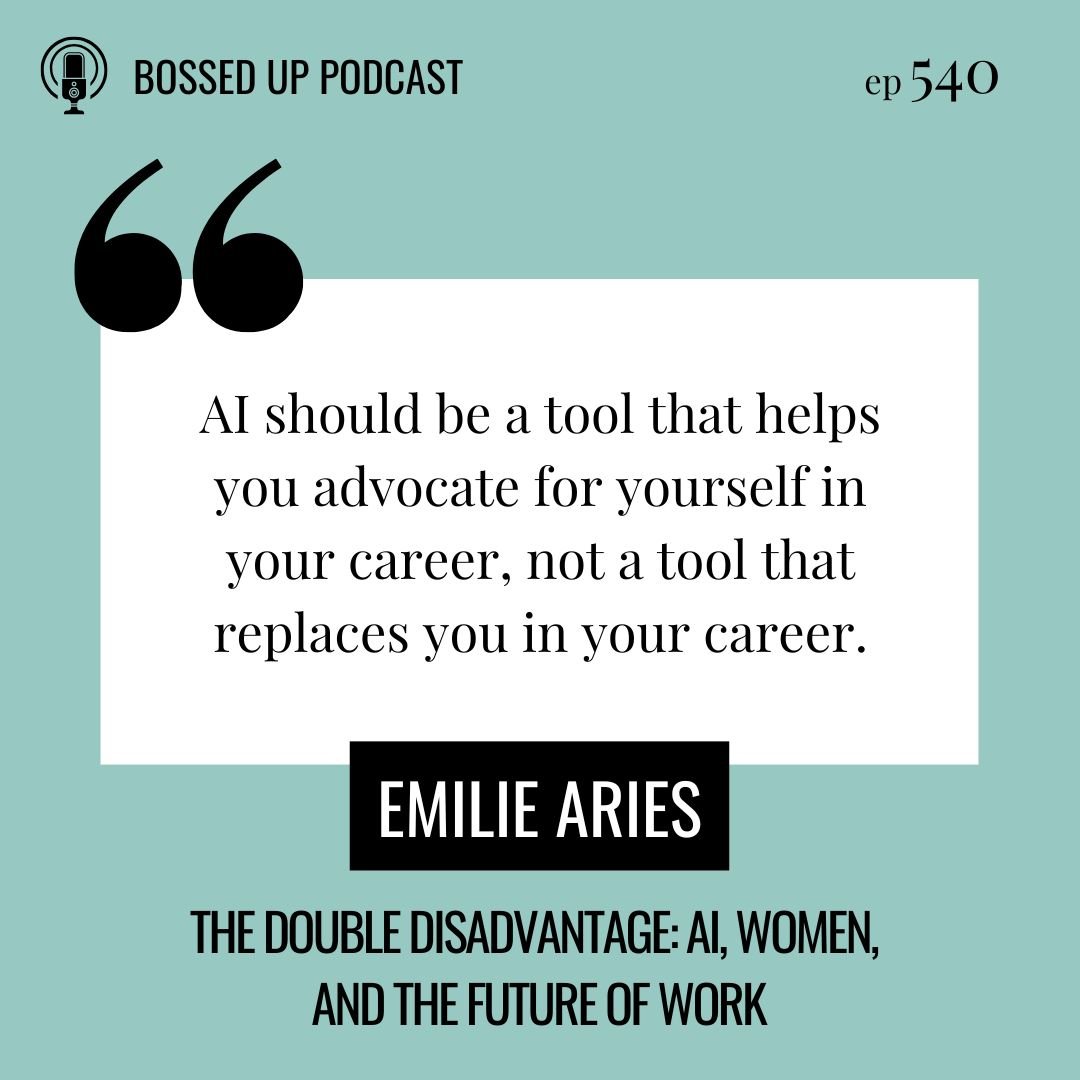
There's also really interesting, fascinating role playing scenarios that LinkedIn Learning has developed with their AI tools embedded into the course itself so that you can start experimenting with those tools as you go through the course. Because I believe that AI should be a tool that helps you advocate for yourself in your career, not a tool that replaces you in your career.
So check out my course via the link in today's show notes. Today I've actually made it free and available to anyone via the link that I shared on my LinkedIn profile. So make sure you're following me or connected to me on my LinkedIn profile personally. And then you can see in my recent post there, I've unlocked the course by sharing it on my posts so that you can access it for free.
Okay, so the double disadvantage, the usage gap, those are the problems. Let's talk about what we can actually do about it. I think about solving for the double disadvantage on three levels, which you've probably heard me talk about here before it Bossed Up. I like to think systematically here. What can individuals do listening to this podcast right now? What can our organizations do? What must they do? And what can policymakers do as well? Now, there's way more to say about this than I have time in today's episode, but this is just sort of the tip of the iceberg.
For individuals listening to this podcast right now, start using AI tools if you haven't already. I don't mean that you need to become a data scientist, and I don't think that every single, you know, task in your life warrants an AI tool. I mean, just open ChatGPT or Claude and start experimenting. Use it to actually experiment with some of your workflows at work. I think a lot of women have been told to use it for grocery list management, and meal planning, and vacation planning, and that's great, sure, fine, use it for all that stuff if you want. But I think the labor market and the economy is going to call upon us to really start thinking in systems as it relates to your work workflows, like the actual paid labor that you are paid to do.
I think it's more beneficial and productive for you to focus your time there in experimenting with how AI tools can help support you in getting your work done at work. Now, obviously, different workplaces have different policies. Check your handbook, ask IT, make sure you're not violating any security protocols. But finding ways to incorporate LLMs, large language models, into your work at work is what I would challenge you to do. Use it to draft an email, to brainstorm ideas, to prepare for a meeting, to research a career move. Start auditing your regular workflows and try to identify where in your regular workday you can experiment with incorporating AI.
The more you use these tools, the more you'll understand what they can and can't do and the more valuable you become in a workplace that's increasingly prioritizing them. Second, don't let ethical concerns stop you from engaging. And I know this is like, this is somewhat painful advice for me to give because I don't want to, I don't want to ask you to compromise on your values. Like, I fully respect that women are more likely to be asking harder questions of AI, and I appreciate that about women. I do. I think frankly, women's voices should be listened to more on that. But opting out of using this technology doesn't make it any more ethical. It just means that people shaping how AI gets used don't include you. So I would think about a both and path forward. Engage with AI and ask the hard questions. It's both, not either or.
And finally, advocate for yourself in this situation. If your company is deploying AI tools, make sure that you're getting trained on them. If roles are being restructured, make sure you're in the room and do everything you can to be in the room when decisions are being made about what comes next. Make sure that women and underrepresented folks voices are included in those discussions because they will help shape the blind spots that are otherwise going to be missed when those big workplace conversations are happening.
Now for organizations, because I know leaders are listening to this too. I encourage you to stop treating your AI strategy and your people strategy as separate conversations. Like, if you are automating roles, if you are looking for efficiencies, act. Ask yourself who holds those roles, right? If you're investing in AI upskilling at work, ask who's getting access to that training, who's more likely to opt into that training? The Anthropic report that I mentioned found the most exposed workers tend to be female and higher paid. These are your experienced knowledge workers. Losing them isn't just an equity problem because that will really undo some of the progress that we've made over the past 20 years in closing gender gaps at work. But this is a business continuity problem at its core because that institutional knowledge is going to walk out the door if we replace those roles with AI bots.
Furthermore, make sure your organization is setting really clear expectations for AI use in the workplace. Koning's Harvard Business School research suggests that when companies don't give explicit guidance about how to use AI, women are much more likely to hang back, while men experiment with those tools in the shadows. So create permission structures, offer training, make it clear that AI use is encouraged, not suspect, because that's going to make it much more likely for rule following women. We know women are more likely to follow the rules. Yes? To actually proceed in diving into this kind of experimentation.
And finally, this is a big one that I can't do justice right now, but would love to talk more about. Audit your AI tools for bias. A Berkeley Haas study of AI systems found that 44% of them exhibited gender bias, everything from like, hiring tools to voice recognition to financial services. So if you're using AI in hiring, performance reviews or workforce training, you need to be asking what is inside those systems and what are the ramifications for using them.
And finally, for policymakers, we need more transparency requirements for AI tools, especially those that are used in highly sensitive decision making processes like employment decisions. We need investment in workforce transition programs, programs needed to account for the gendered impact of AI displacement. And we need to be collecting better data on who's being affected so that we're not flying blind throughout this process, as per usual. I am proud to share that Colorado is at the forefront on this issue yet again. Colorado, until very recently was the only state in the country to have passed a first of its kind AI anti-discrimination law. Although I just read maybe a week ago that New York State has followed suit and maybe there's, there's one in California as well, I believe.
And our law is actually not being implemented on time due to some drama happening between the governor's office and the legislature right now. So this is a very active story happening right now. But the Colorado law regulates that high risk AI systems that are a substantial factor in decisions around employment, education, loans, government services, health care, housing, insurance and more, that they are held to higher standards around transparency in decision making processes.
Now, as I mentioned, the implementation has been delayed, but we're watching this play out in real time and I'll be keeping you updated on what it means for Coloradans, for workers across the nation and for women in particular. In fact, stay tuned because I am organizing some events both in Colorado and virtually that feature policymakers, tech professionals, technologists, ethicists and more to talk through how these decisions are being made in real time.
So here's what I want to leave you with today. The fact of the matter is AI will create the next economy. And the question I'm asking is who gets to be a part of it? Just yesterday I stumbled upon this clip by Tressie McMillan Cottom, who I think sums this up absolutely beautifully. Here's what she said,
[AUDIO CLIP OF TRESSIE MCMILLAN COTTOM BEGINS]
TRESSIE: When people try to sell you on the idea that the future is already settled, it is because it is deeply unsettled. And I think about this a lot right now because I think that, you know, this promise of like an artificial intelligent future, as we talk about future, is really just a collective anxiety that very wealthy, powerful people have about how well they're going to be able to control us in the future.
If they can get us to accept that the future is already settled, AI is already here, the end is already here, then we will create that for them. My most daring idea is to refuse the proposal for a post-human future is one where there will be human beings who will just be treated inhumanely. We're not gonna stop making people or humans. They're just saying we're not gonna treat you as humans. And I refuse.
And I think that we all can. I think that being black is an act of refusal. I think we know how to refuse. I think everybody else needs to learn it from us. I think refusing is actually the more hopeful, expansive vision of the future. Than the one that is telling us that the future is already settled and decided. That's my daring idea. Just say no.
[AUDIO CLIP ENDS]
EMILIE: So it's clearly an abbreviated clip from a longer panel discussion that she was part of, but, man, does she make a great point here. Like, we cannot accept that the future is inevitable. I've been feeling somewhat fatalistic recently about, oh, my gosh, we're all going to be left behind. This is going to cause so much pain. And then I hear from others in the AI space. I went to an AI event last night, and this woman was like, oh, see, I think this is going to be, you know, the key to unlocking equity for us all. And I was like d***, we're on different sides of a spectrum of some kind, but the truth is somewhere in between.
Like Tressie is saying, like, we cannot just passively and tacitly accept the premise that this is inevitable, that we are going to be displaced and replaced and treated inhumanely as a result. And we need to actively shape what the future of our workforce looks like. I've spent over a decade helping women to be their own best advocates in the workplace, and I'm here to tell you that the workplace is changing faster than ever, right? The ground is shifting beneath our feet. The skills that got you to where you are today may not be the skills that keep you here. And frankly, the biggest risk right now isn't AI taking your job. It's standing still and clinging to the present moment while everything around us changes.
So my challenge to you is this. And this is really where I'm going to be taking this podcast now and taking Bossed Up next. We got to start learning. We got to start experimenting. We got to keep asking hard questions as we go. Questions about your company's AI strategy, about who's benefiting and about who's getting left behind. And questions of our lawmakers and the technologists behind these big companies who are shaping the future by shaping how this technology works.
And let's keep talking about it, because I'm going to keep digging into this. Thank you for listening. As always, I want to keep the conversation going after each episode. There's lots of show notes to dig into. If you want a blog post that summarizes today's key points and links to all the great studies and research that I cited today, head to bossedup.org/episode540. That's bossedup.org/episode540.
[CONFIDENT RHYTHMIC DRIVING THEME MUSIC STARTS]
Join me in the Courage Community on Facebook and or the Bossed Up Group on LinkedIn to keep the conversation going as well. I'd love to hear what you make of this discussion. And until next time, let's keep bossin’ in pursuit of our purpose, and together, let's lift as we climb.
[MUSIC BUILDS THEN FADES AND ENDS]