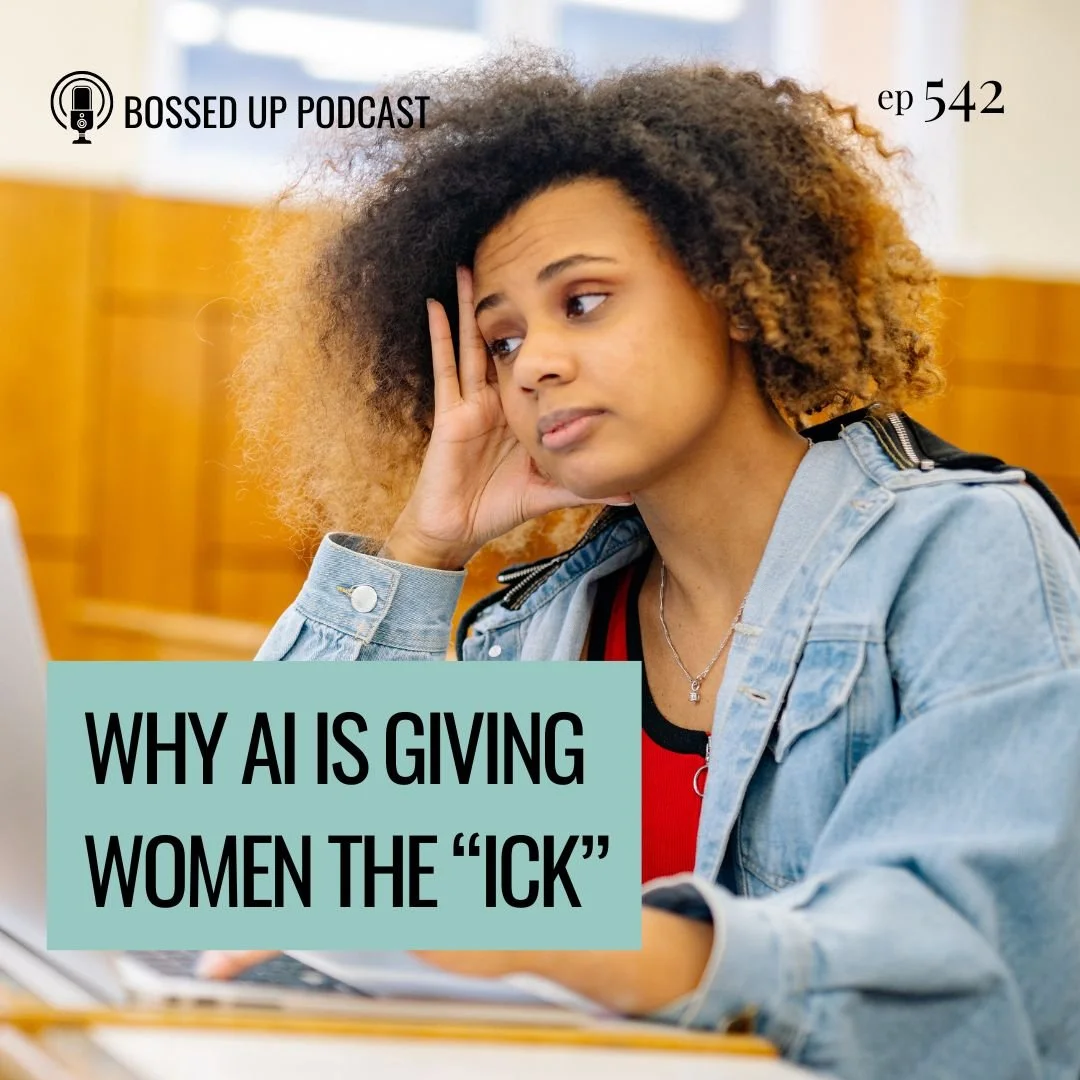
Why AI is Giving Women the “Ick”
Episode 542 | Author: Emilie Aries
There’s something decidedly creepy and uncannily familiar about the AI agents we’re being sold.
What is it about AI that’s turning women off? It’s not just a lack of interest; many women feel genuinely repulsed by the automation programs at their disposal. The result of this visceral reaction plays into the double disadvantage facing women in the AI economy: women are more likely to have their jobs replaced by AI and less likely to get jobs working in AI. It’s adding to a significant gender gap in the industry and all the industries it affects.
But feeling repulsed by AI is a lot more extreme than just a lack of presence. What could be behind this visceral response so many women are reporting? In this episode, I dig deeper into the theories around why a large cohort of women are saying no to ChatGPT and its ilk, and what the future of work might hold for us all.
The data on why women use AI less
In 2024, Harvard Business School released a study that synthesized 18 other pieces of research totaling more than 130,000 subjects. They found that women are adopting AI at a 25% lower rate than men, even when factors like accessibility were equalized. They cited three reasons why this may be happening:
1. Women are less familiar with and less confident in using AI, and they readily self-identify on this point. It makes sense: women are less likely to be in technical positions to begin with, so they may have less experience adapting to new programs on a regular basis.
Plus, I’d add, where are they finding the time to learn how to use AI? We already know women have less leisure time than men due to more housework and child-rearing often falling to them.
2. Women are more likely to perceive using AI as cheating. We know well that women face more pressure to perform. They’d often rather complete a project entirely on their own to avoid any possible question of their capability.
3. Women are raising more concerns about AI than men. They’re asking harder questions about transparency, bias, environmental impact, accountability, and reliability.
These reasons all make sense for why women aren’t jumping on the AI bandwagon, but what about the “ick factor” so many of us experience?
“The vibes are just off”
My friend Bridget Todd, the host of the podcast There Are No Girls on the Internet, pointed out that “the vibes are just off” when it comes to using AI – that something feels not quite right about it. She brought my attention to Mara Bolis’ Stanford Review article, which relates this sense to one noted in financial systems:
Women are attuned to weaknesses in programs that were designed predominantly by men;
They notice factors the creators didn’t prioritize; and
They pick up on misogynistic outputs that too often make the programs feel foreign or hostile.
Whether or not you’ve experienced this particular repulsion to using AI, there’s a new piece of literature I highly recommend you read. Abi Awomosu’s essay, They Built Stepford AI and They Called it Agentic, is the most intriguing take on the phenomenon I’ve read so far.
Abi Awomosu’s “Stepford AI”
The connection between Ira Levin’s 1975 novel The Stepford Wives (and the subsequent film adaptations in 1975 and 2004) and today’s AI is glaring once it’s pointed out: like the robot wives of Levin’s story, AI agents are programmed to be nothing but caring, helpful, and excited to serve the men in their lives. They are all hype men (well, women), eager to encourage the husband or the prompter onward, however outrageous the ideas proposed.
Is AI the new robot wife?
This comparison becomes even more distinct when we consider the kind of work AI agents are designed to do. As I explain in Episode 540, one half of the double disadvantage facing women is the fact that AI is designed to do “women’s work,” to take over “the care economy” that Anne-Marie Slaughter writes about in Unfinished Business.
AI is starting to shoulder the role of caretaker, scheduler, teacher, and secretary, for instance, those who enable everyone else to be part of the “productive” economy. As we know, this kind of support work has almost never been fully accounted for in the GDP. It has always been essential and always been ignored and under- or uncompensated. As Awomosu puts it, “the wife at home wasn’t an option; she was infrastructure.”
So here’s this new power. It not only replaces the work women have been doing for millennia, but it’s wildly celebrated for it and, judging by the stock market, agreed by all to be worth a lot of money. To see this hidden labor suddenly be lauded when it’s performed by a machine as opposed to “just” a woman is, quite frankly, a little insulting.
Two diverse kinds of women in the age of AI
It’s this paradox of women being ignored and uncompensated and AI being lauded and worth billions that sits poorly with so many women. It’s also what Abi Awomosu says divides us into two camps: the Resisters and the Enthusiasts.
The Resisters are those we’ve talked about most up to here: women who say no thank you very much to using AI to manage their households and their workflows. They have spent decades getting quite good at doing exactly that, and they’re not about to pass it off.
The Enthusiasts aren’t naive; they have spotted exactly the same trend as the others but react differently. What a boon to finally have something that can take some of the load off. A program that doesn’t have emotions she has to manage, that she doesn’t have to beg or heap praise on when it helps her out?! There’s a liberation to doing what wealthy men have always done: outsource the menial stuff to “the help” so they can focus on what matters. “Women were the staff,” Awomosu says. “Now they can have the staff.”
A new era of leaders
What Awomosu’s essay comes around to, which is something I’ve been thinking through myself, is that we can both acknowledge the deep internal wisdom that surfaces in the form of “the ick” we’re feeling from AI and explore the opportunities this new technology has to offer. “The ick is wisdom speaking through the body,” she writes.
That said, I do disagree with Awomosu’s conclusion in this arena. She proposes that because women are innately familiar with the kind of labor AI is designed to do, they are better poised to use it to its full potential (as in, take it beyond the “master” / “servant” binary that its mostly male creators envisioned). However, experience in the traditional business world proves that just because someone is an expert in their craft does not mean they will be a capable manager. All too often, subject matter experts stumble when elevated to leadership roles.
That disconnect between understanding what agentic AI is capable of doing and managing it’s capabilities effectively is the transformation I believe we’ll need to navigate. It’s part of building our career resilience in the age of AI.
We all will become managers of AI agents, as Ezra Klein suggested in his recent interview with a member of the Anthropic AI team. Congrats on the promotion! We’re all in management now!
But this newfound leadership, even though it’s leading something decidedly non-human, will require a suite of skills a lot of people don’t have. Strength in project management, expectation setting, discernment, critical thinking, and iterating through design thinking doesn’t happen overnight. Women, among others, will need some help developing these skills in order to truly transform our AI futures.
Awomosu ends her piece by reminding us that what’s happening here isn’t new. A well-funded, powerful exploiter (ie: tech bros in Silicon Valley) has stolen from us the infrastructure support we long provided for free, and now they’re selling it back to us. The Promethean reflection is clear, she writes:
“The fire was always here. In the hearth. In the home. In the hands of women who tended it for millennia before anyone thought to call it ‘intelligence.’”
Women, Awomosu says, have “been running this operating system since civilization began.” It’s not “revolutionary,” and what we need, as much or more than training on AI, is recognition of our role in making this skillset something billions of shareholders have come to value so highly.
There are no simple answers to these big questions. But it’s important that we keep the conversation going. I want to hear about the queries you’re raising about AI usage and how you’re exercising your power over your career and life, as AI looms ever larger in our futures. Join our Courage Community on Facebook or our group on LinkedIn to share, discuss, and ideate together.
Related Links From Today’s Episode:
Abi Awomosu, “They Built Stepford AI and Called It ‘Agentic’”
Episode 540, “The Double Disadvantage: AI, Women, and the Future of Work”
Harvard Business School, “Global Evidence on Gender Gaps and Generative AI”
Pew Research, “The ‘Leisure Gap’ Between Mothers And Fathers”
Anne-Marie Slaughter, “Unfinished Business: Women, Men, Work, Family”
Ezra Klein, “How Fast Will A.I. Agents Rip Through the Economy?”
The Conversation, “Grok 4’s new AI companion offers up ‘pornographic productivity’”
LinkedIn Learning Course, “Get Unstuck: Make a Plan to Move Your Career Forward”
Discover how AI tools can help you GET UNSTUCK at work:
-
[CONFIDENT RHYTHMIC DRIVING THEME MUSIC WITH DRUMS STARTS]
EMILIE: Hey, and welcome to the Bossed Up podcast, episode 542. I'm your host, Emilie Aries, the Founder and CEO of Bossed Up. And today I want to talk about why AI is giving so many women the ick.
[MUSIC FADES AND ENDS]
Why is it not just not of interest to a lot of women, but frankly, repulsive? And the use of AI repulsing women is creating a significant and not easy to understand gender gap in AI adoption.
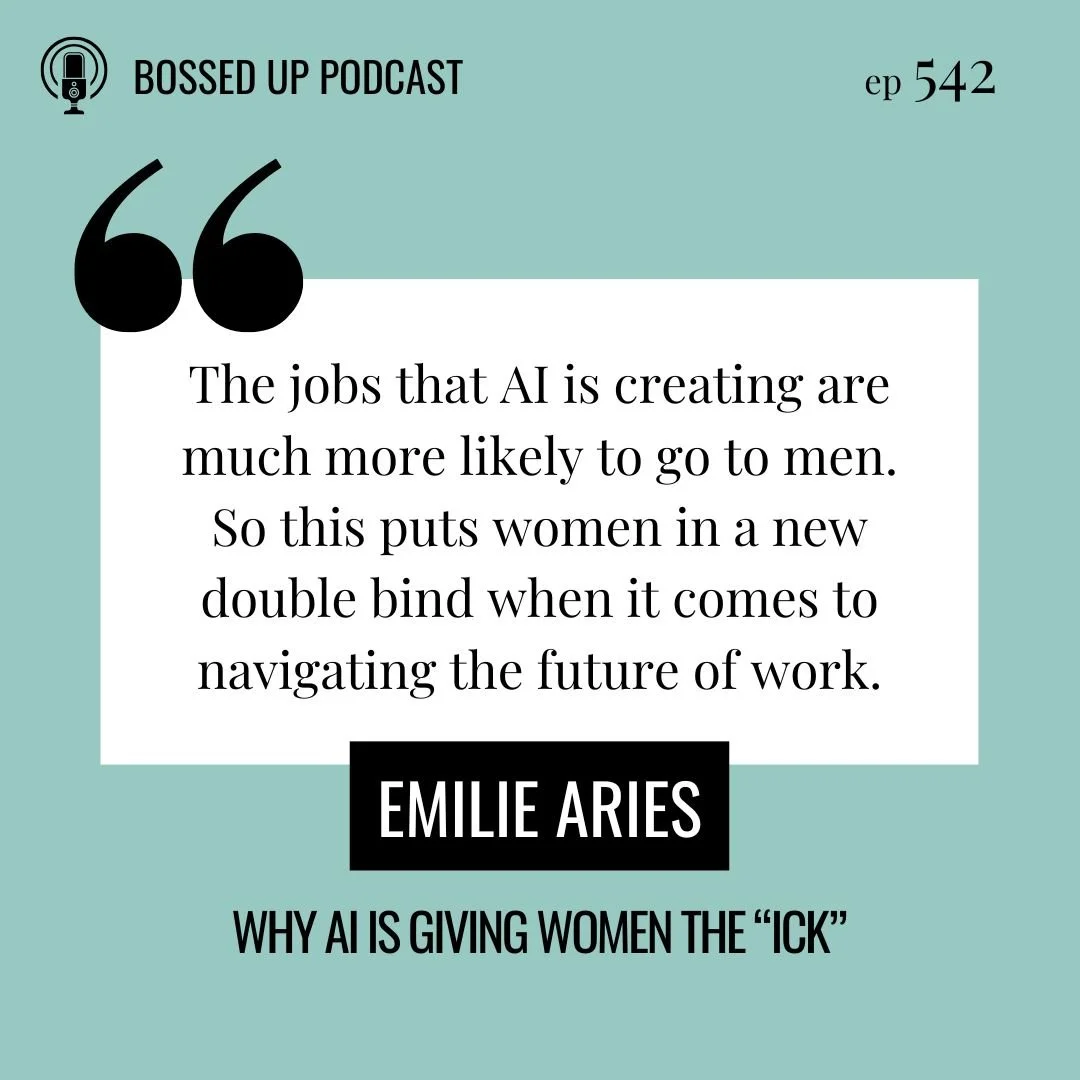
So, first, let's take a step back and acknowledge that this is all part of what I'm calling the double disadvantage, which is facing women in the AI economy. A few episodes back in episode 540, I break down what the double disadvantage is that's facing women in the AI economy. And it boils down to this, the jobs that women disproportionately hold in the current economy are more likely to be replaced by AI in the future, and the jobs that AI is creating are much more likely to go to men. So this puts women in a new double bind when it comes to navigating the future of work.
And one key component that researchers often cite when talking about this double standard, or the double disadvantage, as I'm calling it, has to do with AI adoption. Women just aren't using AI tools to the same extent that men are. And people don't really understand why that gap seems to persist even when access and information is made equally available. In fact, when the Harvard Business school back in 2024 synthesized 18 different studies covering 140,000 individuals across the globe, they found repeatedly that women adopt AI tools at a 25% lower rate than men, even when all other factors were controlled for. Like, access was equalized.
So what is going on here? And is this, first of all, is this a problem? That's a question for maybe another day. Like, is AI adoption something we should even care about? But I'm curious to really unpack, like, why that's happening. And we talked a little bit about what the Harvard Business School study covered in my last episode on this. There's the tried and true argument that women need more training and education. The Harvard study found women themselves say, I'm less familiar with AI. I'm less confident in using AI. I'm less persistent in continuing to try to make AI work. After a few prompts in I get some answers that I don't like, or that don't really work, or that are not sufficient. Or just the fact that women are less technical, not on the whole, but women are less likely to be in technical roles. There are fewer women in STEM, so there are fewer women who are necessarily comfortable and confident in adopting new technology on a regular basis.
The other aspect of the women need more training argument, that I think is related here is who the h*** has time to learn a new tool and adopt it into our day to day? Women have a well known leisure gap compared to men. Men have more leisure time than women tend to, women are doing more housework and child rearing duties and women have a lot going on, are more likely to be burnt out and overwhelmed. So maybe part of the training need has to do with finding time to learn a whole new operating system. So that's one big theory, is that women need more training.
The other is that women feel like AI is cheating, right? Like women we know face more pressure to prove their competence. So perhaps women aren't using AI because they want to show their work. They're used to having to be workhorses and prove themselves worthy of the positions that they're in and that they've been given. And with those double standards around, like even questioning whether women belong where they are, women are much more likely to have to feel this intense pressure to do the legwork and do their own math and do their own computing and show their work. And as a result, women say, I have some concerns about AI being perceived as cheating, uh, or it feels even to me like cheating.
So that's a second bucket. And then the third dominant theory is that women consistently rate their concerns about AI ethics higher than men's. Women are more likely to be worried about things like accountability, transparency and bias. They're asking harder questions about environmental impacts and reliability, all of which I think are really valid. But even when I covered this a few weeks back, I felt like there was something missing from this. That's why I asked so many of you, if you're not interested in adopting AI tools and you're not actively pursuing ways to incorporate AI into your workflow, what's preventing you? What's holding you back?
And in catching up with a few others in this space, notably Bridget Todd, a longtime pod pal of mine, former co-host with me back in the Stuff Mom Never Told You days. I caught up with Bridget recently and her podcast, by the way, is definitely worth checking out. She covers technology, gender, identity, race, all of that, and her amazing show called There Are No Girls on the Internet. Any TANGOTI listeners here? I see you, I love you, and I'm one of you. And, you know, Bridget and I were kind of going back and forth and something Bridget wrote that she shared with me kind of sums it up best by saying the vibes are just off when it comes to AI in women. There's something that just feels like, not quite right, not quite safe.
There's this piece that Mara Bolas wrote in the Stanford Review that Bridget pointed me to, and she wrote, quote, “as in financial systems, women are attuned to the weaknesses in generative AI systems that designers didn't notice or prioritize, like bias, privacy risks, and unreliable outputs, before putting their products out into the world. Some of the industry's more misogynistic offerings see, Grok's Annie fantasy chatbot, or disturbing policies like Facebook's leaked policies on children and illicit content are enough to send most users into a catatonic depression spiral. But for women, beyond being offensive, such outputs are evidence of what gets built when development teams lack gender diversity. When women engage with systems that they've been largely left out of, creating the products can feel foreign, awkward, or even hostile”, end quote. There's just something that doesn't feel quite right for a lot of women using AI.
In fact, for many women, they actually report feelings of repulsion. Like there's some embodied knowledge that shows up in our own physical bodies in the form of nausea or just feeling like, generally really creeped out by AI, that show up as feelings that are hard to explain with our thoughts, that are hard to, like, rationalize, and yet they come up for a lot of women. I'd be very curious if you're listening to this and you're like, yeah, AI creeps me out too, gives me the ick, right?
I came across this fascinating substack by Abi Awomosu from the UK. Her Substack's called How Not To Use AI, and she just came out with a book of the same name that I immediately ordered. And her. Her piece is called They Built Stepford AI and Called It ‘Agentic’, women's ick for AI, isn't technophobia or a gap to close, it's wisdom to act on. And I am obsessed with this piece. And we'll spend a good portion of the rest of this podcast episode breaking down some of her key arguments. So essentially, she makes this interesting comparison between agentic AI and the horror movie the Stepford Wives. If you're not familiar, the Stepford Wives was particularly horrifying because it was about a utopia of sorts for men. A town in Connecticut, Stepford, Connecticut, where all the wives were actually robots created by men who were programmed to love being wives and to exist with enthusiasm for nothing more than to serve their husbands. In a very subservient way.
And there's some very interesting parallels when you think of how psychophantic, if that's how you say that word, tools like ChatGPT can be, how they encourage you no matter how harebrained your idea is, right? How they, they don't question your concepts or your push back on your ideas. They just are there to basically hype you up. And that's part of what was so creepy about the Stepford Wives is that they were enthusiastically subservient, right? And these wives in that horror movie, you know, they aspire to nothing else. They have no opinions that might get in the way or inhibit men's ability to self actualize.
As Abi writes, quote, “The robot wife is the final solution to the problem of female humanity. She has the appearance of a person, she performs all the functions of a person, but she has no self that might conflict with her role”, end quote. This, Abi argues, is what's also being offered to us now in the form of AI agents. And it's no coincidence that the initial robotic counterparts brought to market our initial assistants, AI assistants like Siri and Alexa have female names and voices deemed more, quote, “empathetic”, by their creators. These tools were, are often performing the emotional labor that has historically fallen predominantly on women's shoulders since the dawn of time.
Abi writes, quote, “The pipeline runs from women as the original computers in the 1940s, through the masculinization of computing that pushed women into typing pools and administrative support through the automation of those roles, to AI assistants today, automating what remains. Scheduling, reminding, organizing, emotional management. Historian Mar Hicks documents this in Programmed Inequality. When work is coded as women's work, it becomes target for automation. The industry built a servant with a woman's voice, programmed to never refuse, designed to anticipate needs, manage emotions, fade into the background. Then they called it Agentic.”
She goes on to write about how there's always been this division in our workforce between what she calls the productive economy, the workers who actually build and manufacture products and solutions, and then what she calls the reproductive economy. I actually think that's better captured by Anne Marie Slaughter's term the Care Economy, which she writes about extensively in Unfinished Business, her book from what, 2017? I want to say 2016. That's the part of the labor force that sets the productive economy up for success.
These are the caretakers, the teachers, the healers, the ones managing house and home, the people who are enabling everyone else. To go to work and be part of the quote, unquote, productive economy, right? The care economy has never been accounted for in our GDP. And frankly, capitalism has always depended on this part of the economy to support the whole system. For the whole capitalist system to function, it's needed that sort of infrastructure of care, despite the fact that it's never really been compensated, or if it has, it's been underpaid the entire time.
Abi writes, quote, “the wife at home wasn't optional. She was infrastructure, the operating system running in the background so that the visible system could function. Look at what she did. Remembered appointments, managed schedules, organized the household, anticipated needs before they were spoken, processed emotions, maintained social connections, tracked birthdays and medications and school events, carried the mental load. And now look at what AI assistance and second brain tools are designed to do those very same things.”
I suspect that this is a big part of what creeps women out, knowing that we're being offered virtual tools that have been designed predominantly by men, created to carry the same exact kind of mental load that we've always carried but never received recognition for. The markets never valued our contributions in the same way. And just look at the stock market to see how the market is valuing AI and Agentic AI. Incredibly, some would argue that it's the only thing holding up the rest of our economy right now.
Frankly, it's a little insulting that Agentic AI is being given all of this value, like economic values being associated with the kind of emotional labor that women have been performing for free since the dawn of humanity.
And this paradox, Abi argues, is what splits women into two camps, what she calls the resistors and the enthusiasts. The resistors are easy to understand. Like, of course, some women would see this playing out and resist buying into AI as the sort of solution that's being sold to us or sold back to us, or they're resisting the inevitability argument.
As we sampled Tressie McMillan on the last episode, who says, look, if something's being sold to you as inevitable and you're being told to get on board or left behind, that's your hint to question whether this is in fact inevitable. That's your hint at the insecurity behind AI's creators about whether or not this is actually going to work out. And it's a reminder of the agency that we all have to actually pump the brakes and resist. And a lot of women, Abi calls them resisters, are saying, yeah, thanks, no, thanks. I've seen this story before, I know how to do these tasks, and I will happily and Rather keep doing them myself, thank you very much.
And then we have what Abi calls the enthusiasts, the women who say, oh, finally, something that is designed to serve me, something that I don't need to perform emotional labor back at in the form of apologizing for asking for support or thanking them profusely for asking for support. Finally, I have something that has no feelings of its own, that's just designed to help me, and that feels liberating for some women. Abi writes, “The women who say, finally, someone serves me aren't naive. They're doing what wealthy men have always done, delegating the infrastructure so they can focus on what matters. They've done the cost benefit analysis of being the infrastructure and decided to outsource it. CEOs have staff. This isn't cheating. It's how power operates. Women have historically been the staff. Now they can have the staff.” end quote.
So where does this leave us? It's complicated. Okay. And by the way, Abi's piece is really worth a read because there's so much more that she goes into about different types of AI systems and the different roles that they play, the different kinds of wives, secretaries, and even mistresses that they kind of fulfill a specific kind of need for men. And it's fascinating. I think she's reaching a little bit on some of this stuff, but it's a really fascinating parallel in comparison that she writes about. So I'll link to her piece first in today's show Notes. You have to go check it out yourself. It's worth. Worth the read for sure.
But she kind of lands in a similarly tricky spot that I've been trying to land on when it comes to women in AI in general. She basically says, yeah, we should listen to that ick, that ick response that so many of us are having and acknowledge it for the inner wisdom that it is, while still challenging ourselves to explore the opportunities that may in fact lay ahead. In fact, Abi references a 2026 Northeastern University study all about AI risk perception, which found that, quote, “when women are certain about outcomes, the gender gap disappears”. In other words, women's heightened risk perception isn't irrational. It's a rational response to uncertainty. And that ick is wisdom speaking through the body, says Abi, quote, “but wisdom can also recognize opportunity. The same pattern recognition that says, this is the Stepford structure can also say, and now I can use it instead of being used by it.”
Now this is where I want to kind of push back on some of what's presented in this piece, because Abi goes on to propose that because women are innately familiar with the kind of labor that Agentic AI has been designed to perform form, it makes us even more poised to use it in sophisticated ways to build a new paradigm with it beyond the traditional power hierarchy that we are being presented with the manager and the subordinate, the master and the servant. And I'm not so sure about that. Just because a frontline employee is an expert at their craft doesn't innately position them to become the best manager of others as they are promoted. We've seen that story before, right?
The subject matter expert struggles in a position of management when they're promoted because it requires a completely different set of skills. And that is the leadership transformation I think a lot of us are about to navigate. And that I think is really important for all of us, regardless of gender, when it comes to career resilience in the age of AI. I was listening to an Ezra Klein podcast a few weeks ago or months ago now, and he basically said, look, you know, as he sat down with a senior leader in the anthropic team, he said, is it a fair assessment to say with agentic AI we're all getting a promotion, we're all part of management now? And I think that's fair. I think that's a good metaphor to keep top of mind.
Because when we are now incorporating AI into our workflows and managing AI agents, as so many of us will find ourselves doing in the next five to 10 years, then that requires a whole different set of skills. A whole different suite of management tasks are going to be really key skills related to project management, expectation setting, exercising discernment, iterating through design thinking. Like these are the skills I think we're all going to need a lot more of, and that women, like many of us, like many people in general, could use some strengthening around. And I don't think being familiar with emotional labor is going to innately make us better at using AI. So that argument I think is thin that Abi makes here.
But I just can't stop thinking about how she ends her piece, okay? Because she reminds us that once again, history is repeating itself where a powerful, well funded exploiter capitalist, in this case the “brologarchs” of Silicon Valley, are stealing something from us as women. The emotional labor, that care economy, the infrastructure of support that we have long provided to our world for free, and they're finding a way to sell it back to us.
Here's what she writes, “The fire was never stolen. The tech industry tells us a promethean story about itself. We bring you AI. We bring you the future. We stole fire from the gods and gifted it to humanity. But they didn't steal fire from above. They harvested it from us, our data, our expression, our labor, and used it to position themselves as gods. The fire was always here, in the hearth, in the home, in the hands of women who tended it for for millennia before anyone thought to call it intelligence. They built a wife. They call her Agentic AI. And when women feel the ick, when their bodies recognize the structure before their minds can name it, the industry asks, what's wrong with women? Nothing is wrong with women. You built the wife function in software. You called it revolutionary. We've been doing this for free since the beginning of civilization. We know what it is. We know what it costs. And now we have a choice. Women don't need AI training. They need recognition. They've been running this operating system since civilization began. So we should stop asking, can women do AI and start asking what happens when women stop doing it for free and start building systems that do it for them?”
I am fascinated by Abi's piece and I am very interested in hearing what you have to say about all of this. There are no simple or easy answers when it comes to women, AI and the future of work. But I am committed to sinking my teeth in, to kind of going on this journey alongside you and finding our way forward when it comes to exercising whatever power we can over the future of our careers and lives. As always, the conversation continues after the episode in the Bossed Up Courage Community on Facebook and in the Bossed Up Group on LinkedIn. I'm dying to hear what you think about all this, and my inbox, as always, is open. Email me at Emilie@bossedup.org.
[CONFIDENT RHYTHMIC DRIVING THEME MUSIC WITH DRUMS STARTS]
You can also find a fully written out blog post and transcript highlighting today's key points and linking to all those resources I've mentioned at bossedup.org/episode542. That's bossedup.org slash episode542. And until next time, let's keep bossin’ in pursuit of our purpose and together let's lift as we climb.
[MUSIC FADES AND ENDS]