Managing Through The Millennial Career Crisi
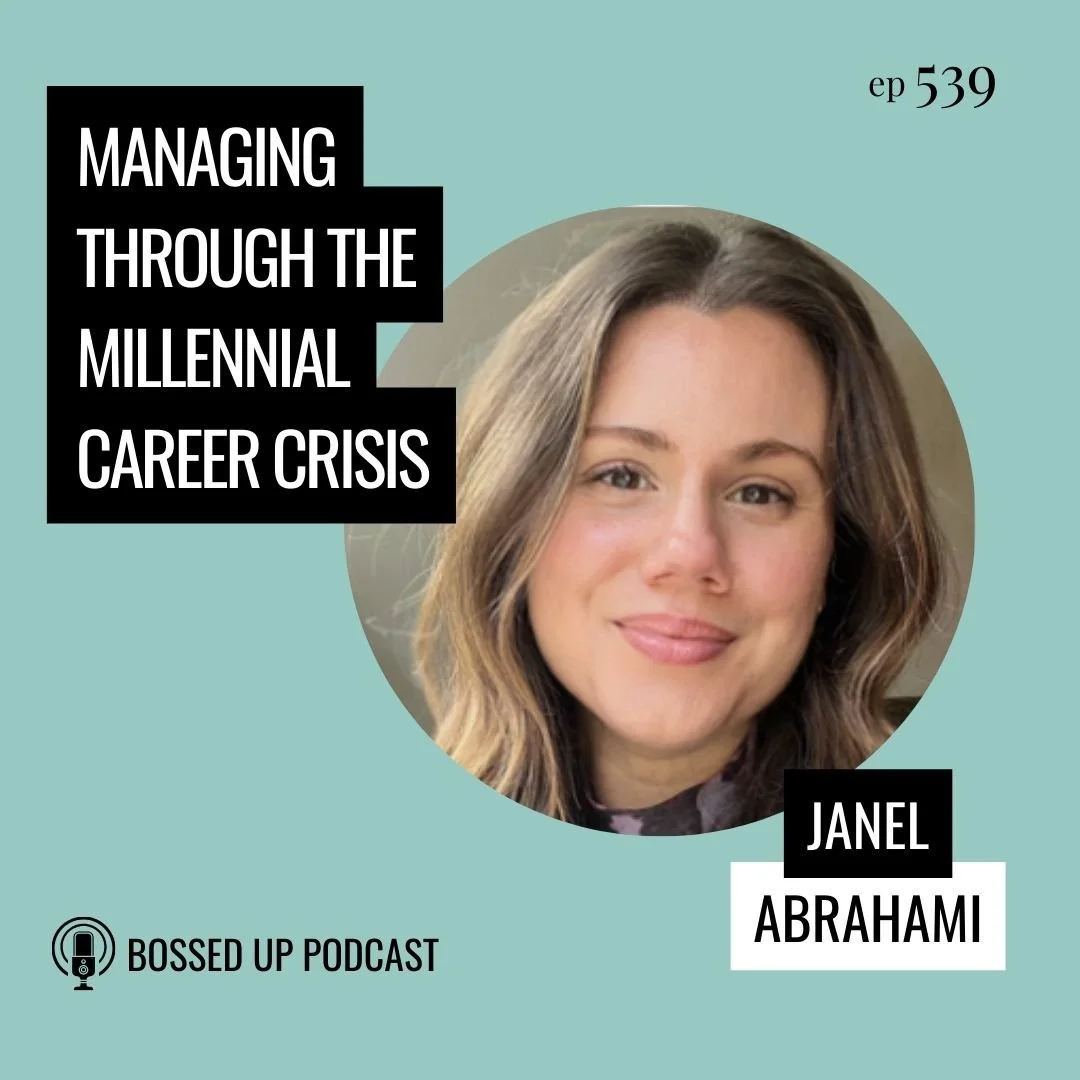
Episode 539 | Host: Emilie Aries | Guest: Janel Abrahami

A whole generation is looking for a better path to sustainable success.
If you’re feeling stuck, or unfulfilled, or disillusioned in your career right now, you’re in excellent company. When I saw that the term “millennial career crisis” trending, I knew I had to chat with the person who got us talking about it to really nail down what this phenomenon is and why it seems to be affecting my generation, especially.
Janel Abrahami is a career coach, speaker, writer, and creator. Her background in organizational psychology and her own career-crisis experience positioned her as the perfect advisor and spokesperson for this worrying trend. After a decade working in corporate HR for companies like NBC and Tinder, Janel realized she didn’t have any desire for her boss’s job or any of the other titles the corporate world could give her.
She started a career -oaching business off the side of her desk, eventually spinning it into her own version of a “successful career,” one that looks quite different from how our parents defined that term. Since then, Janel has helped more than 100,000 millennials find their place in the future of work.
What’s so “millennial” about this career crisis?
Janel attributes the present situation to the pandemic. In 2020, the vast majority of white-collar workers went remote. We got sneak peeks into the sitting rooms of our bosses’ third homes from the workspaces we shared with our three roommates. We saw how much quality work we could get done without our two-hour commute, often in a fraction of the old eight-hour workday.
Those glaring financial discrepancies and time-management inefficiencies were too big to ignore. We couldn’t pretend we weren’t seeing things about our jobs that we didn’t like or that didn’t make sense.
There’s certainly been other times in the past when workers didn’t like what they saw behind the curtain, but, as Janel puts it, millennials are the cohort that’s always been raised to speak our minds. Despite being the most educated generation raised in the hustling girl boss era, too many of us lack the stable social contract our parents had with their employers and the economy at large. In the face of that uncertain future, acute crisis mode is never far off.
Janel’s six choose-your-own-adventure pathways
Thank goodness for career coaches like Janel, who saw the problem—a whole generation of go-getters at the whim of widespread systemic inequality and downturn—and created a solution. Once we accept that most of the factors causing our disillusionment are societal, political, and structural ones outside our control, we can begin to focus on what we do have agency over.
None of Janel’s steps call for wiping the job slate clean and starting fresh. The security, however unreliable, of a “regular” job—health insurance, for instance—can’t be abandoned lightly. Janel herself returned to a corporate gig even when her coaching business was “successful,” because going without great health insurance just wasn’t tenable.
These six pathways go a long way to abolishing the idea that there’s just one version of success, or that you have to choose a corporate job or entrepreneurship. They’re designed to be applied with whatever approach and order speaks to you, to help you find a unique route to satisfaction - both financially and spiritually.
Stabilize
If it feels way too early to do anything substantial to change your career prospects, Janel recommends starting here. Begin by negotiating for the benefits you need to feel secure in your current position. Flexible hours, more money, better health coverage, more vacation days—try advocating for what you need to feel stable before you jump out of the plane without a parachute.
Redefine
Sometimes, the problem is less with where you are and more with where you think you should be. All high-achieving women grew up hearing how impressive they were, how much promise they had. If you don’t feel like you’ve lived up to your own expectations, it might be time to redefine your version of success and what it means to “make it.” Getting on a 40 Under 40 list isn’t the only sign of a career well-worked.
This doesn’t sound as radical as it once did, given all the chatter today around success on your own terms, but it’s still not an easy ask. Before you can start accepting a different reality, you need to figure out what your version of success even looks like. The inspiration and role models are out there, but it takes some legwork.
Strategize
The next pathway is to start building the leverage you need to win yourself more optionality moving forward. Increasing your visibility at work and in your community can have a major ripple effect, such as being asked to lead a particular team, or being able to snap up a new job right away if anything does seismically change.
There’s a big difference between internal and external strategizing, though. You might have been privately assembling a business plan for the past year—but that’s internal. We’re talking about getting out in the world, here. You need to get feedback and start iterating; find people who can bear witness to your exploration.
Build
If you’re farther along in the career re-envisioning journey, maybe you’re ready to start branching out. The Build pathway can look like whatever you want it to (remember, this is all about your definition of success). You might kick off a full-fledged business or launch a course or other type of content that makes you a bit of extra money on the side.
Building out from your unsatisfactory career doesn’t always have to be about making money. The point here is that your name is on it, and your boss doesn’t own it. Even if it never becomes your financial life raft, it could be the emotional buoy that keeps you afloat.
This one made me think of Priya Parker’s The Art of Gathering, and the idea of building the community and, in turn, the world you want to be a part of! Kind of like I’m exploring with my pop-up bakery side hustle, “build” can apply to building your community, too.
Diversify
Speaking of that financial life raft, this pathway is the one where fallbacks come in. It’s the step that explores not keeping all your income eggs in one basket, so you aren’t forever at the whim of one CEO or one market plummet.
Janel argues that this is what real stability looks like now, as opposed to the “company man” of yesteryear. It's the new “9 to 5 with the 401K on the road to retirement,” and as long as we know that, we can work with it.
Rest
If Rest shows up on a client’s list of most-resonant pathways, Janel always encourages it to come first. A leave of absence or a sabbatical could be what makes everything else possible. If you’re pulling up to burnout or already left that station far behind, you’re probably making decisions based on panic or scarcity, and that rarely pays off. Get yourself to a spot where you can choose the next moves with intentionality, not fear. As Jillian Johnsrud said just a few weeks ago on the pod, retire often!
You’re more agile than you think
Janel’s six pathways and entire approach to career coaching remind us that while this era we’re in can feel like everything is huge and out of our control—and much of it is—we do have agency and agility.
You don’t have to squash yourself down into the box of “impressive success” that people from other generations took for granted and foisted upon you. You have the tools to turn your millennial career crisis on its head…there’s just a bit more assembly required than there used to be.
How are you navigating a looming or full-fledged career crisis? Which of Janel’s six pathways resonates most with you, and which one are you going to dive into next? Find support and inspiration in that journey by joining us in the Courage Community on Facebook or our group on LinkedIn.
Related links from today’s episode:
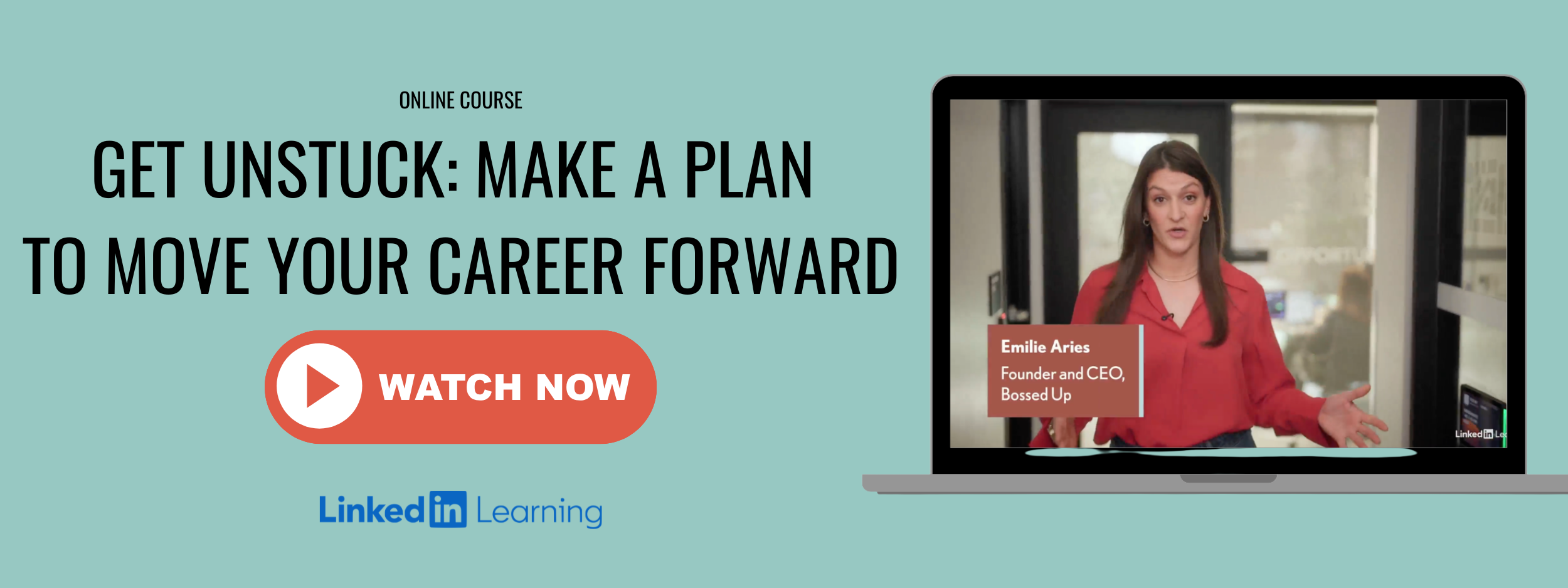
My new LinkedIn course helps you plan your next career move:
-
[CONFIDENT RHYTHMIC DRIVING THEME MUSIC STARTS]
EMILIE: Hey and welcome to Bossed Up podcast, episode 539. I'm your host, Emilie Aries, the Founder and CEO of Bossed Up. And today I am delighted to bring you a fun and fabulous conversation brought to you by my doom scrolling habit.
[MUSIC FADES AND ENDS]
Thank you to the Instagram algorithm for bringing me to today's guest, Janel Abrahami, who is doing phenomenal work and going viral for it. She is the creator behind the trending term “The Millennial Career Crisis”. And today we're going to unpack why this mid life crisis is hitting millennials particularly hard. And if you are among the many millennials or any of our Gen Z, Gen X, Boomer counterparts, we love and also want to make sure feel included in this show. But I know, I know the demographics, y'all. I survey you pretty regularly and like myself, many of you are millennials.
If you are feeling ennui, if you are feeling lost, if you're feeling stuck, if you're feeling unfulfilled, if you're feeling disillusioned, let me tell you, you are far from alone. Today's conversation is going to unpack why this kind of career crisis is hitting now and hitting hard, and hitting millennials in particular, and what we can do about it. Today's guest, Janel Abrahami, is a career coach, writer, speaker, and creator at the forefront of modern careers and ambition, helping over 100,000 millennials find their place in the future of work.
She's a corporate HR veteran at places like NBC Universal, Stitch Fix, and Tinder, and she's got degrees in industrial organizational psychology from the London School of Economics and NYU. She conquered her own millennial career crisis in 2020 and has used that deep personal connection as fuel for her movement. Janel welcome to the Bossed Up podcast.
JANEL: Thank you. I'm so excited to sit down with you today.
EMILIE: Likewise. I'm a big fan of all that you talk about on social media and beyond. And I'm really excited to bring you in to talk about the millennial career crisis that so many of us are navigating. [LIGHT LAUGHTER] Before we jump in, tell us a little bit about how you came to this point in your career and what your story is that led you here.
JANEL: Yeah, it all started with a millennial career crisis. Spoiler alert. Definitely not immune to it myself, even though I have a 10 year background in corporate HR. You would think that if anyone was able to kind of like, sidestep or avoid that whole, like, life collapsing moment, it would be someone like me. But no, it happens to all of us. I have actually been studying work psychology and the reasons why and how we work and choose our careers for 15 years now, which is kind of crazy because I'm still just like a 15 year old girl, so that doesn't make sense. [LAUGHTER] But I started as like kind of a career, a peer career advisor when I was an undergrad at NYU.
That turned into full time roles in learning and development, recruiting, employee engagement at, uh, big places like NBC Universal and Stitch Fix and then smaller tech startups and consulting firms and all of that. And then in this little year that we all remember, 2020, when everything was kind of swirling and all this, like this perfect storm was taking place, I was looking around and realizing like, hmm, don't really like my options to grow this corporate world. I don't really want my boss's job. I don't. Anything else would be just more of the same. So what else could I possibly do if it wasn't this? Because this is all I've ever done.
So I started career coaching on the side, nights, weekends, like doing your little like covert double life, [LIGHT LAUGHTER] and realized that, you know what, I actually don't think there is a corporate job title out there that can capture everything that I'm excited about and everything that I want my career to be and to look like at any given moment. And so, while that's a very exciting prospect, it's also kind of that, may I, like, use some colorful language?
EMILIE: Oh for sure yeah.
JANEL: “Oh s*** man” and being like, okay, but what does that mean? Like, if it doesn't exist, that means I have to create it, me? Like, I've never done something like that before. And so for the past five years, I've been on that journey of figuring it out, embracing the portfolio career model, dealing with layoffs, helping other people navigate layoffs, and understanding that there is no one model of entrepreneurship that we have to follow. And so I just feel like I said a lot of things that all could be their own podcast episode, but that's not here. [LAUGHTER]
EMILIE: Yeah, no, I think that is so relatable. I think back of how we've kind of branded these big moments in the millennial career trajectory over the years and how 2020 had that great re-evaluation vibe to it where we all really were like, kind of faced with mortality, right? And we saw a lot of challenge, a lot of hardship, a lot of illness, a lot of death. As a society it kind of made us step back and look at the bigger picture and reevaluate, especially for those of us who all of a sudden didn't have the commute, didn't have the same infrastructure and constraints in our lives that work historically just came along with.
And so, I think there's a lot of people who are on the same journey who have been questioning big things since then. And I'm wondering what you think is particularly millennial about it, right? [LIGHT LAUGHTER] Some generations will be like, finally, the millennials who were so obsessed with their careers as part of their identity are realizing there's more to life beyond your job. And so I'm wondering, like, you know, what has been our particular journey as women in our 30’s creeping up on 40 here, you know, what is common about our experience there?
JANEL: Yeah, you make a really good point about what was happening in 2020 as a result of all of these, like, external factors. And what you made me think of is kind of like, we couldn't play dumb anymore, and we couldn't pretend like, we weren't seeing other things that we didn't like. And for example, like, I was just talking with another friend about his experience in 2020 and 2021, everyone getting on Zoom and, like, suddenly where your, your CEO was in the conference room with you, now they're in their, like, third home in Tahoe while you are trying to, like, not make noise because your roommate in your studio is also on a call, and you're like, oh, we live very different lives. And, like, we can't play dumb anymore, but also, we can't play dumb that we don't have to be in an office to do really great work. And actually, I can do eight hours of work in two and a half,
EMILIE: Yeah.
JANEL: And it'll be just as good. And, like, we never talked about that anymore. And so what I think is uniquely millennial about this generational career crisis is a couple of things. One that millennials have in our DNA, we just have for our entire lives. So said the thing out loud that perhaps other generations weren't saying. And also our parents or even our older siblings who also went through, like, midlife crises or realized, like, ooh, this career isn't working for me anymore, they still had a pretty stable contract with the economy.
They still were operating under a, like, give and take, a trade that, like, okay, I'll do this full time job and you give me security, you give me the option to buy a nice comfortable house for my family to go on, to be able to afford a couple of vacations, to send my kids to school and to retire comfortably, then all right, then, yeah, it makes sense for me to look for another nine to five, another full time and keep doing the commute, keep giving a little bit more to this system because I know that my return is pretty much guaranteed.
EMILIE: Yes.
JANEL: We do not have that anymore. And so we have to do things differently.
EMILIE: Yeah. That belief in our institutions, right? That social contract as a, as a country, as a world, it's really interesting to see this like great disillusionment happening. And I'm the most patriotic person I know and I really feel like I'm losing faith in that social contract we've made here in the United States, in this idea that like, that you've alluded to income inequality.
I recently spoke with Stefanie O'Connell, a friend of mine, an author also on the east coast, who's talking about how women have been hustling in this lean in girl boss era for over a decade and we're just frozen in time in terms of any progress being made on the gender equity front. So this hard work equals success premise to the most indebted generation to graduate from college. The most overeducated, right? And under rewarded generation. We've got a chip on our shoulders at mid age because we can't afford to send our kids to daycare and continue to work, you know?
And so, I think there is this, this big question that's not only like is this job everything to me that I wanted it to be in terms of my passion and my identity and my ability to hustle for it, but also is that social agreement that belief in my institution still being upheld and those are all under question at the same time for us, right?
JANEL: Yeah, absolutely. Like what do you mean? We all have Master's degrees in PhDs, but I can't afford to freeze my eggs and take advantage of the societal mobility that I was told I would get by putting my money and my time into those things because my healthcare is tied to my employment. And what do you mean I just keep getting laid off and I can't guarantee that I will have that health insurance for enough time to, to take advantage of the reproductive rights that just should be inherent? Or you know, like should have, like say I have chronic illness or an autoimmune disease, whatever it is. It's just oh, the system actually doesn't have my back and it doesn't owe me anything. So what do I owe it?
And that's the kind of reframing that is happening. But then where that leaves us is again. You and I were um, talking about the concept of a playbook before we hit record, it doesn't exist. And so, like, okay, no, I don't want to keep investing in this broken contract that I realize is taking advantage of me. But then what we have not. We don't have good models of what else could work, because it hasn't been done.
EMILIE: Right, exactly. And we're sort of grasping as individuals at a sense of agency, right? So nobody wants to feel subjected to the whims of systemic inequality, but that's what we're doing. We're bobs in an ocean. You know, these massive tides are impacting us. But that is not a very empowering framework.
And so, as someone who straddles that world, as someone with a poli-sci degree, but who. You know, my. This whole podcast is about playing the cards you've been dealt as you change the game. It's like, okay, well, what can I do about that? How can I take ownership, like you have described, of my own career in the face of systemic academic challenge? You put forth your own sort of approach, the six pathways. I'd love to hear more about that.
JANEL: Yeah, absolutely. And so the six pathways are actually within another kind of, like, umbrella structure in that you're so right that we are addressing a lot of the problems, but then that could lead to even more heightened disillusionment if we don't start talking about some kind of solutions. But I think what's very important for any millennial going through their career crisis listening to this right now is that the majority of the factors at play that are causing all of this are not your fault. And no, that is not before any boomer enters the chat and it's like, of course the millennial is not accepting accountability for what's going on here.
EMILIE: You mean it's not how many lattes we're buying from Starbucks?
[LAUGHTER]
JANEL: You know what? Turns out, lo and behold, I could have been having avocado toast every day and no one told me. But no, it actually, most of these factors are societal, political, structural. They are, and also on the organizational level. In order for us to really, really solve the millennial career crisis, companies need to stop looking at individuals like line items. They need to give us actual better layoff hygiene if you do have to conduct layoffs, more decency, more connection to more opportunity, etc. But then it also has to be our like, portable health care. It cannot be tied to our employment. It needs to be universal.
EMILIE: I also just, like, love whenever an HR corporate girly turns into a, like, Bernie Sanders soapbox person. I'm just like, amen. We're coming around. We're making it.
JANEL: Thank you. Yes. And surprisingly, I think a lot of HR girlies are like, Bernie's in disguise. [LAUGHTER]
EMILIE: I know.
JANEL: You know, we do it for the love of the humans in the human. Anyway. Yes. It has to do with, like, making sure that we have health care, that we have affordable housing, that your employment opportunity is not hindered by the fact that you cannot travel to the place that you need to work or that the buses don't go where you live and they can't connect you to your job. Like, all of those structural things are not within your individual millennial control. And so that leaves us thinking like, well, we're doomed. What else are we going to do?
EMILIE: We're doomed. Yeah. I think that's my Gen Z listener who's like, give up the illusion that you will ever own a home. And I have siblings who are a decade younger than me, and I've had now their mid-20s. I'm like, you guys, it's time to start talking about saving for retirement as though you will actually retire someday. We have to have that. So there's a balance to be struck there, right?
JANEL: Yeah, well, I think that's also, like, goes back to your question in the beginning. Like, what makes us very millennial is that, you know what? I think millennials will always have that little bit of hope. Whereas, like, our parents, or older siblings, or aunts and uncles are just like, don't rock the boat. Just be grateful for what you have. It's not that bad. And then our Gen Z, like, younger siblings or like, younger co-workers, are like, f this place, like, it's not worth it. Just, like, totally hedonistic. But I feel like millennials are that, like, no, guys, like, we can change…
EMILIE: Incrementalism, yay.
JANEL: …it might have been that, like, Obama-era optimism. We're like, no, it's possible. And like, I honestly, personally just need to hang on to that. So there are things that we as individuals do have agency over. And so when we're looking at what's in our locus of control, that's where the six pathways come into play.
EMILIE: Okay, break it down. I love it.
JANEL: So we've got, in order of, I guess, how dramatic this change might be. We have stabilize. Path number one is stabilize. And that's where you want to find stability, where you are. Negotiate for the benefits that you really need to feel secure, whether that's other working, different working hours, more money, better benefits. But just state, find stability by negotiating for what you really need so that the rest of your life can, can benefit.
EMILIE: Don't throw the baby out with the bath water. Start where you are. Love that.
JANEL: Precisely. Like, we do not need to make a whole 180. Maybe just advocating or asking for the things you need is what we need to do.
EMILIE: It should not be overlooked because I know emotionally, so many folks I know just want to pull the rip cord and be like, it's trash here. I have to get out. And then they think about it after the fact. And I, I've been guilty of that myself. And there's a better way.
JANEL: There is such a better way. Then we can redefine. And that means redefining your version of success and making it. And I know that that's also like, very buzzy right now, like success on your own terms. But it really just sometimes all you need in order to like, get your footing in this millennial career crisis is releasing. Oh, I should have made a 30 under 30 list by now. Or it's too late for me to do something meaningful. It's too late for me to do something impressive or important. Like, no, it's not. Like you actually do have time. And just redefining what like, making it and being impressive, being successful for you actually means.
EMILIE: Absolutely. I just had a coaching call with a client who went through our HIRED job search program years ago and we have these recurring office hours every month for alums from that program. And she said she's kind of pursuing a portfolio career. She's in an in between liminal period between full time work and she's taking, taking on contract jobs. And she hosted an event as sort of like a pursuit of a community building, profit driven like, business that she was launching. And she said it was kind of a failure. And like we unpacked well what made it a failure? What would have made it feel successful?
And we recognized actually it was really successful in a lot of different ways. One aspect she would have changed, which was having the logistics more handled so that she could be more present to get out of that event what she actually wanted, which was community, connection, networking, not just facilitating community and connection and networking for others. So you're so right. Like coming up with your own rubric and, and re-evaluating that rubric for success can make or break your whole experience of work or a portfolio career.
JANEL: Precisely. Yeah. And that was a great clarifying question you asked your client. Like, what about it wasn't successful? And it turns out that the whole thing wasn't a failure. In fact, nothing was. But there are some things that she could do differently to make it feel better and to play to her strengths. And the next time she will. And just like that, we've turned something being like, wow, I can't. I'm not good at anything. I'm not cut out for this. I suck. Into a, oh, maybe I could do it a little bit better next time.
EMILIE: Rinse and repeat. Yeah. And then try again. Yeah, right.
JANEL: Exactly, exactly. But millennials and our, and the generations before us did only have a very narrow model of success for any given type of path. So this is actually a little bit more radical than it seems on paper because it has been diluted by headlines like, success on your own terms, ambition on your own terms. And that's great. But then if I only have one definition of that, how do I start to come up with a different one? And so that's where this one, a redefine takes a little bit of work.
The next might be strategize. And so you'll notice that these also, all of these three so far, do not require leaving your full time job or like making a huge change, but strategize. This next pathway is where you start to build leverage. And that leverage gives you more optionality and agency in your career moving forward. And by leverage, that means more visibility. People know your name, know what you're great at, you become more top of mind for people in the position to make decisions like promotions, like, hey, we're opening an international office, we want you to go there. Or because you're always top of mind for us. Or hey, we're actually starting this new initiative. I think you should lead this team.
Or hey, I have a podcast and I would love to get your ideas on this because I'm always seeing you pop up on my LinkedIn and has nothing to do with your 9 to 5. But all of a sudden you are building something of your own. It's the strategy to build leverage where you are. And that can be a long game, that can be a slow game. Sometimes it just takes one thing for you to pop off, but it's again returning the agency back to you within.
EMILIE: Yeah, I think one key component of what you just described is the difference between like, internal strategizing versus vocal, visible, external strategizing. So can you speak to that? Because sometimes folks might hear strategizing and say, oh yeah, I've been writing my own business plan for a year.
JANEL: Right.
EMILIE: You know, and I'm like, oh, that might be too long to be strategizing all by yourself. So what's really key about that pathway.
JANEL: Yeah, I think you've hit it on the head and that the key is action and the key is actually getting out of, off of the paper and out of your head and into the real world. Because what that gives you is something to react to, something for other people to react to, something for you to get feedback on and then start iterating. Whereas if, and hey, I spent a year living my double life between building my coaching business and my 9 to 5 job. And a lot of that was okay, how many clients do I need per quarter to make X?
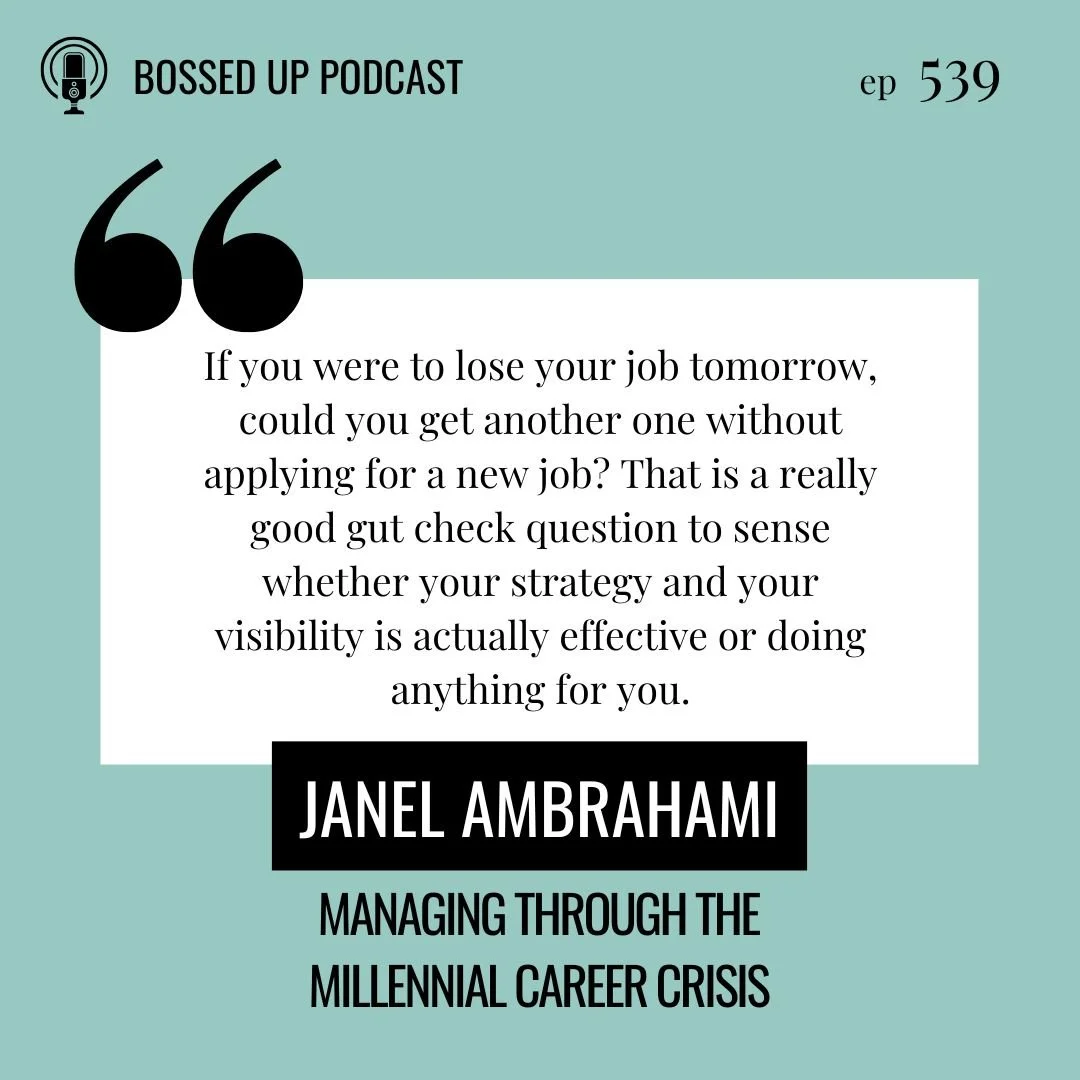
And then, and then that makes I replace my salary. Yes, I get that and that is useful to some degree. But if you were to lose your job tomorrow, could you get another one without applying for a new job? That is a really good like, gut check question to sense whether your strategy and your visibility is actually effective or doing anything for you.
EMILIE: You get other humans involved. Yeah, get another person. You need a witness to your strategizing.
JANEL: Mmm. I like the word witness. Yeah, yeah, yeah, that's good. Because if a tree falls, make a sound. You know that whole thing, that old chestnut.
EMILIE: So what's number four?
JANEL: Okay, so number four is where we start to branch out from that, the status quo. And that might be to build. Start your own thing. And by start your own thing, sure, that could mean your own full fledged business or it could mean creating content that just makes you a little bit of extra F-U money every month. You know what I mean? Maybe it can mean buying a vending machine and installing it in a high traffic place and getting that passive income. Maybe it's like your client building another outlet of community or creativity. It could be a creative pursuit. It could be something that like, isn't necessarily money motivated, but it could be, you know, but the point is, is that your name is on it and your boss doesn't own it.
EMILIE: Right. Yes.
JANEL: That is the biggest differentiator between strategizing and building. When you're strategizing, maybe it's like kicking a new initiative off the ground in your 9 to 5, or it's bringing in your own new business and getting celebrated for that and like being the client lead or whatever it is or an intrapreneur. But at the end of the day, if you lose that job, you lose all of that with it. Building means your boss doesn't own what you're building.
EMILIE: Yeah, I love that. I think every one of us should have a little something going like that.
JANEL: I totally agree.
EMILIE: Yeah, I said that recently to my little sister and she was like, don't ruin my hobbies with your entrepreneurial mindset. [LAUGHTER] I was like, fair, fair. I just, you know, the hustle culture is so baked in for me as a millennial. I think it's just part of how I view the world.
JANEL: Truly, to your sister's point that, like, it could be a creative pursuit, you know, like, maybe it is like, hey, I've always wondered about this collaging thing. Or like I said, like, I'm on collage talk right now, and so my algorithm is giving me, like, crafts and was like, great, I love it. Keep that coming. Like, again, if you got fired, your boss doesn't own your collage station, right? And that could be. Maybe it's not what, like, brings you in that extra income, but that's. It could just be your life raft, mentally and emotionally to carry you through. But the point is that it's separate from work.
EMILIE: Yeah. You're also just reminding me of what's her name? Priya Parker's book, The Art of Gathering.
JANEL: I love that book. Yes. Required reading.
EMILIE: Yeah, absolutely. Required reading. She was on NPR this January, and my husband heard her and mentioned this to me. I have been railing about, like, I'm always hosting. I love to host. I like to keep it casual. I want it to be not too premeditated. Like, hey, we've got some extra dinner on the docket for tonight. Do you want to bring your family over? Like, casual hangout culture. I'm trying to bring that back. And I got really burnt out at the end of last year because I realized, oh, my god, if I don't initiate every single hangout, will anyone ever call or host anything? Because all of my friends seem like it's just not in their second nature. Or maybe they've, like, I've created a dependency because I'm always taking up that space.
So I stopped full, like, cold turkey. And then Brad told me he heard Priya Parker on CPR, a Colorado public radio station here, saying, nobody wants to host anymore. And, like, that's the art of gathering. Like, if you want to be the collage coordinator, right? Like, build can mean build community. It can be, be the one to host. And it doesn't have to be Pinterest perfect for it to be powerful, right? So build whatever the h*** you want to see in the world. Whether it's a you know, I'm working on a porch pop up bakery to bring my neighborhood together. Or writing your next book. Whatever the h*** you want. Like, build the community. And the thing that you wish was in the world.
JANEL: I'm so glad you said that. I'm really, really glad you said that because I don't think I, that would have occurred to me to frame it that way. And it is so. I also think, like, takes so much pressure off of the build thing, you know, like, you don't have to be doing this with a goal of getting on Shark Tank or like, of being like, you know, like a Kris Jenner level, like mastermind, which, like when she ends up hosting a course at Harvard Business School to audit, I'm first in line. But it does not, that doesn't have to be creating the thing, building the thing you want to see in the world. I love that framing. So triple underline.
Once you start building, then you have the option to do path number five, which is diversify. So, perhaps you're not building just to replace, but you're building to have a safety net to have a little bit more at play so that all of your eggs are not in one basket. Again, your livelihood doesn't depend on the whim of one CEO, or one market downturn. But that's real stability, I think, for, for generations to come. Whereas like our previous generations or those who came before us, our parents, our grandparents, stability was that 9 to 5. It was getting the gold watch at your retirement party. It was like, this is my 401k and now I can finally retire and do the things I've always wanted to do. But as we, we called out in the beginning of this conversation is like, that is not guaranteed anymore. That as, that is a false sense of stability. It's a false sense of security. Real stability and security in this economy is diversifying.
EMILIE: Are we the same person? Because I've been saying this for ages. It, uh, sounds like it.
JANEL: Honestly.
EMILIE: I'm obsessed because you're totally right. I think there was this powerful story that Jim Carrey tells that I included in my book ages ago in 2019 when it came out, because it just, it just struck me so profoundly around safety, right? Because so much of this comes back to our basic needs and our. That sort of cave woman instinct to protect yourself, right? And as someone who grew up in economic volatility myself, I was taught, work hard, get good grades equals reward, right? And then as an entrepreneur over the, and just as a human being living in America for the last 25 years, as our institutional faith has declined and plummeted.
I remember being struck by this story Jim Carrey tells, which is, you know, his dad was a, was a standup comic or was someone who loved comedy and always wanted to try his hand at it, but said he couldn't put his family through that. He had to choose a path that was more responsible, sort of in the shroud of. Of the company man culture. And so he became an accountant, and then he lost his job and his family for a couple of years there, really struggled. And young Jim Carrey says, wow, you can give up on your dreams for the sake of safety and still fail, so you might as well go for it, is what his conclusion was. And I was like...
JANEL: Wow. Yeah. Yeah.
EMILIE: …yes. You might as well go for what you want and then not bank on anything. Like, not feel like any sense of stability is a real sense of stability. Like, diversification helps you have more bets on the table, and that, to me, helps me sleep at night.
JANEL: Precisely. Yeah. Jim Carrey's dad sacrificed so he could avoid the worst, and he still couldn't avoid the worst. It still caught up. So what could have happened if he had done that? And I think, I even saw an interview with Jim Carrey afterwards. I don't know if this was related, but I think he was also a big. He is a big believer in, like, the power of manifestation, which I'm a woo woo as well. Like, I'm a woo girl as well. I'm very practical in, like, what has to change, but also, like, sure. And he wrote himself a check for $10 million signed from the universe…
EMILIE: Oh yes, I did hear this.
JANEL: …He had never made that much money on a film before. And then he booked. I think it was Ace Ventura.
EMILIE: Oh, was it? Yeah, yeah, yeah.
JANEL: Yeah, something like that. And his payment compensation is the word I was looking for, for that film was exactly $10 million, and he gave it to his dad.
EMILIE: Oh, my god. Amazing.
JANEL: Chills. I know, right? And it's like also that.
EMILIE: There’s a Jim Carrey rabbit hole. We could go down even further. That gets really weird. [LAUGHTER] But I'll. I'll let my listeners just Google that and check him out because he's. He's had quite an experience over the last 10 years in terms of the paths he has taken. But we'll take, we'll pick and choose what we like from Jim Carrey for today.
JANEL: Totally. Yeah, absolutely. So we've got one more pathway left, and that one is rest. And maybe that is the one that needs to happen to make all the others happen. You know, like putting on your own oxygen mask. And so resting can mean taking a sabbatical, if that's available to you. Taking a leave of absence. I took a medical leave of absence from a job that was. I had already was so far gone past burnout that I just needed that. Or maybe it's an undefined period of time off. But the rest is truly what you need if you are approaching burnout or past that point. If the decisions that you feel like you need to make for your career are based in panic or based in scarcity, that's a really good signal that rest should be the first pathway you take, because then the other ones will be made with intention and not just from fear.
EMILIE: I love that so much. There was a recent episode we did here on sabbaticals that was featuring an author of the book Retire Often, which I just love the concept. Look, if you can't retire early because the fire movement was so niche for such a slim percentage of people are like, yeah, retire early. Sure, 99% of people are like, huh, retire at all would be great, but retire often Is this idea of, like, take the leave you need now as opposed to waiting later. So just to clarify the pathways, I'm sort of envisioning someone at a crossroads with six paths in front of her. Is that how you envision these options? As sort of like, it's not an order to be followed, right?
JANEL: Not necessarily. I think that the beauty of these pathways is that it really is a choose your own adventure. And so what is very likely, though, and how, when I've presented these pathways to real millennials in a career crisis, is that it's likely that two or three are the right pathway for you. And then it becomes a question of your order of operations, which one to take first. If rest is anywhere in there, that's always going to be your first one. But sometimes you are really driven or drawn to building and diversifying.
But in order to do that, you need to strategize first. Like, you need to start building that visibility, because the things that you're excited to build require that. And no one knows that you're great at these things that you're great at yet. And so first you need to strategize. Then you get to step two, step three, pass, go and collect. You know? So the way that we're envisioning it, as a woman looking two forks in the road, but it's six forks in the road and which one's you take. It may actually kind of be like a choose your own adventure book. Like, first flip to chapter three, then flip to four, and then come back to two.
EMILIE: Yeah, I like that because, and also, what you're alluding to is really interesting to me, which is listening to your energy, like, really listening to, let's get woo woo, right? Like, it's not a rational decision of necessarily what is the right pathway. What I hear you saying is like, what am I feeling called to? What am I feeling energized by? And not to ignore that instinctual wisdom, but instead to say, let me listen to this and see where it leads me and not necessarily quit my day job to do it, right?
Like, let's go down some of these paths in an experimental way. Open eyes, you know, without fear. But really like, exploring, not committing, right? When I hear people, either my clients or my peers in the entrepreneurial space say things like, this has to work, I'm like, oh s***, they're in trouble.
JANEL: Mhm. Too much pressure.
EMILIE: Too much pressure. And so, I like that. Choose your own adventure. Gives a lightness to it. It gives a levity and a curiosity mindset, right?
JANEL: Definitely. Separating from like a binary either or choice is really important because that's almost never how it works out in the real world. And to your point, I think it also helps us again, move away from. I can either have a corporate job or be an entrepreneur, but there's so much in between. You know, I have an entire like, visual matrix of all of the things that fall in between the two, like, opposite ends of that spectrum.
But for example, it also gives optionality and agency to the current freelancer, to the current entrepreneur that is still burned out because you and I can be the first to say, like, the grass isn't always greener and like, just the millennial career crisis is not happening in a corporate vacuum. It is happening across this entire cohort of peers and myself and a couple of my other, like, freelance coach consultant entrepreneurs. We found ourselves choosing to go back to the nine to five for a period of time to stabilize. We chose stabilization. And for us, like, or at least in my case, I had been running my career coaching business for almost two years. It was working for all intents and purposes.
So actually, I guess I had to redefine too, because by everyone's definition of working, it was, it wasn't working for me because I was so burnt out. I was unhappy. I was stressed. I was like, I don't want to be the CEO of a career coaching company. Like, that's not what I want. But like I mentioned at our very beginning of our conversation, we didn't have enough. We only had one model of entrepreneurship. It was either like this kind or Shark Tank. And so when I realized like, no, like I need the kind of benefits to like afford really great therapy again...
EMILIE: Yeah, I bet.
JANEL: …or like I just need like the health insurance to not stress about this, I paused my business, put it on ice, and I went back to a corporate job, got laid off from that job. Spoiler alert.
EMILIE: Oh no. [LAUGHTER]
JANEL: But that just proved everything. I was just saying. But like redefining what entrepreneur. Being a great, a good successful entrepreneur meant stabilizing in a 9 to 5 so that I could get back on that like mental health hygiene that I needed and then build something different, which meant entrepreneurship in a different form, a different flavor. Was that order of operations for that time in my career.
EMILIE: That's amazing. I mean you're alluding to so much agility, like there's so much change agility required to navigate all this. And what I want folks to hear is not like, oh god, there's more that I should be doing or should be trying or should be experimenting with, but rather there are so many more options that I may be already envisioning for myself, right? Which is like, how do I practice relinquishing my expectations that have been taught to me my whole life of what success looks like and recognize the ability to be more agile throughout, the course of my career?
You know, I was sharing with you before we hit record here and I've shared with my listeners over the years. I was leading a business for over a decade with full time employees and then I went back to a corporate 9 to 5 and really it was kind of my first corporate 9 to 5. Which is the big joke about all of this, right, is that you've got more options like you can make happen than you might realize. And so feeling stuck is the antithesis of what you're trying to pitch here, right? Like none of us are as stuck as we are perhaps taught to feel in this economy. And I think that's, you know, it's an empowering message in an imperfect sense. Systematic failure, right, that we're, we're navigating here. But I love what you're doing and I love how you're saying it.
JANEL: Thank you. My biggest hope is that this message reaches as many people who really need it. Because sometimes what feels like a no brainer or obvious to us just because like, we're in our bubble of like, work and careers and ambition, blah blah, blah, is revolutionary or totally new and life changing to someone else. And I just hope that this conversation lands on the feeds and in the ears of the people who just like really, really need this right now.
EMILIE: Yeah. Let me ask you one final question before I let you go, which is, what's been the most surprising part of your journey and of all the conversations that you've initiated throughout this process?
JANEL: I have a personal answer, like a self-centered answer to that, and then an outward, like, general answer. The general answer, or as it applies to as many folks as possible and the people that I've spoken with and, and worked with is that, I think going back to that word agility, folks are so much more agile already than they give themselves credit for being. I think they are very quick to, like, I could never do that. Like, aren't you kind of already doing that? Like, what about that? And they're like, oh, that doesn't count. I was like, okay. But those are the same skills and the same, like, action behavior that you need to do this. So you're already doing that well, so, like, oh, why not you?
EMILIE: Yeah.
JANEL: I think what's. What surprises me in that it surprises other people is that the barrier to entry into any of these pathways is actually a lot lower than they want to think or want to believe. And the personal, more like self centered answer is that for all of the big talk and the big ideas that I do about pivoting and reinvention and you're not starting from scratch. You can make a change. So much more is possible for you. I think the big cosmic joke on me is that this is the career that I said I wanted when I was like 17 and applying to college and didn't know if it was possible. [LAUGHTER]
Just like being invited to have these conversations about why and how we work. Like, and I know that sounds kind of unbelievable for a 17, 18 year old to be like, that's what I want to do when I grow up. But like, I believe it trace it back to the exact fresh college freshman year assignment, essay assignment that I had that had to do with like the industrial revolution and work and careers and thinking about my like, immigrant parent and my like, mom who was the first woman in her entire family to have a real job. And it's like, I always want to talk about this and now this is my career. But it looks like the shape and the color that it takes is different, but I feel like that's like a, oh, you actually are where you wanted to start. [LAUGHTER]
EMILIE: You know, I mean, it's the alchemist journey, right? It all leads us back home. I love that so much Janel, it's so beautiful. Thank you for being here, for doing what you're doing. Where can our listeners keep up with you and all the great work you're doing?
JANEL: Yeah, for better or for worse. I am very easily findable on the Internet. [LAUGHTER] For better. I'm Janel Abrahami on all of the socials and I have a weekly newsletter called Going Places where I dive deeper into all of these. Like that's where like, uh, the identity exploration, the thinking, the open ended discussions happen. And Going Places was created for the women like that, like us who grew up hearing you are so impressive for your age. You are really going places. And then we look around at 30 and we're like this place? This can't be the place. So I would love for, for anyone to join me over at Going Places Weekly, subscribe. It's free. And that's where I feel like we're having those really like juicy conversations.
EMILIE: I love it. I'll put links to all of those great resources in today's show notes. Thank you so much for being here.
JANEL: This is a joy for me. I love these conversations. Thank you so much.
EMILIE: For links to lots of resources and everything Janel and I just talked about, including a blog post synopsis version of Janel's key points. Head to bossedup.org/episode539, that's bossedup.org/epsiode539 for more.
And now I want to hear from you as always. Let's go. Keep the conversation going after the episode. In the Bossed Up Courage Community on Facebook or in the Bossed Up Group on LinkedIn. Are you navigating a millennial career crisis? Which of the six pathways are you going to explore next? I'd love to hear how this landed for you and I hope you can hear the like, sound of a budding friendship on today's episode. Janel and I, I think, stuck around for like 20 minutes after I hit stop record today. And we just had so much in common and so much to talk about.
This is living proof that you should chase down your Internet friends and make them friends in real life. I think we have like a million people we want to connect each other with and there's just so many great thought leaders out there on this particular zeitgeist moment of like, what the h*** is happening with women, work and millennials navigating midlife career crises? There is a zeitgeist and energy I feel around this topic that I have not felt since 2013 when I launched Bossed Up. So it's pretty exciting to connect with Janel today and I hope you can feel that energy and love and carry it forward.
[CONFIDENT RHYTHMIC DRIVING THEME MUSIC STARTS]
All right, y'all, let's keep the conversation going after the episode. I'll see you on the Internet is what I said to Janel and I'll say the same to you. My inbox is always open for feedback, it's Emilie@bossedup.org. And until next time, let's keep bossin’ in pursuit of our purpose, and together, let's lift as we climb.
[MUSIC BUILDS THEN FADES AND ENDS]