How to Go From Anxious Perfectionist to Empowered High-Achiever
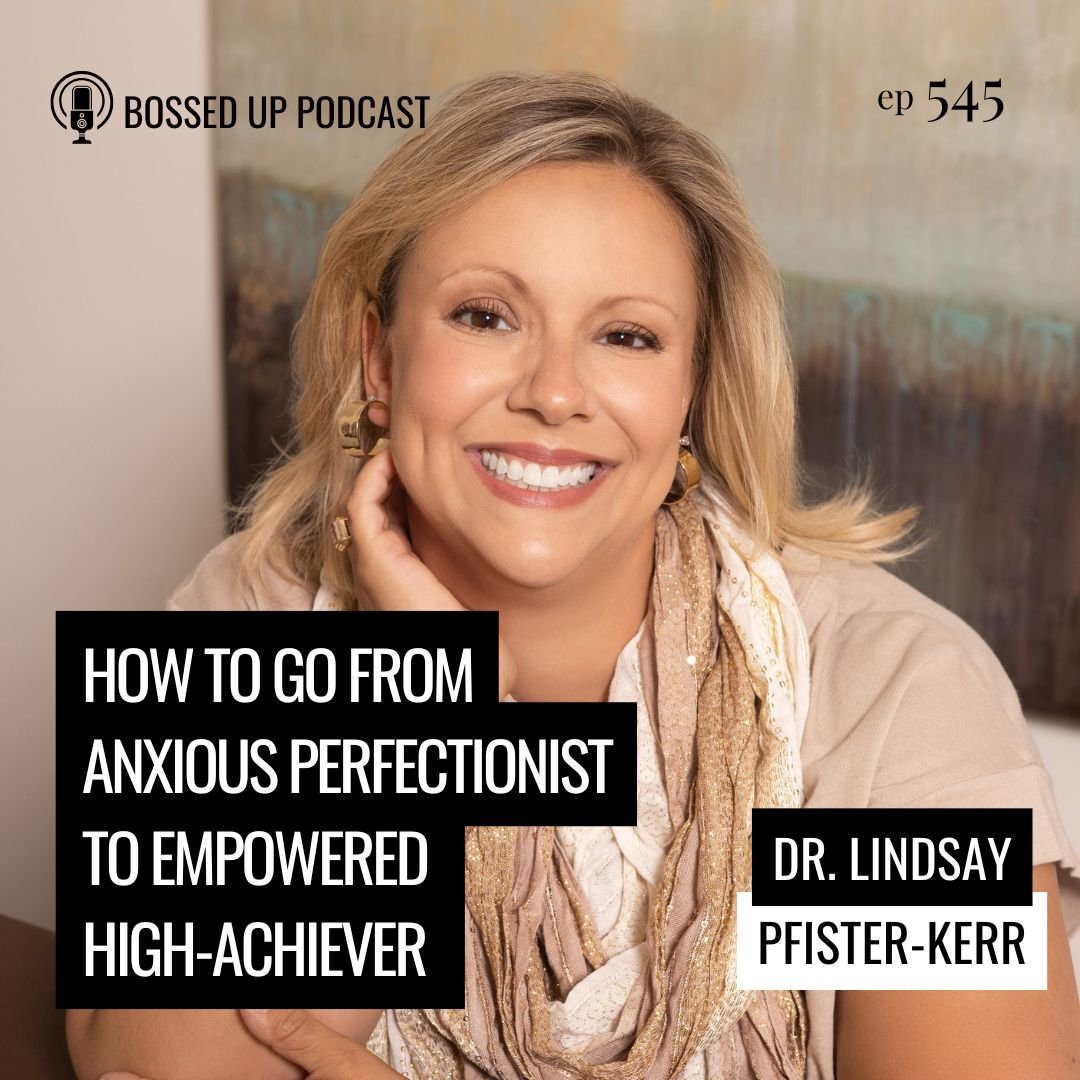
Episode 545 | Host: Emilie Aries | Guest: Dr. Lindsay Pfister-Kerr
How do you manage your anxiety-driven overachieving without losing your competitive edge?
The spiral of the do-it-all overachiever is probably familiar to you. You’re stressed out, maybe burnt out, probably faced with anxiety spirals, and you fear what will happen if you take a step back and stop running full-tilt. Won’t you lose the drive that makes you successful and sought-after?
Dr. Lindsay Pfister-Kerr has been there. She muscled her way through coping with her perfectionist tendencies for decades, until she realized she needed to find a better way. After a high-achieving career in education and human resources, including a doctorate in educational leadership, Lindsay was faced with total overwhelm as her anxiety spun out of control and began seeking out mindfulness techniques and other tools to foster positive change. She recently published a new book chronicling her journey, From Perfectionist to Empowered: A Makeover Guide,and today serves as a coach, writer, and speaker, helping people step out of the stress of perfectionism to embrace intentional, fulfilling lives.
Crossing the line into toxic perfectionism
I wanted to get Lindsay’s thoughts on how we, the anxious perfectionists, can differentiate between high-achieving excellence and the more troublesome, perfectionistic, anxiety-riddled behavior that carries us away. Many people, Lindsay acknowledges, make excuses for themselves. They just have high expectations. They’re just a high achiever. Luckily, Lindsay’s approach to empowerment isn’t about lowering your expectations or turning off that drive to accomplish. It’s about being more intentional about it.
Our super-focused, hardworking nature can move into toxic perfectionism when our whole persona gets wrapped up in the idea that “I must do everything perfectly, no one else could possibly complete this to my specifications, and if I don’t do it flawlessly, I will destroy myself internally.” When our need to do something just right means we can’t move or make decisions about a situation, we’ve crossed that line.
Your perfectionism isn’t just a “you” problem
There’s a caregiver component hard-wired into so many women; it’s unsurprising that realizing how it’s affecting the people they love is what often tips the overachiever’s scale from “sure I barely sleep, have 16 commitments this week and panic attacks every evening, but I’m fine” to “Okay, I need to work on this.” This was certainly true for Lindsay, who finally acknowledged the direness of her anxiety when she broke down in tears as her infant son ate his breakfast and her husband’s concern peaked.
Naturally, we don’t want the people we care about to worry about us, but the impact our overachieving has on others goes beyond the front door. I’ve realized, and Lindsay was quick to confirm, that our coworkers, direct reports, and anyone else who sees us drilling ourselves into the ground over perfection assume we expect the same from them. In truth, we likely hold ourselves to a ridiculous standard apart from everyone else, but that’s neither here nor there if we’re depositing secondhand stress on everyone in our orbit.
The tools that actually make you better at your job
Here’s the shining takeaway from Lindsay’s coaching methodology: you can give up that chest-clenching, gut-twisting, mind-racing need for perfection and remain an impressive, high-achieving badass. In fact, Lindsay argues that more often than not, getting your anxiety and spur-of-the-moment urges under control leads to a better version of yourself.
So often, what blocks people from taking the first step into change is the fear that they’ll lose their edge if they adjust. But think of the state of your nervous system when it’s constantly on high alert, anxiety sparking at every nerve ending, and, sometimes, driving you to make snap decisions without considering the whole picture. Is it any wonder that learning to breathe, take a beat, ask some important questions, and tap into your own inner powerresults in working at an even higher level?
The small, practical steps that lead to mindset change
Self-awareness and intentionality are two of Lindsay’s favorite topics, but at the same time, turning your hyper-focused, perfectionist gaze on the need to change can quickly become just one more pressure you place on yourself. Instead, Lindsay helps her clients find the right entry point, the one that their nervous system is almost as comfortable with as it is with the familiar stress they’re already navigating.
The first gentle step Lindsay teaches is to just start learning. Look into mindfulness practices and see what seems most likely to offer even a small moment of relief. It doesn’t have to be intense. For example, lots of people think meditation is emptying the mind, but mindfulness is simply leading your thoughts, rather than letting your anxiety drive. Practices like the 5-4-3-2-1 method (identify 5 things you see, 4 things you hear, 3 things you feel, 2 things you smell, and 1 thing you taste) bring you out of your mind and into your body, breaking the mental spiral into stress.
Lindsay’s second step is to find the smallest ways to start inserting mindfulness into your day-to-day. After an a-ha moment where taking a beat to look deeper before reacting resulted in a lot less work and stress, she started practicing a new kind of pause button: simple questions. The next time something urgent comes up, before you let your fix-everything-instantly impulse take over, ask yourself:
What’s the reality? (Re-read the email, ask a follow-up question.)
What do I need to know? (Take note of any gaps in your knowledge. Being valuable doesn’t mean knowing everything right away.)
How do I want to proceed? (Based on 1 and 2, which option is really the best?)
Head over to Lindsay’s website to download her printable 3-minute reset, just one small method you can test out to bring a bit of mindfulness to your day.
Transitioning From Perfectionist to Empowered is never about giving up being good at your job. It’s not even about working less. It’s about doing those things from a position of self-awareness and a calmer nervous system. You can still work 14-hour days, take on three new projects, and agree to cook dinner for the extended family this weekend, but do it because you choose to, not because it’s your default setting. The anxious overachiever that lives in your head will thank you.
Are you, like so many listeners, on a journey of overcoming perfectionism and managing your anxiety? I’d love for you to join us in the Courage Community on Facebook or our group on LinkedIn to share your story and the best practices and strategies that work for you, and to take some inspiration from others.
Related links
Episode 333, An Honest Look Into Motherhood and Mental Health
Episode 494, Matrescence and the Transformation of Motherhood
Episode 530, Disability Accommodations: What All Leaders Need to Know
Get HIRED for your dream position
With our job search accelerator:

-
[CONFIDENT RHYTHMIC DRIVING THEME MUSIC WITH DRUMS STARTS]
EMILIE: Hey, and welcome to the Bossed Up podcast, episode 545. I'm your host, Emilie Aries, the Founder and CEO of Bossed Up. And today I'm excited to be chatting with Dr. Lindsay Pfister-Kerr,
[MUSIC FADES AND ENDS]
who brings over 20 years of experience as an educator, leader, and coach who focuses on helping overachieving, hyper functional women who are burnt out, stressed out, and anxious overcome perfectionism and develop resilience. That's certainly a relatable topic for me personally, and I have a sneaking suspicion that lots of you out there listening are going to find this conversation relatable to you, because we're going to talk about the hidden costs of just holding it all together and of holding yourself to such unrealistically high standards. So if you've ever found yourself completely burnt out from holding yourself to such high perfectionistic standards, today's conversation is for you.
But first, a little bit about today's guest. Dr. Lindsay Pfister-Kerr has her doctorate in educational leadership from the University of Pittsburgh. She's certified with SHRM, the Society of Human Resource Management Professionals. And she's also an ICF certified coach. She's passionate about personal growth and mindfulness. She's also completed Dr. John Kabat Zinn's famous course on mindset and mindfulness, Mindfulness Based Stress Reduction.
While her professional experience spans education and human resources, Lindsay now dedicates her time to coaching, writing, and speaking to help people step out of stress and perfectionism, to embrace intentional, fulfilling lives. Her approach is deeply informed by her background in creating equitable systems, empowering teams, and mentoring others to step into their best selves. Lindsay, welcome to the Bossed Up podcast.
LINDSAY: Thank you so much. I'm so excited to be here today.
EMILIE: It really does feel like kind of a full circle moment in some ways, because I'm excited to hear about the transformational journey you've been on, and it's also interesting to know more about where it started. So why don't you take us back and tell us how you got here?
LINDSAY: Absolutely. It's, you know, trying to think about. There's been so many on ramp points that they all kind of converge into one. So, a lot of it started when a friend of mine gave me an idea about a coaching program in 2016/17. She actually never did it. I did. And that started the transformation of connecting me with coaching, connecting me with mindfulness. I had tried it before, and in my mind, I couldn't do it right, so got away from it, had to do it as part of a class. So of course I was going to do it right, being a perfectionist, but then really learned the ins and outs of it, what it was supposed to be, not what I thought and built from there. And then as I was going through, went through that.
And then a couple of years ago I happened to be listening to a podcast and you were on it and I was, I love listening to you. Picked up your book. I think I've shared with you. Your book got me through COVID. I was sitting, had to sit in the parking lot waiting for the results of my test when I had been exposed in a school district I worked in and was like, okay. And luckily never tested positive for it at that time. Yay. But I had to sit there so long and I got through the book and loved it. Which then brought me to HIRED and that was a fantastic program.
But that helped me really refocus what did I want for my career, for my life. And that brought me to starting to build a plan of I wanted to step out in the 9 to 5. I had to work. I knew after having my son and being on maternity leave, if I didn't work, my family would kill me [LAUGHING] or vice versa if I wasn't doing something. But I needed time with him too. I didn't want someone else controlling my time. And so that brought me to writing the book and really developing my own way of helping and supporting people. Both what I've been through and getting them, helping them find what works for them.
EMILIE: Awesome. I really loved reading your book because it picks up right in that moment of like peak COVID times. And you talk about going from a perfectionist to someone who feels more in control of their thoughts, more in control of their over functioning anxious tendencies. And I'm just like, hard relating page by page. [LAUGHTER] And so take me back to what life looked like before you really focused on mindfulness meditation and the coping skills, the many coping skills that you have when it comes to managing anxiety.
LINDSAY: Absolutely. So previously it was in my mind, it was only affecting me. So I could kind of check out, sit and binge watch something and didn't really have to think about, because the only person who had to put up with me was my mom, and God bless her, she's done it since I've been little. So she just worked with me and we moved on and I, I was only affecting me. Was it miserable? Yes. Did I hate the stress of it? Absolutely. But again, I was fine. I was functioning. I, so I was a functioning perfectionist. Who was dealing with anxiety, but it hadn't, I'd hit some peak parts, but it was like, oh, I'm past those.
So the only time it really started to, and as women, we do this when it started to affect someone else. So I met my husband. I was able to keep it in check for a really long time. And then he started picking up on when my anxiety would kick in, and I could still step away a little bit. So, like, when he would go out for something, I could go back to my normal coping strategies. But it really hit a peak when I had my son. And the pandemic hit, and I had to, we got to, I just finished maternity leave. I was back at work maybe kind of three, four months. And then I'll never forget it. We got called into my superintendent's office and told we were going home until we don't know when.
And it was like, okay, no big deal. It's all good. I went home and was getting to be with my son, which was great. I could work, which was awesome. And I was loving all that. But every time the phrase started coming up, like, hey, we could come back in, I would start to panic. But I wasn't telling anyone because I could lock the door, and then the panic would go away. And it, what I didn't realize is how much it was building in the background until, as I shared in the book, I was sitting at breakfast one morning, and luckily, my son is not old enough to remember it. I just started hysterically crying about nothing because it wasn't even in that moment I was feeling the tension. I started crying, and I looked up, and my sweet husband, like, he just had this, like, scared look on his face. Like, he's like, are you okay? And I'm like, no, I'm not.
And I had hit it for so long because they kept moving the date or whatever. I'd get little glimpses of relief. And in that moment, I got up and walked away. And it was. I was like, well, if it's just me, I could work through this, but I don't want my son remembering Mom just breaks down randomly. I couldn't put that pressure on my husband of trying to, you know, fix me or hold me together. And I'm like, something has to happen here. And that was the big turning point for me. Like, before that, like I said, I could break away, do a little detachment. Whatever it was.
EMILIE: Well, you were holding it all together is, like, the image. And you use that terminology a lot. And I think it's so relatable, this idea of like, how much pain can I withstand, how much suffering can I do silently, you know, having a panic attack in the car so nobody knows with anxiety. You mentioned, binge watching TV, which doesn't fit the profile, but I can so understand where that comes from, right?
Like, so this kind of experience of anxiety often looks like you are so fixated on controlling everything and holding all together and then you hit some kind of wall and you got nothing, right? And so for me, it was doom scrolling on social media. And that's part of the reason why social media is not for me. It's just not good for HM me. Like, it's such a drug from a dopamine standpoint for me. I remember in the Pandemic era I had to uninstall TikTok, almost like less than a year after installing it, because I was like, I've lost days to TikTok [LAUGHTER] and I'm like, what is happening? And it was, it was anxiety. It was like the flip side of over functioning.
So can you just tell me more about what that looks like so that the women who are listening who are like, **** is she talking about me? Can just like recognize themselves? And obviously we're not clinically diagnosing anyone over the podcast, but what does that duality look like? The holding it all together and the falling apart eventually?
LINDSAY: Absolutely. You know, and it's funny you mentioned that because there's a ton of clients I work with that, you know, one of the things that actually brought me to putting some things to help people on Instagram was because the number of clients I've had probably in the last six months to a year who share with me, I need to get away from doom scrolling or that that's their go to and what they're trying to get from that. So it's funny you brought that up because that's been such a big thing.
EMILIE: Well, the pandemic is now rivaled by World War three, that we're, you know, we're kind of, kind of living through another global crisis right now. And we're just like, there's no real playbook for coping. And here we are again, you know what I mean, trying to just muscle through it on our own.
LINDSAY: And for me, I think I resorted to TV because I, I'll be honest, I'll show my age. I'm a, I'm a Gen X kid. I grew up. So our, our only real go to was television. So I think that's why for me to check out a little bit, to not have to think, even though my brain was reeling. And then, you know, when Google came around, it was great because I was problem solving, trying to fix it, and so that people wouldn't realize I was looking for, it wasn't quite doom scrolling, but it was trying to find some way to relieve, like, what can make me feel better or how can I check out for a little bit because I just can't do this anymore.
And I think that's why maybe mine was to go to TV was because that's what I grew. I grew up knowing, like, watching TV shows and they gave me comfort. And I was looking for something to feel calm, something to feel like you said, during a time that's very high intense, very worrisome, you want something that makes you feel comfortable. So I would go back to old TV shows I watched as a kid.
EMILIE: Oh, wow. Like comfort shows, yes.
LINDSAY: They really were like. I remember watching, like the Bob Newhart show at night or. And it was like, that was a time I could mentally go back to that was simpler that it wasn't, I didn't have to deal with everything. So it was a way to check out. The challenge was I would go into work. And I remember one of my colleagues saying to me, once, I finally had to admit to everyone in the office, which was the hardest thing I've ever done. I had anxiety. As an HR director I had to ask for my own Americans with disabilities exemption to keep working from home. And because I had to start medication, because the way it was described to me is, you can't cope your way out of chemical imbalance. And right now everything is a threat to you and you don't see anything differently.
And when the one nurse described that to me, I'm like, that I could resonate with because I always said, I'm not doing medication. And when she finally described, she's like, you can't cope your way out of chemical imbalance at the moment. Because I was doing postpartum. And I'm like, okay. So when I went in and I had. I was so worried what my colleagues would think. Were they gonna minimize me? And I remember saying to the one colleague, she looked at me, she goes, you don't have anxiety. I'm like, oh, totally do. She goes, you look like you've got it all together on the outside. You're like, your face doesn't show. And she's like, I wear mine, like on my sleeve. Everybody knows it. I am, like, nervous. And she goes, but you're not.
I'm like, oh, sweetie. I'm like, calm on the outside, hot mess on the inside. I'm like, it's like they didn't see when I'd go in my office and close the door and try and pull together or when I would sit and just, you know, scroll on my phone or sit and stare because I was trying to find something either to relieve what was triggering the anxiety or something to distract from the, I call it like a jitteriness or the feelings inside. So I either wanted to distract or I was going to find that perfect piece of information again. It had to be perfect. And it never landed because there really wasn't anything that could, could do this. Except for me. Except for me doing the work and dealing with what I was going through. But it was either distraction or relief. I'm going to find relief somewhere.
EMILIE: Yeah. And that craving for action, something, right, there's got to be a fix. And then you get so tired and so exhausted from looking for a solution that you just like zone out. And it's so interesting to hear, you know, even as an HR director getting on medication, you know, post, we've done lots of episodes here on postpartum mental health and how postpartum anxiety is huge right alongside postpartum depression. Doesn't have the same branding, [LAUGHTER] but very common. And I certainly experienced an aspect of that myself. And no one would ever say to your face, or at least I hope not, you're not depressed, right?
So how could, like, how interesting is it, how telling is it that someone would say to the HR director, you're not anxious. Because we do think it fits a certain profile. And if you're masking very effectively which high achieving perfectionistic women know how to do, you know, you're right to be wary of the perception and the double standards that were held to.
And so I guess my, what's coming up for me here is, you know, how do you both internally with your own set of expectations and in managing the perception of others, differentiate between like, high achievement and really troublesome perfectionistic anxiety riddled behavior? Because being really good and really on top and the details person and the girl who holds it all together at work is such a common trope. And yet there's a fine line between high achievement and like, suffering your way to those outcomes. So how do you think of those two things differently?
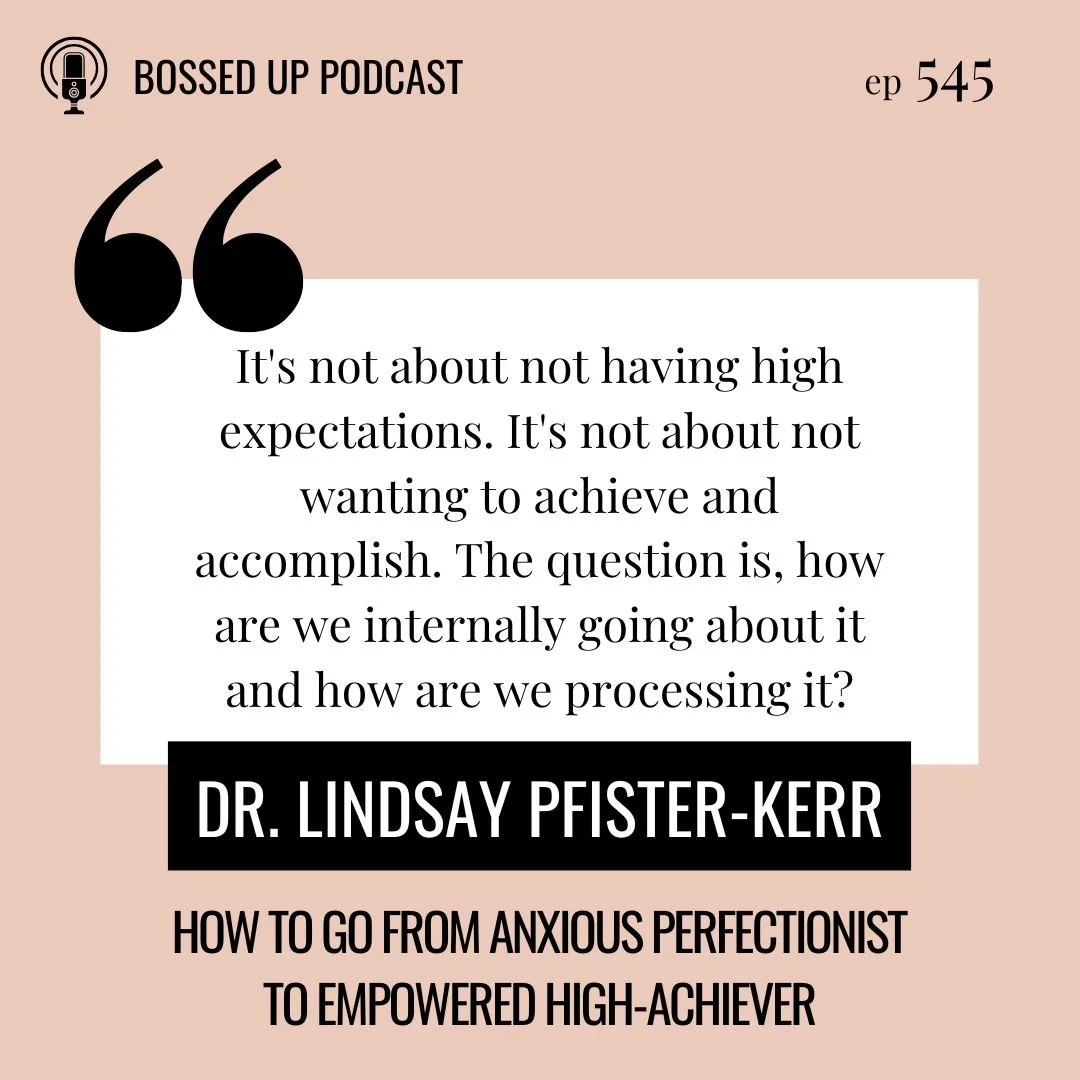
LINDSAY: I love to think about things on a spectrum is always my like, what does that look like? How do I know when I'm moving in a certain direction. And that's funny you ask because I've played around with this a lot, especially with some presentations I've done in women's groups I've talked to, because a lot of people like to say, well, I'm just, I just have high expectations. I'm just a high achiever. And that's not wrong. And the thing I like to really make sure people understand is we're not. When this conversation is happening, it's not about not having high expectations. It's not about not wanting to achieve and accomplish. The question is, how are we internally going about it and how are we processing it?
So when we're in a place of high achievement, we're. If we make a mistake, it's okay. It's truly taken as not just the logic of, I know this should help me to grow because that should where it loves to come in. It's more about, you know, how can I grow? This is, it's truly okay logically and emotionally. I made a mistake. Do I hate it? Absolutely. Do I wish I would have done it differently? We can have those feelings. The challenge is, is we can discern how can I grow, what can I do differently? You know, how am I continuing? Like, it's a positive experience that I'm seeing myself. I'm discerning ways to make myself better, to, to fix the situation next time.
Where it starts to move into toxic perfectionism is we start slowly moving down. And I almost think about it like a slippery slope between discernment down into self-judgment. And now I'm not learning and growing anymore to be better or to, you know, help myself and give myself some, I want somebody one time said self-compassion to me and I must have like, in that time I hadn't done any work on it and I must have physically recoiled from it [LAUGHTER] because the person's like, does that phrase make you uncomfortable? I'm like, I don't know what you're talking about. They're like, if you could have climbed into the couch when I said it, you would have them. Like that just means excuses to me.
And so it, but when we're in that space, we can. Now that I'm better with it, I call it grace because it makes me feel a little more comfortable. But we can have some self-compassion. We can be okay with what happens. And when we start sliding, we can still be starting to move into some perfectionism, but we can still have some wiggle room, like, being a little harder on ourselves a little longer, but being able to come out of it and get back to how can I grow? It gets into toxic perfectionism.
When my whole value is wrapped in I have to do it right. I have to do it perfectly. No one else can do it but me. And if I don't do it right, I am going to basically obliterate myself internally with negative phrases and just completely tear myself down. And now I can't. It's it actually leads to a freezing because we can't do anything because nothing will ever be good enough to do it. And, uh, we have to take a step back and see how are we handling ourselves, how are we handling what we're saying, what we're feeling. And if we're starting to find that we can't move, make, can't make decisions, all those things, we've now become toxic.
EMILIE: Yeah. It's so interesting when you were describing the before you. How you would recoil at the term self-compassion. And when you said, like, it sounds like just excuses to me. I can so. I just like, can so imagine not only myself, but others that I know saying that. And it's like this tough girl mentality of like, I have no compassion for myself. I hold myself to a high standard. It's, yeah, it's hard to be excellent. Like, that's why I'm the way I am. Like, you think this is easy? You know what I mean? I feel underappreciated and how that shows up, we think when we're acting that way, when we're operating in that kind of a system, you know, we think we're just beating ourselves up, right?
But this came up in a conversation with my husband recently where really, like a year ago, I started working with a toddler therapist on, like, parenting challenges we're having with our four year old. And the therapist is for us to be clear, right? Like, how we can be good at parenting. And so much else comes up in those sessions. And one thing that came up that just like, really was a light bulb moment for me. It sounds kind of like your journey too, was when I hold myself to all of these standards, including, I loved your opening. When you were like, reorganizing how my husband loads the dishwasher. I'm like, yes, because there is a right way and a wrong way.
LINDSAY: The world won’t end, I'm telling you. Yeah.
EMILIE: When I act that way, when I can't go to sleep unless the kitchen is clean. right? When I can't calm down, like, my nervous system is triggered unless things are done perfectly right. It creates an environment where everyone else is on edge too. Where everyone else feels like if she holds herself to that standard, she's holding me to that standard. She judges herself in that negative way. She's judging me in that negative way.
And I was like, [GASP] it was never supposed to go that far. This was just me beating myself up. What are you talking about? And it just, it really hit home for me. Like you've been saying that it's not just happening to you, it's perceptible by everyone around you. And it has a real damaging effect over time.
LINDSAY: It does. And, and we think we're holding it together. We don't think that's coming through. And the thing is, is what we would expect. And, and like you said, what we're expecting from ourselves, we're not cognitively expecting from someone else. I'm not expecting everyone to be like, to handle it. And you know, one of my favorite questions that I learned in coaching and that I use a lot is, you know those things you're saying to yourself, what would you say to a good friend? And we say that they'd be like, it's like I, and I think I shared in the book, I, I, you would never look at your friend and like, if they got dumped and be like, you should have expected it. I can't believe he didn't dump you sooner. He didn't like this or that.
And when it comes to ourselves, though, we would never say that to a friend. We'd be like, he's the, he's the one who's going to lose. You're awesome. You're this. And we would build up, we'd sing all their strengths. But when it comes to us, that's not where our mind goes. We're going to go through all those things. And like you said, we don't think it's relaying to other people. But if I'm, you know, I expect this to be handled in a specific way. It should be this clean, should be this way. And the, and we're relaying that in a passive way without intentionality, but it's still coming through. And that's really hard.
EMILIE: That is really hard. So I guess my question is, what do you say to the woman who's listening, who can deeply relate to what we're saying, but who feels like if she were to change, if she were to work on herself, if she were to work on her mindset, she would lose the high output performance, right? Because that feels very threatening to a high achiever, to say chill out, [LAUGHTER] or that's not what you're saying. But to say like, okay, change your mindset here. But what if I am not as good? What if I'm not the person who's always holding it together in the office? Like, will I lose my competitive edge if I don't beat myself up or experience anxiety like this? So take me through what that transformational process is like and how it impacts the output.
LINDSAY: And it is, I think the word that has stood out to me with a lot of people I've worked with and even for myself is they want relief. Because the hard part is, is we're torn, is our mind is telling us we have to stay like what you just described. I'll lose my edge. I know when I had to admit I had anxiety, that vulnerability was like, are people not going to trust my opinions anymore? Are they going to think I'm, you know, being crazy or being overly anxious? And because as HR, you're always looking 10 steps ahead. And I'm like, are they going to think I can't handle this?
And so that is a common challenge. The challenge is finding one, what your system is open to, and that's what I work with a lot of people on, is we have, it's finding the phrasing that works for you. And the thing is, is what we don't realize is that by, if we stay in that zone, we think we're getting further ahead and we're actually not. Our clarity becomes diminished, our creativity becomes diminished, our ability to make decisions becomes diminished. And I know it sounds cliche, but we're not in the best version of ourselves.
Even though we've been convinced ourselves and we've been patted on the back for being the hard driver, we've been patted on the back for always being detail oriented and always being the one who will take it on and run with it. And so I've gotten promotions for that. I've gotten where I am because of that. And actually we, the thing is, is you get to a point where now the expectations were building it up. They may have been smaller, you may have chosen them and that. But now it's not a choice anymore. And so it starts to wear, like you said, on your nervous system. It can start to make your nervous system very at a high level that it can't see anything else. And it can, it has a hard time functioning outside of intensity, urgency, demand we have to do. And so now we end up hurting ourselves and we're actually not working at our highest level.
So some of the things that, you know, really we need to stop and take a look at and, and take a step back from is one, what makes me think I have to be here and what makes me think I have to keep working at this level? One approach can be values. I'm not competent if I don't, I'm not responsible, and that's a big one if I'm not. And when we look at those values, we don't realize they're playing a role in the background, but they're driving how I have to show up, how I have to think, what I have to do. And I often use since we've been talking about postpartum, I used to, I often use the example of when I have two pairs of shoes and before I had my son one size fit and I love them and I can make them fit, but I bought the same pair in a bigger size because they're a little more comfortable.
I still love them just like my values. But the difference is now I have to expand the definition that competence doesn't mean I have to know the answer as soon as you ask it. It doesn't mean I have to be the one on top of it before everyone else. Competence can be me saying, can I get back to you on that? Competence can be, hey, can we talk about this a little more and let me see what I have time for. Competence can be delegating and asking for help. But until we work that into our definition, our brains are going to tell us no. Until we say responsibility can be letting my husband load the dishwasher however he wants as much as it's cringe worthy.
Or responsibility can be letting you know, sharing with someone else what we're struggling with, that can, we're still being responsible because if we're trying to hold it all together and all we're worried about is that crack in our veneer showing we're not going to be focusing on what, you know, we're not, we're really not fully focused on the work if our system is inundated, overloaded, and we're stressed to the point that we're not making good decisions anymore.
EMILIE: Right. It sounds like you're saying like it's all about expanding your thinking from this like rigidity and this clinging to what it means to be perfect to just expanding that definition, which is a really beautiful way of thinking about that. Talk to me about default thinking. You know, so much of what you write about is about self-awareness and kind of uncovering those value systems that might be steering your ship, so to speak, without you realizing it. How do you start to uncover your default thinking?
LINDSAY: My two favorite things to talk about are self-awareness and intentionality because they're huge. One of the examples I often use, especially with intentionality is when I had been doing this work and that's why I wrote the book, was I stopped for a moment and asked how I got to a point. I had a really life changing moment. It was literally five seconds but it helped me realize what I had been doing.
So when I was in HR, I got an email and it was someone threatening a grievance and those usually ruined my day. And I started panicking and we had to get it fixed and. And I went to reach for the phone because I was going to fix this because I wanted this feeling to go away. It was a bad decision. Like calling was a very bad decision. I would have made the situation worse. There really wasn't a problem. But my, my nervous system, my approach was perceiving it and I could have really made things horrifically worse.
And I was reaching for the phone because I was going to take care of this and get this feeling to go away. And when I went, I was at the phone and my hand paused and I'm like wait, read the email again. Just you can call in five seconds. And I read the email again, it's like wait, they were just saying this could be. B, we know we didn't do anything wrong and C, there is no problem right now. You're going to make a problem. And literally I was able to sit back down, I didn't make the call and it was like m, what decision do I need to make right now? I need to wait because I'm going to make this worse jumping in here.
And I waited and, and that's really., that moment really kept sticking in the back of my mind of um, all this stuff I've been doing. Whether it was the vulnerability of having to share that I had anxiety, the self-awareness of learning about what was important to me, starting to be accepting of self-compassion and really through my coaching, really understanding what role values were playing. And then you work in my meditation, my mindfulness, some gratitude. And I started finally realizing all these things were coming together and they made me a stronger leader and they made me a stronger at my job because I could make better decisions. I could assess what was a real threat. I could assess what really was the, not that there's a right way to do things, but I had a much clearer insight as to what approach would be much more collaborative, successful, helpful.
And that's why I wrote, is because I wanted to help people. Because, and I went back and said, wait, what got me here? And that's when I started seeing these parts. And I saw, I got relief because in that moment that would have ruined my whole probably next 36 hours because there was nothing to fix, but I was going to. And I was able to start to see how I was able to be better by taking that pause and just asking myself a couple of questions. And I found questions can really stop us in our tracks. And that was the biggest thing was, you know, being able to be intentional and ask myself, like, what does this actually say? Not what's the story my brain loves to tell me, what does this actually say? What do I actually need to do?
EMILIE: I think that's such a good example of how that action oriented, kind of anxiety driven perfectionist, she thinks she's doing better work, right? But sometimes doing more does not equate to doing better, right? Doing the most is not exactly what that situation needed. And so it's a really good illustration of actually working on your mindset. Working on your own relationship to your inner monologue, your inner feelings and experience of anxiety, or just your emotional state and awareness can in fact improve your professional outcomes.
And so, I guess what I'm left wondering is how on earth does someone start to make that happen? Because it sounds so elusive, you know? And we've talked about mindfulness a little bit, we've talked about meditation, but practically speaking, what did it look like to work up on your mindset in that way?
LINDSAY: Yeah. And like I said, it was all those things coming together. And it's actually starting to realize not just I need to make a change, because need could just become one more perfectionistic pressure I put on myself.
EMILIE: Check. Did therapy today. Check. Worked out today. Check. Went to meditate, you know, did my five minutes of meditation. Yeah. Good point.
LINDSAY: Yeah. And you know, and wait. And it's like, but did I do them right? It's not so much did I do them? Did I do them? And I did I do them exactly right.
EMILIE: Give me my gold star for being so. So well adjusted.
LINDSAY: Yeah. Yeah. And the thing is, the question is, is when we hit that point, it's like, I want to do something because this isn't manageable anymore. This isn't, you know, and we have to. You have to find the right entry point for you. And that's what's really important to me, is offering people multiple entry points because not everyone's ready to jump into coaching or therapy. It's like, oh, I'm not that bad. And that's why I wrote the book is, I wanted to give people an opportunity to pick up something that is, you know, not more demanding on their time and give them some coaching guidance, give them some insight.
Because if we don't know what self-awareness is, if we don't know that meditation doesn't have to be me sitting quiet for five minutes with a quiet mind. The key point of meditation is, you're deciding where your thoughts are. You're bringing them back to, I want to feel my feet on the ground, I want to see the beautiful sun, whatever it is. And not letting your to do list take over, not letting the conversation from earlier in the day consume you.
So my first thing is, I think it's learning what are these things and how do they show up and what do they offer? And then building from there, trying some of them out and seeing. Do they offer me some space? Do they offer even, you know, one thing I like to talk to people about is, you know, the five, four, three, two, one method. Look at five things, feel four sensations, hear three sounds, if you can smell two things, taste one thing, and any of those break the mind spiraling.
So I'm frustrated, I'm annoyed. I'm going to take action and you can't be in your body and your mind at the same time. So if you can do one of those and it sounds really simplistic and people are like, that won't work for me. But you can't be in both. Your mind is great, but it's not that talented, it can't be in both places. So I like to The first place to start is just trying some things or learning about these topics and seeing about them. What do they offer, what do they look like? And then I think from there it's finding what works for you.
So self-awareness isn't going to look the same for everyone. I try to offer people the idea of like asking questions. So even putting up a reminder Post-it that says before I respond to an email, you know, ask these three questions. If I start feeling anxious, stop and ask, you know, or if I start feeling overwhelmed by all the things that need done. What's the one thing in front of me I need to handle right now? No, not the party planning that needs to start in six months or buying Christmas gifts that are how far down the road, which our brain will tell us you need to start now. What do I need to do right now?
So when we start playing with little ways, then we start to find small reliefs and small chances to pause to really interact. And then we can start to build to, if I need more support with this, I can reach out to a coach. I can reach out to someone and start to talk to them, or you can find some, you know, other guides that can help. But it's learning about it, I think, is one part. And then starting to use small pieces because just saying I'm going to take this whole thing on, it's just more stress on your system, and I think it's building those. But I think questions are one of the easiest places people can start. Like, just find three questions, like, what's the reality? Or what's really going on here? What do I need to know? And how do I want to proceed?
EMILIE: Yeah, I love that. I mean, so much of your book was kind of choose your own adventure. Like, it's very interactive, right? You can't just conceptualize your way through this. You can't. You can't, like, think your way to a new mindset. It's definitely experiential, embodied work, right? And so I do like this, it's not to be oversimplified, but it's a practice, and you have to start figuring out which elements of a mindfulness practice will work for you. And maybe that includes a medication routine as well. Maybe that includes, you know, clinically diagnosable mental health support and therapy, or maybe it includes coaching, whatever it might be.
But you can't think your way through it, right? It's. It's not intellectualizing. As my one of my therapists I worked with for years was like, I think you're intellectualizing again. [LAUGHTER] And I was like, I think you're right. You know, it's feeling your way. And it sounds to me like you write over and over again in the book that it's a work in progress. It's not a linear process. So I guess I'll leave you with this one question, which is, as a recovering perfectionist, [LAUGHTER] what was it like writing about this or coaching folks through it when you're still navigating the process yourself?
LINDSAY: You know, it's funny. Somebody asked me, if I set out, do these people find me or do I go and look for clients that, you know, or just do I look for these opportunities? And I'm like, I think it's a mutual admiration. I said, because, one, I respect and appreciate that the person has to find what works for their system. Because all these things that people threw at me, my system was like, oh, you're so cute. Give up being hard on myself, how? Be self-compassionate, that's just an excuse. You're so cute. And like, I knew my system would keep shutting things down that maybe were very broad and worked for other people, but not for my system.
So that was one part to it is finding what worked with my system. And I think the other side of that is I do this work because also, I want people to be able to step into a non judgmental space. A lot of times it's like, just find the silver lining. Just think happy thoughts. And it's like, oh, I wish I would have thought of that. And people who are this high achieving, this level of perfectionism, this intensity, their systems have, are not going to be open. Their nervous system, their, and logically they'll say, and everybody loves this phrase, I know I should, I know I should. And they logically know. But until we find that entrance point as to their system is going to be like, okay, I'm willing to play ball with that. Let's see what you've got then. They're not going to make that change. They're going to stick because it's stressful, but comfortable.
EMILIE: Yeah. Familiar stress, right? Yeah.
LINDSAY: I'd rather do this than run the risk of losing my edge of not being thought of as the best at my job at not having the level of respect. And it's scary to say like, if I do this, will people still respect me in the same way? Actually, people start to respect you more, because it's like, oh, you don't walk around, you're not, you know, you do have flaws. Yay. [LAUGHTER]
EMILIE: Yeah, you're human. Yeah.
LINDSAY: That was my superintendent's favorite phrase. To me, he's like, you know, you are human. I'm like, oh, you're so cute, don’t go there.
EMILIE: As if that's a weakness, right?
LINDSAY: And that's what we act like it is. And in reality it's not. But until especially like I said, these people who've achieved so much and accomplished so much until they find the phrasing and the way to start to address this that their system is willing to say, I can say, still be who I am. I can still accomplish things, I can still go hard. And that's where intentionality is. We're not saying stop those things. It's, are you choosing to work 14 hours right now? Okay. If you're choosing that, you're setting yourself up. You're going into it eyes wide open. Or are you saying I have to work 14 hours on autopilot or default just because. And when we start to make choices, then we're deciding where our system goes. We're leading our system. Our system's not leading us.
EMILIE: I mean, and that's what getting bossed up is all about. Right? It's like feeling like you're in the driver's seat, which is impossible when anxiety is in the driver's seat.
LINDSAY: Absolutely. Yeah, totally.
EMILIE: Lindsay, I could talk to you all day about this. Thank you so much for joining me and sharing so much of your story and so much of your experience coaching others through all of this. Where can my listeners learn more about you and the great work you're doing?
LINDSAY: Absolutely. The main place they can, is they can head to my website, which is LPK Coaching. And I have a quick three minute. It's a three minute reset, but it's a download that you can hang up in your office, keep a picture on your phone that helps you pause and actually ask those questions I shared. And catch your breath. But also Instagram, LinkedIn, the book we've talked about. I'm not good at this part of it, but it's on Amazon, so if anyone's interested or they can reach out to me.
EMILIE: Amazing. From Perfectionist To Empowered: A Makeover Guide, which is a great synopsis of what you've accomplished and are helping others to do. So. Thank you again for being here.
LINDSAY: Oh, no, thank you for this opportunity to get to talk to your amazing listeners. And I, I truly appreciate the opportunity.
EMILIE: Learn more and get links to everything that Lindsay and I just talked about at today's corresponding blog post, bossedup.org/episode545. That's bossedup.org slash episode 545. There you'll find a corresponding blog post with all the key tips and takeaways that Lindsay mentioned, as well as a fully written out transcript if that’s your thing. And I want to hear from you if you, like me, are on your own journey of overcoming perfectionism and managing your anxiety, whether it's clinically diagnosed or not, I want to hear about it.
[CONFIDENT RHYTHMIC DRIVING THEME MUSIC WITH DRUMS STARTS]
Let's share stories and swap best practices and strategies that are working for you over in the Bossed Up Courage Community on Facebook or in the Bossed Up Group on LinkedIn, where we always keep the conversation going after each episode. And until next time, let's keep bossin’ in pursuit of our purpose. And together, let's lift as we climb.
[MUSIC FADES AND ENDS]