Episode 531 | Author: Emilie Aries
After two decades of slowly shrinking, the pay differential between men and women is growing.
For 20 years, the wage gap between men and women in America was slowly shrinking. Then, in October, the National Partnership for Women and Families released a disheartening report: according to 2024 data, the trend is reversing. Women in the U.S. earned 76 cents for every dollar men did, resulting in a loss of around $14,000 a year.
The Trump administration isn’t helping
Rather than continuing to fight the systemic issues that cause this gap—one that still has a long way to go—the Trump administration has instead begun eroding the few existing protections we had in place.
For instance, the administration recently revoked Executive Order 11246, which enabled federal contract workers to discuss pay—their coworkers’ and their own—without the risk of repercussions from their employers. The erosion of this protection affects 20% of the American workforce.
The National Labor Relations Act (NLRA) still protects the rights of many other workers to participate in concerted activities such as collective bargaining and discussing pay at work. However, supervisors were never covered under the NLRA, so managers on federal contracts are now at risk of repercussions for daring to inquire about their pay.
The gender pay gap impacts entire families
More than 36 million households in the U.S. are headed by female breadwinners, further broadening the impact of each dollar lost. The wage gap disproportionately impacts women of color, too: 69% of Black mothers and 56% of Native American mothers are the primary or sole income earners in their families.
When a family relies on a woman’s paycheck, and that paycheck earns just cents on the dollar compared to a man’s, the gender wage gap’s effects become less insidious and more glaring. There’s no question that each and every woman, child-free or raising a family, feels the negative impact of unfair pay practices. When kids and all the costs that attend them are in question, however, that discrepancy directly impedes an entire family’s ability to be financially stable. In the case of families of color, it’s one more barrier on top of the dozens of other systemic inequities they face every day.
3 ways you can make a positive difference
Pay inequality is fundamentally unfair, and that impacts all of us.. I recently gave a keynote speech on this topic for Women’s Equality Day, and presented a few concrete strategies we can tackle the wage gap on both an individual and systemic level:
Individually: Take it upon yourself to negotiate hard for your pay. Whether it’s nailing down a starting salary when you sign onto a new job or vying for the raises you deserve, you’re helping yourself and women everywhere when you normalize negotiation and ask for more.
No idea where to start? My Definitive Guide to Negotiating as a Woman is a free resource that will give you the tools you need to get the wage you deserve.
As an employee: Talk to your company about their fair wage practices. The best companies will be willing to (or already do) conduct regular pay audits to ensure they’re offering competitive wages and catching any lingering inequalities that were previously established. Asking HR about clear policies and protocols for pay bands, offers, and raises shouldn’t be contentious—if it is, that’s a big red flag.
As an American: Keep the pressure on lawmakers at all levels of government to pass systemic reforms, like pay transparency laws. We need more policies like Colorado’s Equal Pay for Equal Work Act on the books. Recently, Senator Patty Murray and and U.S. Representative Rosa DeLauro introduced the Paycheck Fairness Act in Congress, though it doesn’t stand a chance of becoming law with the current administration.
It’s maddening to see positive change stall and start moving backward. Instead of sinking into the depths of despair, though, let’s take a moment to focus on what we can do—and what we’re already doing—to restart that forward momentum.
What creative ways have you found to advocate for changes that close the gender wage gap? I want to hear all about your most unhinged negotiation stories, your successful and stymied attempts to fight for what you deserve. Lend inspiration and motivation to women all across our workforce by dropping your own wage warrior story in the Courage Community on Facebook or our group on LinkedIn.
Related Links From Today’s Episode:
National Partnership for Women and Families, “America’s Women and the Wage Gap”
Equal Employment Opportunity Commission, “Executive Order 11246”
LinkedIn Learning Course, “Negotiating Your Compensation Package”
Episode 462, “Understand Pay Transparency and Your Rights as a Job Seeker”
Episode 422, “What Actually Creates Gender Equality at Work?”
Learn to ask for more and negotiate like a boss:

-
[INTRO MUSIC IN]
EMILIE: Hey, and welcome to the Bossed Up podcast, episode 531. I'm your host, Emilie Aries, the Founder and CEO of Bossed Up. And I've got some bad news today, unfortunately, to share and hopefully it'll light a fire beneath all of us to fix this problem.
[INTRO MUSIC ENDS]
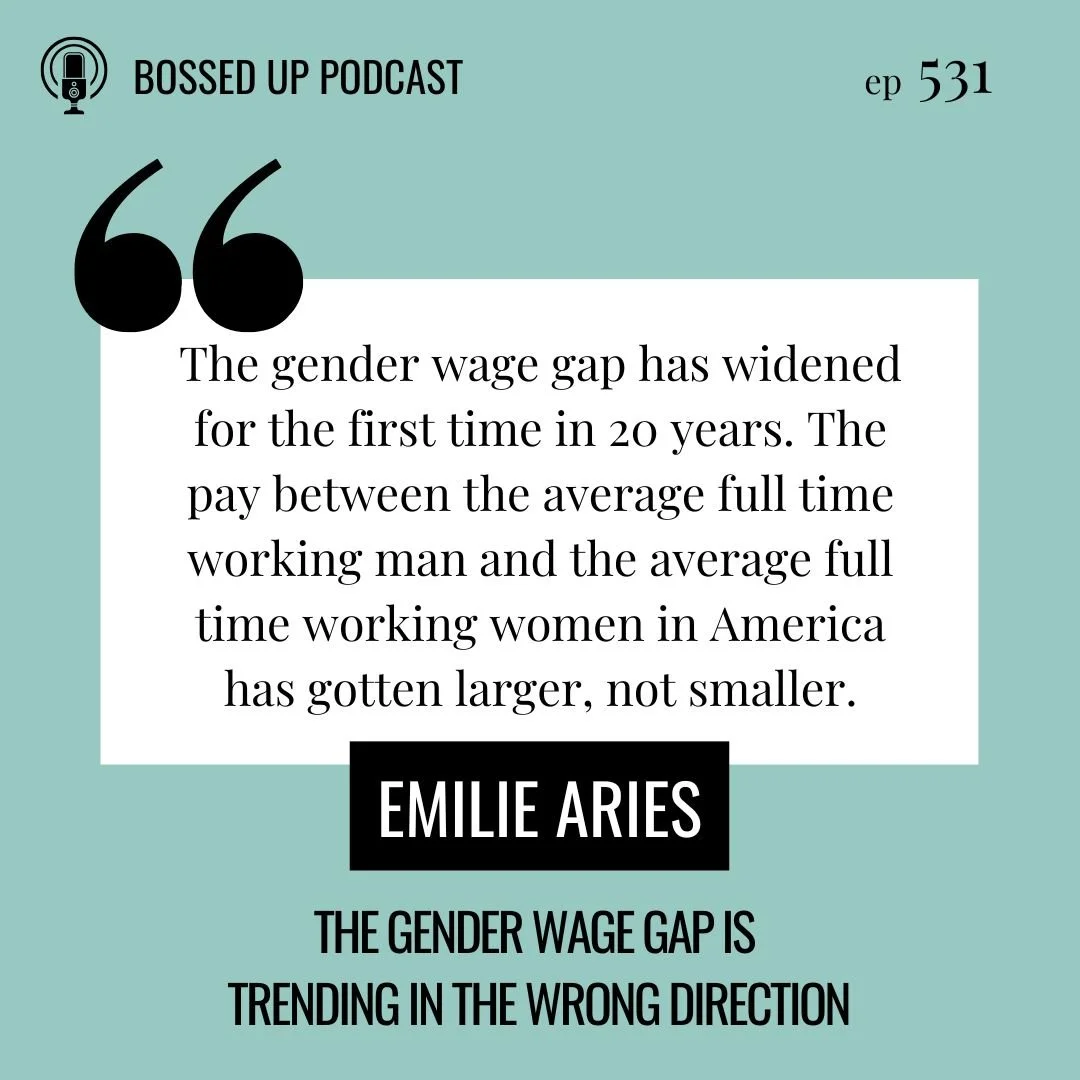
Here's the headline. The gender wage gap, which I know you know about because we've talked about it here many times before, has widened for the first time in 20 years. Since new research has come out based off of 2023 and 2024 data, the pay differential between the average full time working man and the average full time working woman in America has gotten larger, not smaller.
Women in 2024 were typically paid just 76 cents for every dollar paid to a man, which adds up, by the way, to a pretty healthy sum of $14,640 over the course of the year. I don't know about you, but a $14,000 bonus at the end of the year would make quite a big difference in my life. I feel like we all could use that. And that gap, that bonus that women are missing out on, is getting bigger instead of getting smaller.
What's more alarming here is that the Trump administration, instead of fighting the forces and the systemic pieces at play that contribute to the gender wage gap, they've actually begun eroding at the few federal protections that do exist to protect people's rights to discuss pay and to foster pay transparency, which we know helps eliminate unconscious bias or conscious bias in terms of how much our pay is different than our male counterparts.
Executive Order 11246 was recently revoked by the Trump administration, removing a 10 year old protection that was in place to help workers discover pay discrimination. This particular protection extended to federal contract workers who make up over 20% of the U.S. workforce. They were directly impacted when this executive order was revoked and in doing so, they lost protections for asking about their own pay. Essentially, this executive order prohibited discrimination against employees who ask about or discuss others pay or even their own pay at work.
So you know how I've actually podcasted here before saying that if your employer says you cannot discuss your pay, that there were federal protections in place protecting your right to do so. Not so much anymore. If you're a federal contract worker, there are some workers who are federal contract workers and the rest of us who are still protected by the National Labor Relations Act, which created the National Labor Relations Board, the NLRB, among other things, which continues to protect your right to engage in what they call concerted activity, like, collective bargaining and discussing your working conditions with your fellow workers, including the right to discuss pay with other employees.
But now that this executive order was revoked, if you're a federal contract worker, you're not so protected if you're just asking about your own pay, which is a huge problem if we're trying to foster laws on the books that shed light on pay and bring transparency to the compensation process, which we know helps root out discrimination.
Furthermore, when this executive order was revoked by the Trump administration, supervisors lost their protection. So it specifically had covered federal contract workers, including supervisors who had the right to discuss their pay and their compensation. The NLRA, the National Labor Relations Act, did not protect supervisors concerted activity in this way. And so now if you're a federal contract worker and a supervisor, you are particularly at risk because you no longer are protected from discrimination if you're talking about your salary at work.
This is a huge step backwards because female managers pay gap is even bigger than female employees overall. So women managers are paid significantly less than male managers on average compared to the overall gender wage gap. Now, what comes to mind here is a certain name. You might have heard of it. Lilly Ledbetter. President Obama signed the Lilly Ledbetter Fair Pay Act into law as his first act as president. And it was named after Lilly Ledbetter, who over the course of 20 years working as a soldier, supervisor, a manager, a leader at Goodyear, received smaller raises than her male counterparts all along her tenure there, and it cost her.
She sued Goodyear ultimately because she was actually made aware of these discrepancies only through an anonymous tip, a note that was slipped to her from one of her colleagues who realized that she was significantly being paid less than her male counterparts. She ended up discovering that she lost out on close to $200,000 over the course of her career. And because of her story, because of her lawsuit, because of the law named after her, you have a longer window now to have a class action lawsuit against an employer who's perpetuating pay discrimination based on anything, age, race, sex, et cetera, in a systemic way. So managers like Lilly are more likely to face wage discrimination. And now federal contract workers who are managers do not have protections when it comes to discussing their own wages. So this is a huge problem.
Now I want to highlight some relevant intersectionalities when it comes to identity and wage gaps in the United States, in particular motherhood and race. Okay? The wage gap overall growing instead of shrinking, is bad news for all of us as women, but it's particularly, particularly bad news for moms and for breadwinner moms who are predominantly women of color. Okay, so first and foremost, mothers who work full time year round are still only paid 74 cents on the dollar, compared to fathers who work full time year round. That is not great. Certainly not far from the 76 cents on a dollar that impacts all women on average. But 74 cents on the dollar’s even worse.
Now, when you layer the motherhood aspect of the wage gap on with race, we have to recognize, like, who's actually carrying the households. For 69% of black mothers and 56% of Native American mothers, they are the breadwinners in their household. So this is impacting significant families, particularly families of color who rely on women's wages even more so than their male counterparts if there is a male counterpart in the household contributing to the household income.
So the wage gap, as it intersects with motherhood and race hits black women harder and hits native women harder than it does white women and women of other races. Not to say there aren't women of other races who are also breadwinners, who also support their families, who are also single parents, single mothers supporting their families. But it's worth just highlighting how the wage gap gets more complex the more you layer intersectionality onto all of this. More than 36 million households in the United States are headed by women, and more than 6 million of them have children under 18. So eliminating the wage gap is not just a good thing for women, it's a good thing for families. It's a good thing for those households who rely on women's wages to get by.
So this is my renewed call to action here. The depressing news is the wage gap is getting worse instead of better. The good news is, is there are many ways to get at this problem. Just a few years ago, I gave a keynote address for Equal Payday in Milwaukee, of all places, with an amazing group of organizations who are advocating for women's rights there. And I structured my keynote around what you can do individually and what you can do collectively to get at this insidious, seemingly intractable wage gap problem.
So if we want to solve for the gender wage gap, there are three things we can do. One, negotiate your salary. Negotiate a starting offer whenever you have the chance, and negotiate raises when you are continuing to be employed by the same employer. I have a great free negotiation guide that walks women through a step-by-step process for negotiating a starting salary offer or negotiating a raise at your current employer. Head to bossedup.org/negotiation to learn more.
The second thing we can do is advocate for wage transparency in our workplaces. Challenge your employer to share the pay bands and the compensation philosophy that guides their compensation strategy. Ask your HR team about your compensation philosophy, about publishing transparent pay bans that align with different levels across hierarchies. Challenge them to engage in regular pay equity audits to not only make sure your compensation is competitive for the market you're in, but to make sure that wage inequities aren't hiding in the data of people who've been employed by the company for a long time.
The best companies out there take a scientific approach to compensation, right? They're conducting regular pay equity audits to ensure fairness and equity is at play when it comes to compensation. And they have clear policies and protocols in place for compensation, strategy, pay bans, making competitive offers, handling negotiation, and doling out raises in a way that is fair and equitable.
The final tactic for closing the wage gap is to pass systemic reforms. I'm talking about passing laws on the books like the ones we passed here in Colorado, and that inspired similar laws in New York and California that require employers to list compensation when when they're posting new jobs. I had a great conversation with Louise Myrland of the Colorado Women's Foundation, all about this groundbreaking legislation back on episode 462, which I'll share in the show notes. When pay transparency laws become the law of the land, all workers benefit. Not only does it help close gender and racial wage gaps, but every worker benefits when it's on the company to state the numbers first. So I'm happy to hear that the Paycheck Fairness Act is legislation that's been put forth in Congress by Senator Patty Murray of Washington and Rep. Rosa DeLauro of Connecticut. Now, does that bill have a shot in h*** in terms of passing in this Congress? No. But it's something we have to keep our eye on and advocate for moving forward.
So individually negotiate your pay as a worker within a company. Advocate for pay transparency at the company level. Advocate for pay equity audits if you have an HR department and a compensation team that can help make that happen, or bring in a consultant to do that for you. And finally, we all need to keep the pressure on lawmakers, both at the state, local, and federal levels to pass pay transparency laws that can help shrink the wage gap for good.
There are lots of ways to get at this problem, but what frustrates me more than anything is seeing us taking steps backwards and seeing the gender wage gap widen for the first time in two decades, as opposed to chipping away at it, even if we're chipping away at it slowly.
So I'd love to continue the conversation after the episode, as always in the Bossed Up Courage Community on Facebook or in the Bossed Up Group on LinkedIn. What are some creative ways in which you're advocating for pay transparency, or you're helping to close the gender wage gap? I'd love to hear your most unhinged stories and advice around negotiating your pay as we continue to explore how we can learn from one another and help close the gender wage gap.
I also have a great LinkedIn learning course all about negotiation called Negotiating Your Compensation Package, which I'll link to in today's show notes and I highly recommend for anyone who's trying to negotiate a raise or is preparing to negotiate a new job offer.
[OUTRO MUSIC IN]
For a fully written transcript and corresponding blog post that goes with today's episode, including links to all the resources and past episodes I mentioned Today, head to bossedup.org/episode531 that's bossedup.org/episode531. Until next time, let's keep bossin’ in pursuit of our purpose, and together let's lift as we climb.
[OUTRO MUSIC ENDS]